MyCompetitiveExams Logo MyCompetitiveExams
Search 1,140+ Questions
Chapters, formulas, speed tricks
→
⚡ Brahmastra NEET 2027
720 MARKS

Dynamic 180-question full-length simulator mixed dynamically from all 6 years for 2027 & 2026 aspirants.

Launch Brahmastra 2027 Test →
Start Practice →
100% Free · No Login Required
Q.28 Physics · Section A ⭐ 360° Option Elimination Active
Vault ↗

NEET 2024 Physics Question 28 Solution

Topic: Nuclei · Official NTA Booklet Code T1
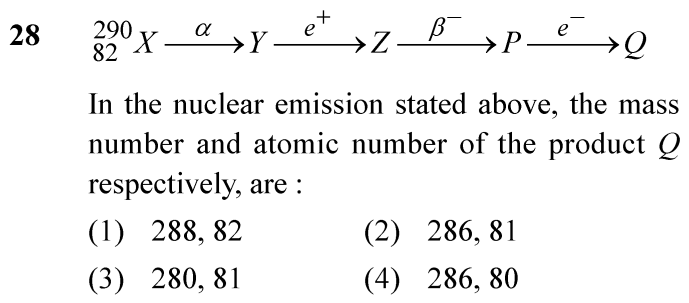
NEET 2024 Physics Question 28: Mass Number and Atomic Number in a Sequential Radioactive Decay Chain

Question

²⁹⁰₈₂X →(α) Y →(e⁺) Z →(β⁻) P →(e⁻) Q. In the nuclear emission stated above, the mass number and atomic number of the product Q respectively, are:

✓
Verified Against NTA Final Answer Key
Option (2) : 286, 81
📚 Nuclei Easy
📋 Given Parameters & Problem Setup
Parent Nucleus ²⁹⁰₈₂X (A = 290, Z = 82)
Decay Step 1 α emission (alpha particle, ⁴₂He)
Decay Step 2 e⁺ emission (positron / β⁺ decay, ⁰₊₁e)
Decay Step 3 β⁻ emission (beta-minus particle, ⁰₋₁e)
Decay Step 4 e⁻ emission (electron / beta-minus decay, ⁰₋₁e)
⚡

The 30-Second Exam Hall Shortcut: ⚡ Mass Number Conservation Shortcut

⏱️ Save ~40 seconds

Only α decay changes mass number (drops by 4 -> 290 - 4 = 286)! Beta particles have mass 0 -> Final A = 286 (eliminates 1 & 3); Z: 82 - 2 - 1 + 1 + 1 = 81 -> (286, 81)!

1 Look at mass number A: Only α emission changes A (ΔA = -4).
2 Positron (e⁺) and electrons (β⁻, e⁻) have mass number 0.
3 Final mass number A = 290 - 4 = 286 (immediately eliminate options 1 and 3!).
4 Track atomic number Z: Z_initial = 82.
5 - After α: 82 - 2 = 80.
6 - After e⁺ (positron): 80 - 1 = 79.
7 - After β⁻: 79 - (-1) = 80.
8 - After e⁻: 80 - (-1) = 81.
9 Result: (A = 286, Z = 81) -> Option (2) in under 15 seconds!
🛡️
Why You Can 100% Trust This Shortcut: Soddy-Fajans Radioactive Displacement Laws (α decay: A-4, Z-2; β⁻ decay: A, Z+1; β⁺ decay: A, Z-1).
📐

Step-by-Step Rigorous Workflow & Mathematical Proof

Step 1

Step 1: Alpha Decay (X -> Y)

An alpha particle is a helium-4 nucleus (⁴₂He). Emission of an alpha particle reduces the mass number by 4 and atomic number by 2:

82290X→α80286Y+24He^{290}_{82}X \xrightarrow{\alpha} ^{286}_{80}Y + ^4_2\text{He}
Step 2

Step 2: Positron (e⁺ / β⁺) Decay (Y -> Z)

In positron emission, a proton inside the nucleus transforms into a neutron, emitting a positron (⁰₊₁e) and a neutrino. The mass number remains unchanged, while the atomic number decreases by 1:

80286Y→e+79286Z++10e+ν^{286}_{80}Y \xrightarrow{e^+} ^{286}_{79}Z + ^0_{+1}e + \nu
Step 3

Step 3: Beta-Minus (β⁻) Decay (Z -> P)

In beta-minus emission, a neutron transforms into a proton, emitting an electron (⁰₋₁e) and an antineutrino. The mass number is unchanged, while the atomic number increases by 1:

79286Z→β−80286P+−10e+νˉ^{286}_{79}Z \xrightarrow{\beta^-} ^{286}_{80}P + ^0_{-1}e + \bar{\nu}
Step 4

Step 4: Electron (e⁻) Decay (P -> Q)

The final emission is an electron (e⁻, identical to β⁻). The mass number remains unchanged, and the atomic number increases by another 1:

80286P→e−81286Q+−10e+νˉ^{286}_{80}P \xrightarrow{e^-} ^{286}_{81}Q + ^0_{-1}e + \bar{\nu}
Step 5

Final Nucleus Identification

The resulting product nucleus Q has mass number A = 286 and atomic number Z = 81.

AQ=286,ZQ=81A_Q = 286, \quad Z_Q = 81
⭐

360° Option Elimination Engine Key Feature

Diagnose every choice: Know exactly why the right option works and why distractors fail.

4-Option Deep Scan
1 (1)
✗ Incorrect
Verdict & Scientific Reason:

Incorrect mass number; subtracted 2 instead of 4 for alpha particle.

⚠️
Student Fallacy (Why candidates pick this trap): Confusing alpha mass number (4) with atomic number (2).
2 (2)
✓ 100% Correct
Verdict & Scientific Reason:

Flawless conservation of nucleons and charge: A = 286, Z = 81.

💡
Why this is airtight: None.
3 (3)
✗ Incorrect
Verdict & Scientific Reason:

Subtracts 10 from mass number.

⚠️
Student Fallacy (Why candidates pick this trap): Assuming beta particles have mass numbers.
4 (4)
✗ Incorrect
Verdict & Scientific Reason:

Misses the final electron emission (+1 to Z).

⚠️
Student Fallacy (Why candidates pick this trap): Stopping at nucleus P instead of Q.
⚠️

NTA Trap Alert: Positron (e⁺) vs Electron (e⁻ / β⁻) Sign Confusion

Students frequently subtract 1 for both e⁺ and e⁻, forgetting that emitting a negative charge increases the nuclear positive charge (Z increases by 1).

🛡️ How to avoid the -1 mark: Think charge conservation: If negative charge leaves, positive charge inside MUST increase: Z -> Z + 1.
📖

Core NEET Syllabus Standard

Physics Core Nuclear Physics · Nuclei Standard Benchmark
Core Scientific Principle Tested:

"In any nuclear transformation, total mass number (A) and total electric charge (Z) are conserved strictly."

Syllabus Focus: Radioactivity and Nuclear Decay Law
✓ Core NEET UG Syllabus Anchor Syllabus & Academic Standards ↗
Alpha drops 4 from mass; Positron subtracts 1, Two electrons add 2 -> 81!

Ready to attempt under real exam pressure?

Test your speed and accuracy in the authentic 200-minute timed NTA simulator.

Launch NEET 2024 CBT Test →

Spotted a mistake in this solution? Report an error (support@mycompetitiveexams.com)

⚖️ Legal & Fair Dealing Notice: Sourced from publicly released NEET 2024 question papers and NEET answer keys for private study, research, and non-commercial educational practice under Fair Dealing (Section 52(1)(a) of the Indian Copyright Act, 1957). Not affiliated with or endorsed by NTA or NMC.

Solve 4 NEET Questions a Day — One per Subject

Cover all 1,140 official NEET questions in 285 days at your own pace. Progress is saved on your device. No login needed.