MyCompetitiveExams Logo MyCompetitiveExams
Search 1,140+ Questions
Chapters, formulas, speed tricks
→
⚡ Brahmastra NEET 2027
720 MARKS

Dynamic 180-question full-length simulator mixed dynamically from all 6 years for 2027 & 2026 aspirants.

Launch Brahmastra 2027 Test →
Start Practice →
100% Free · No Login Required
Q.107 Botany ⭐ 360° Option Elimination Active
Vault ↗

NEET 2024 Botany Question 107 Solution

Topic: Organisms and Populations · Official NTA Booklet Code T1
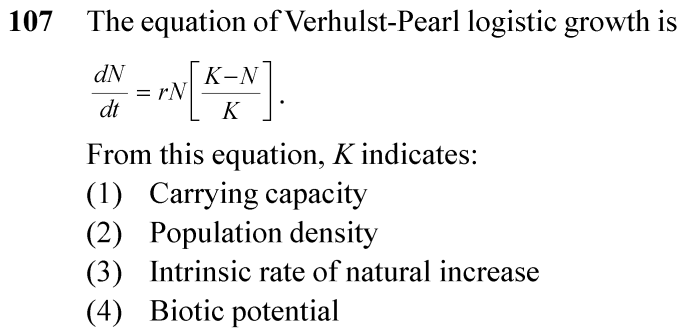
NEET 2024 Botany Question 107: Verhulst-Pearl Logistic Growth Model and Carrying Capacity

Question

The equation of Verhulst-Pearl logistic growth is dN/dt = rN((K − N)/K). From this equation, K indicates:

✓
Verified Against NTA Final Answer Key
Option (1) : Carrying capacity
📚 Organisms and Populations Easy
📋 Given Parameters & Problem Setup
Equation dN/dt = rN((K - N)/K)
Variable of Interest K
⚡

The 30-Second Exam Hall Shortcut: ⚡ Logistic Equation Variable Identity

⏱️ Save ~15 seconds

In dN/dt = rN(1 - N/K), N is population density, r is intrinsic rate of natural increase, and K is the carrying capacity of the environment.

1 Recall the logistic growth equation parameters:
2 - N = Population density at time t
3 - r = Intrinsic rate of natural increase
4 - K = Carrying capacity (maximum individuals an environment can sustain)
5 Direct identification: K indicates Carrying capacity -> Option (1) / A.
🛡️
Why You Can 100% Trust This Shortcut: NCERT Biology · Organisms and Populations (Verhulst-Pearl Logistic Growth)
📐

Step-by-Step Rigorous Workflow & Mathematical Proof

Step 1

Understand Logistic Growth Foundations

No population of any organism in nature has at its disposal unlimited resources to permit exponential growth. This leads to competition between individuals for limited resources. Eventually, the fittest individual survives and reproduces.

Step 2

Analyze the Mathematical Model

Verhulst-Pearl Logistic Growth is described by: dNdt=rN(K−NK)\frac{dN}{dt} = rN\left(\frac{K - N}{K}\right) where NN is population density at time tt, rr is the intrinsic rate of natural increase, and KK represents carrying capacity—the upper ecological limit of population size supported by the habitat without degradation.

⭐

360° Option Elimination Engine Key Feature

Diagnose every choice: Know exactly why the right option works and why distractors fail.

4-Option Deep Scan
1 (1)
✓ 100% Correct
Verdict & Scientific Reason:

K represents the carrying capacity: the maximum population size that a given environment can sustain indefinitely.

💡
Why this is airtight: None.
2 (2)
✗ Incorrect
Verdict & Scientific Reason:

Environmental resistance is conceptually represented by the term (K - N)/K, not by the constant K alone.

⚠️
Student Fallacy (Why candidates pick this trap): Environmental resistance is conceptually represented by the term (K - N)/K, not by the constant K alone.
3 (3)
✗ Incorrect
Verdict & Scientific Reason:

The intrinsic rate of natural increase is denoted by r.

⚠️
Student Fallacy (Why candidates pick this trap): The intrinsic rate of natural increase is denoted by r.
4 (4)
✗ Incorrect
Verdict & Scientific Reason:

Biotic potential relates to r under non-limiting conditions.

⚠️
Student Fallacy (Why candidates pick this trap): Biotic potential relates to r under non-limiting conditions.
⚠️

NTA Trap Alert: K vs (K-N)/K Confusion

Confusing the capacity constant K with the term (K - N)/K which represents environmental resistance.

🛡️ How to avoid the -1 mark: K alone = Carrying capacity; (K - N)/K = Fraction of carrying capacity still available (environmental resistance factor).
📖

Core NEET Syllabus Standard

Biology Core Botany · Organisms and Populations Standard Benchmark
Core Scientific Principle Tested:

"A population growing in a habitat with limited resources shows initially a lag phase, followed by phases of acceleration and deceleration and finally an asymptote, when the population density reaches the carrying capacity (K)."

Syllabus Focus: Verhulst-Pearl Logistic Growth Model and Carrying Capacity
✓ Core NEET UG Syllabus Anchor Syllabus & Academic Standards ↗

Ready to attempt under real exam pressure?

Test your speed and accuracy in the authentic 200-minute timed NTA simulator.

Launch NEET 2024 CBT Test →

Spotted a mistake in this solution? Report an error (support@mycompetitiveexams.com)

⚖️ Legal & Fair Dealing Notice: Sourced from publicly released NEET 2024 question papers and NEET answer keys for private study, research, and non-commercial educational practice under Fair Dealing (Section 52(1)(a) of the Indian Copyright Act, 1957). Not affiliated with or endorsed by NTA or NMC.

Solve 4 NEET Questions a Day — One per Subject

Cover all 1,140 official NEET questions in 285 days at your own pace. Progress is saved on your device. No login needed.