NEET 2024 Physics Question 8 Solution
Question
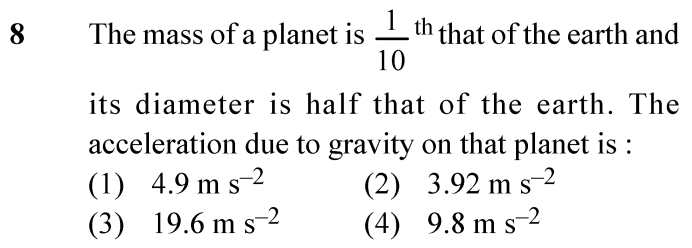
The mass of a planet is 1/10th that of the earth and its diameter is half that of the earth. The acceleration due to gravity on that planet is:
Dynamic 180-question full-length simulator mixed dynamically from all 6 years for 2027 & 2026 aspirants.
The mass of a planet is 1/10th that of the earth and its diameter is half that of the earth. The acceleration due to gravity on that planet is:
g ∝ M / R² -> g_p = g_e × (1/10) / (1/2)² = 9.8 × 4 / 10 = 3.92 m s⁻²!
The acceleration due to gravity on the surface of a spherical celestial body of mass M and radius R is given by Newton’s law of gravitation:
Writing the ratio of the planet’s surface gravity g_p to Earth’s surface gravity g_e:
Given that M_p = M_e / 10 and diameter is halved (meaning radius R_p = R_e / 2):
Multiplying by standard Earth surface gravity g_e = 9.8 m s⁻²:
Diagnose every choice: Know exactly why the right option works and why distractors fail.
Occurs if radius is not squared in the denominator (9.8 × 2 / 4 = 4.9).
Exact solution: g_p = 0.4 × 9.8 = 3.92 m s⁻².
Twice of Earth gravity; occurs if mass is taken as doubled rather than one-tenth.
Standard Earth gravity; ignores the planet’s smaller mass and radius.
Students often wonder if the ratio of diameters differs from the ratio of radii.
"Surface gravity is directly proportional to mass and inversely proportional to the square of the radius (g = GM/R²)."
Test your speed and accuracy in the authentic 200-minute timed NTA simulator.
Spotted a mistake in this solution? Report an error (support@mycompetitiveexams.com)
Cover all 1,140 official NEET questions in 285 days at your own pace. Progress is saved on your device. No login needed.