MyCompetitiveExams Logo MyCompetitiveExams
Search 1,140+ Questions
Chapters, formulas, speed tricks
→
⚡ Brahmastra NEET 2027
720 MARKS

Dynamic 180-question full-length simulator mixed dynamically from all 6 years for 2027 & 2026 aspirants.

Launch Brahmastra 2027 Test →
Start Practice →
100% Free · No Login Required
Q.141 Botany ⭐ 360° Option Elimination Active
Vault ↗

NEET 2024 Botany Question 141 Solution

Topic: Respiration in Plants · Official NTA Booklet Code T1
NEET 2024 Botany Question 141: Tricarboxylic Acid (TCA) Cycle: Substrate-Level Phosphorylation vs Oxidation

Question

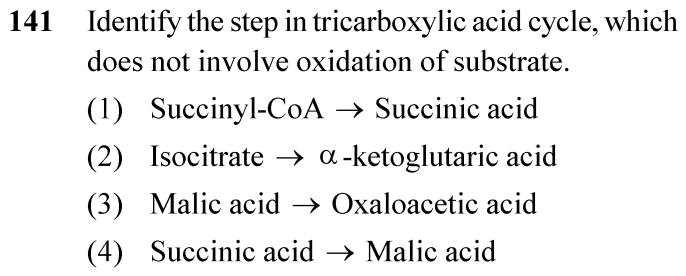
Identify the step in tricarboxylic acid cycle, which does not involve oxidation of substrate.

✓
Verified Against NTA Final Answer Key
Option (1) : Succinyl-CoA -> Succinic acid
📚 Respiration in Plants Medium
📋 Given Parameters & Problem Setup
Cycle Tricarboxylic Acid (TCA / Krebs) Cycle
Criterion Step that does NOT involve oxidation of substrate (no NAD+/FAD reduction)
⚡

The 30-Second Exam Hall Shortcut: ⚡ TCA Oxidation vs Substrate-Level Phosphorylation

⏱️ Save ~30 seconds

Succinyl-CoA to Succinic acid is substrate-level phosphorylation (GDP + Pi -> GTP), involving thioester cleavage, NOT oxidation! All other three steps reduce NAD⁺ or FAD!

1 Check each step in the TCA cycle for oxidation (dehydrogenation):
2 Succinyl-CoA -> Succinic acid: Cleavage of thioester bond coupled to GDP -> GTP phosphorylation. No hydride transfer or oxidation!
3 Isocitrate -> α-ketoglutaric acid: Oxidation reducing NAD⁺ to NADH + H⁺.
4 Malic acid -> Oxaloacetic acid: Oxidation reducing NAD⁺ to NADH + H⁺.
5 Succinic acid -> Fumaric / Malic acid: Oxidation reducing FAD to FADH₂.
6 The non-oxidative step is Succinyl-CoA -> Succinic acid -> Option (1) / A.
🛡️
Why You Can 100% Trust This Shortcut: NCERT Biology · Respiration in Plants (Tricarboxylic Acid Cycle)
📐

Step-by-Step Rigorous Workflow & Mathematical Proof

Step 1

Review Oxidation Reactions in the TCA Cycle

Oxidation of substrate in the TCA cycle is coupled with the reduction of electron acceptors (NAD+NAD^+ or FADFAD): - Isocitrate to α\alpha-ketoglutarate: Dehydrogenation coupled with NAD+→NADH+H+NAD^+ \rightarrow NADH + H^+. - α\alpha-ketoglutarate to Succinyl-CoA: Dehydrogenation coupled with NAD+→NADH+H+NAD^+ \rightarrow NADH + H^+. - Succinate to Fumarate: Dehydrogenation coupled with FAD→FADH2FAD \rightarrow FADH_2. - Malate to Oxaloacetate: Dehydrogenation coupled with NAD+→NADH+H+NAD^+ \rightarrow NADH + H^+.

Step 2

Analyze Succinyl-CoA Cleavage

During the conversion of succinyl-CoA to succinic acid, a molecule of GTP is synthesized by substrate-level phosphorylation: Succinyl-CoA+GDP+Pi→Succinate+GTP+CoA-SH\text{Succinyl-CoA} + \text{GDP} + P_i \rightarrow \text{Succinate} + \text{GTP} + \text{CoA-SH} This is a cleavage/hydrolysis of a high-energy thioester bond; it does not involve oxidation or reduction.

Step 3

Conclude Option

Conversion of succinyl-CoA to succinic acid does not involve oxidation of the substrate.

⭐

360° Option Elimination Engine Key Feature

Diagnose every choice: Know exactly why the right option works and why distractors fail.

4-Option Deep Scan
1 (1)
✓ 100% Correct
Verdict & Scientific Reason:

This step is substrate-level phosphorylation producing GTP; it involves no oxidation (no NAD+ or FAD reduction).

💡
Why this is airtight: None.
2 (2)
✗ Incorrect
Verdict & Scientific Reason:

Involves oxidative decarboxylation reducing NAD+ to NADH + H+.

⚠️
Student Fallacy (Why candidates pick this trap): Involves oxidative decarboxylation reducing NAD+ to NADH + H+.
3 (3)
✗ Incorrect
Verdict & Scientific Reason:

Involves oxidation of malate by malate dehydrogenase reducing NAD+ to NADH + H+.

⚠️
Student Fallacy (Why candidates pick this trap): Involves oxidation of malate by malate dehydrogenase reducing NAD+ to NADH + H+.
4 (4)
✗ Incorrect
Verdict & Scientific Reason:

Involves succinate dehydrogenase oxidising succinate to fumarate (reducing FAD to FADH2).

⚠️
Student Fallacy (Why candidates pick this trap): Involves succinate dehydrogenase oxidising succinate to fumarate (reducing FAD to FADH2).
⚠️

NTA Trap Alert: Succinyl-CoA vs Succinic Acid

Confusing Succinyl-CoA -> Succinate (substrate phosphorylation) with Succinate -> Fumarate (FAD oxidation).

🛡️ How to avoid the -1 mark: Remember: GTP is made during Succinyl-CoA -> Succinate; FADH2 is made during Succinate -> Fumarate.
📖

Core NEET Syllabus Standard

Biology Core Botany · Respiration in Plants Standard Benchmark
Core Scientific Principle Tested:

"During the conversion of succinyl-CoA to succinic acid a molecule of GTP is synthesised. This is a substrate level phosphorylation. In a coupled reaction GTP is converted to GDP with the simultaneous synthesis of ATP from ADP."

Syllabus Focus: Tricarboxylic Acid (TCA) Cycle: Substrate-Level Phosphorylation vs Oxidation
✓ Core NEET UG Syllabus Anchor Syllabus & Academic Standards ↗

Ready to attempt under real exam pressure?

Test your speed and accuracy in the authentic 200-minute timed NTA simulator.

Launch NEET 2024 CBT Test →

Spotted a mistake in this solution? Report an error (support@mycompetitiveexams.com)

⚖️ Legal & Fair Dealing Notice: Sourced from publicly released NEET 2024 question papers and NEET answer keys for private study, research, and non-commercial educational practice under Fair Dealing (Section 52(1)(a) of the Indian Copyright Act, 1957). Not affiliated with or endorsed by NTA or NMC.

Solve 4 NEET Questions a Day — One per Subject

Cover all 1,140 official NEET questions in 285 days at your own pace. Progress is saved on your device. No login needed.