MyCompetitiveExams Logo MyCompetitiveExams
Search 1,140+ Questions
Chapters, formulas, speed tricks
→
⚡ Brahmastra NEET 2027
720 MARKS

Dynamic 180-question full-length simulator mixed dynamically from all 6 years for 2027 & 2026 aspirants.

Launch Brahmastra 2027 Test →
Start Practice →
100% Free · No Login Required
Q.80 Chemistry · Section A ⭐ 360° Option Elimination Active
Vault ↗

NEET 2024 Chemistry Question 80 Solution

Topic: Redox Reactions · Official NTA Booklet Code T1
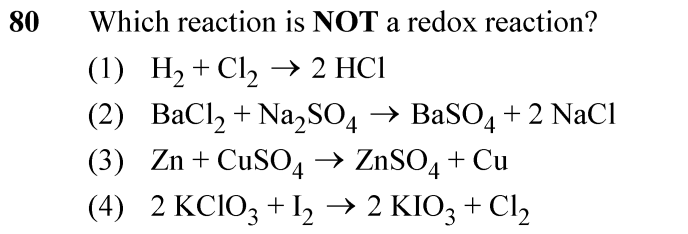
NEET 2024 Chemistry Question 80: Identification of Non-Redox (Double Displacement) Reactions

Question

Which reaction is NOT a redox reaction?

✓
Verified Against NTA Final Answer Key
Option (2) : BaCl2 + Na2SO4 -> BaSO4 + 2NaCl (Precipitation / Non-Redox Reaction)
📚 Redox Reactions Easy
📋 Given Parameters & Problem Setup
Reaction 1 H2 + Cl2 -> 2 HCl
Reaction 2 BaCl2 + Na2SO4 -> BaSO4 + 2 NaCl
Reaction 3 Zn + CuSO4 -> ZnSO4 + Cu
Reaction 4 2 KClO3 + I2 -> 2 KIO3 + Cl2
⚡

The 30-Second Exam Hall Shortcut: ⚡ Oxidation State Invariance Rule

⏱️ Save ~30 seconds

A redox reaction requires changes in oxidation states! Precipitation of BaSO4 from BaCl2 + Na2SO4 has ZERO change in oxidation numbers (Ba²⁺, Cl⁻, Na⁺, SO4²⁻ throughout) -> NOT a redox reaction!

1 Check for elemental forms changing into compounds (clear sign of redox):
2 - Reaction 1: H2(0) + Cl2(0) -> H(+1)Cl(-1) (Redox!).
3 - Reaction 3: Zn(0) + Cu(+2) -> Zn(+2) + Cu(0) (Redox!).
4 - Reaction 4: I2(0) + Cl(+5) -> I(+5) + Cl2(0) (Redox!).
5 Check Reaction 2: BaCl2 (+2, -1) + Na2SO4 (+1, +6, -2) -> BaSO4 (+2, +6, -2) + 2 NaCl (+1, -1).
6 Every single element retains its exact oxidation number from reactants to products.
7 This is a classic double displacement (precipitation) reaction, which is NOT a redox reaction.
8 Option (2) in 5 seconds!
🛡️
Why You Can 100% Trust This Shortcut: NCERT Chemistry · Redox Reactions (Types of redox reactions vs non-redox double displacement reactions).
📐

Step-by-Step Rigorous Workflow & Mathematical Proof

Step 1

Definition of a Redox Reaction

A redox (reduction-oxidation) reaction is a chemical process in which one or more elements undergo a change in oxidation number resulting from an electron transfer between reacting species:

Redox Reaction  ⟺  ∃  element with Δ(O.N.)≠0\text{Redox Reaction} \iff \exists \;\text{element with } \Delta(\text{O.N.}) \neq 0
Step 2

Tracking Oxidation Numbers in Reaction (2)

Assigning oxidation numbers to each atom in BaCl2 + Na2SO4 -> BaSO4 + 2 NaCl: - Barium: +2 in BaCl2 and +2 in BaSO4 (Δ = 0) - Chlorine: -1 in BaCl2 and -1 in NaCl (Δ = 0) - Sodium: +1 in Na2SO4 and +1 in NaCl (Δ = 0) - Sulfur: +6 in Na2SO4 and +6 in BaSO4 (Δ = 0) - Oxygen: -2 in Na2SO4 and -2 in BaSO4 (Δ = 0) Because no element undergoes oxidation or reduction, it is purely a precipitation (ionic partner exchange) reaction, NOT a redox reaction.

Ba+2Cl−12+Na+12S+6O−24⟶Ba+2S+6O−24↓+2Na+1Cl−1\overset{+2}{\text{Ba}}\overset{-1}{\text{Cl}}_2 + \overset{+1}{\text{Na}}_2\overset{+6}{\text{S}}\overset{-2}{\text{O}}_4 \longrightarrow \overset{+2}{\text{Ba}}\overset{+6}{\text{S}}\overset{-2}{\text{O}}_4\downarrow + 2\overset{+1}{\text{Na}}\overset{-1}{\text{Cl}}
Step 3

Verification of Redox Character in Other Options

Checking the other options to confirm they are indeed redox reactions: - Reaction (1): H increases from 0 to +1 (oxidation); Cl decreases from 0 to -1 (reduction). - Reaction (3): Zn increases from 0 to +2 (oxidation); Cu decreases from +2 to 0 (reduction). - Reaction (4): I increases from 0 to +5 in KIO3 (oxidation); Cl decreases from +5 in KClO3 to 0 in Cl2 (reduction).

Reactions (1), (3), and (4) are all bona fide redox reactions\text{Reactions (1), (3), and (4) are all bona fide redox reactions}
⭐

360° Option Elimination Engine Key Feature

Diagnose every choice: Know exactly why the right option works and why distractors fail.

4-Option Deep Scan
1 (1)
✗ Incorrect
Verdict & Scientific Reason:

Combination redox reaction involving elemental hydrogen and chlorine.

⚠️
Student Fallacy (Why candidates pick this trap): Assuming combination reactions cannot be redox.
2 (2)
✓ 100% Correct
Verdict & Scientific Reason:

Double displacement precipitation reaction with zero change in oxidation numbers of any element.

💡
Why this is airtight: None.
3 (3)
✗ Incorrect
Verdict & Scientific Reason:

Classic single displacement redox reaction.

⚠️
Student Fallacy (Why candidates pick this trap): Failing to see electron transfer from Zn to Cu²⁺.
4 (4)
✗ Incorrect
Verdict & Scientific Reason:

Redox displacement where iodine is oxidized to +5 and chlorine is reduced to 0.

⚠️
Student Fallacy (Why candidates pick this trap): Thinking halogen displacement does not change oxidation state.
⚠️

NTA Trap Alert: Confusing Double Displacement with Single Displacement

Single displacement (like Zn + CuSO4) is ALWAYS redox. Double displacement (precipitation and neutralization) is NEVER redox because ions merely swap partners without electron transfer.

🛡️ How to avoid the -1 mark: Look for free elements: if free elements appear on either side (H2, Cl2, Zn, Cu, I2), it is redox. If all species are salts swapping ions, it is not redox.
📖

Core NEET Syllabus Standard

Chemistry Core Physical Chemistry · Redox Reactions Standard Benchmark
Core Scientific Principle Tested:

"Precipitation and neutralization reactions are non-redox double displacement reactions because oxidation numbers of all atoms remain unchanged."

Syllabus Focus: Classification of Reactions: Redox versus Non-Redox Precipitation
✓ Core NEET UG Syllabus Anchor Syllabus & Academic Standards ↗
Ion swap has no electron shift: double displacement gives no redox gift!

Ready to attempt under real exam pressure?

Test your speed and accuracy in the authentic 200-minute timed NTA simulator.

Launch NEET 2024 CBT Test →

Spotted a mistake in this solution? Report an error (support@mycompetitiveexams.com)

⚖️ Legal & Fair Dealing Notice: Sourced from publicly released NEET 2024 question papers and NEET answer keys for private study, research, and non-commercial educational practice under Fair Dealing (Section 52(1)(a) of the Indian Copyright Act, 1957). Not affiliated with or endorsed by NTA or NMC.

Solve 4 NEET Questions a Day — One per Subject

Cover all 1,140 official NEET questions in 285 days at your own pace. Progress is saved on your device. No login needed.