MyCompetitiveExams Logo MyCompetitiveExams
Search 1,140+ Questions
Chapters, formulas, speed tricks
→
⚡ Brahmastra NEET 2027
720 MARKS

Dynamic 180-question full-length simulator mixed dynamically from all 6 years for 2027 & 2026 aspirants.

Launch Brahmastra 2027 Test →
Start Practice →
100% Free · No Login Required
Q.83 Chemistry · Section A ⭐ 360° Option Elimination Active
Vault ↗

NEET 2024 Chemistry Question 83 Solution

Topic: The p-Block Elements · Official NTA Booklet Code T1
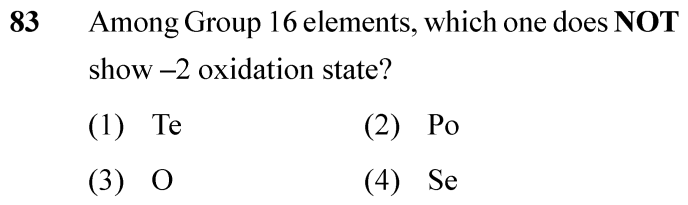
NEET 2024 Chemistry Question 83: Oxidation States of Group 16 Chalcogens and Anomalous Behavior of Polonium

Question

Among Group 16 elements, which one does NOT show −2 oxidation state?

✓
Verified Against NTA Final Answer Key
Option (2) : Po (Polonium)
📚 The p-Block Elements Easy
📋 Given Parameters & Problem Setup
Elements of Group 16 Oxygen (O), Sulfur (S), Selenium (Se), Tellurium (Te), Polonium (Po)
Condition to evaluate Element that does NOT show -2 oxidation state
⚡

The 30-Second Exam Hall Shortcut: ⚡ Metallic Polonium Non-Negative State Hack

⏱️ Save ~25 seconds

Polonium (Po) is a radioactive post-transition metal with low electronegativity. It shows metallic character (+2, +4), and does NOT form a stable -2 oxidation state!

1 Group 16 non-metals and metalloids (O, S, Se, Te) readily form -2 oxidation state (oxides, sulphides, selenides, tellurides).
2 Down the group, electronegativity and non-metallic character decrease while metallic character increases.
3 Polonium is the heaviest member of Group 16 and is a true metal.
4 Due to its metallic character and low electronegativity, Polonium does NOT show the -2 oxidation state.
5 Option (2) in 3 seconds!
🛡️
Why You Can 100% Trust This Shortcut: NCERT Chemistry · The p-Block Elements (Trends in oxidation states of Group 16 elements: metallic character increases down the group and Po does not show -2 oxidation state).
📐

Step-by-Step Rigorous Workflow & Mathematical Proof

Step 1

Periodic Trends in Oxidation States of Group 16

Group 16 elements have the valence shell electronic configuration ns² np⁴. They can achieve a noble gas octet by gaining two electrons to form the -2 oxidation state. However, the stability of the -2 oxidation state decreases sharply down the group as electronegativity drops and metallic character rises:

Stability of −2 state: O>S>Se>Te≫Po\text{Stability of } -2 \text{ state: } \text{O} > \text{S} > \text{Se} > \text{Te} \gg \text{Po}
Step 2

Specific Behavior of Polonium

Polonium (Po, Z = 84) is a radioactive, distinctly metallic element. As stated verbatim in NCERT, because of its pronounced metallic character and electropositive nature, polonium hardly shows the -2 oxidation state; its predominant and stable oxidation states are +2 and +4:

Po shows +2 and +4 oxidation states, NOT −2\text{Po shows } +2 \text{ and } +4 \text{ oxidation states, NOT } -2
Step 3

Verification of Te, O, and Se

Oxygen is predominantly -2 (in H2O, metal oxides). Sulfur forms sulphides (S²⁻, -2). Selenium forms selenides (Se²⁻, -2). Tellurium forms tellurides (Te²⁻, -2, e.g. H2Te, Na2Te). All of O, S, Se, and Te exhibit -2, whereas Polonium does not.

Te2−,  O2−,  Se2−  exist;Po2−  does not exist\text{Te}^{2-}, \; \text{O}^{2-}, \; \text{Se}^{2-} \;\text{exist}; \quad \text{Po}^{2-} \;\text{does not exist}
⭐

360° Option Elimination Engine Key Feature

Diagnose every choice: Know exactly why the right option works and why distractors fail.

4-Option Deep Scan
1 (1)
✗ Incorrect
Verdict & Scientific Reason:

Tellurium forms tellurides containing Te²⁻ (e.g. H2Te, ZnTe).

⚠️
Student Fallacy (Why candidates pick this trap): Assuming tellurium is too heavy to show -2.
2 (2)
✓ 100% Correct
Verdict & Scientific Reason:

Polonium is a metal and does not form the -2 oxidation state.

💡
Why this is airtight: None.
3 (3)
✗ Incorrect
Verdict & Scientific Reason:

Oxygen predominantly exhibits -2 in virtually all oxides.

⚠️
Student Fallacy (Why candidates pick this trap): Thinking oxygen cannot show -2.
4 (4)
✗ Incorrect
Verdict & Scientific Reason:

Selenium readily shows -2 in selenides (e.g. H2Se, Na2Se).

⚠️
Student Fallacy (Why candidates pick this trap): Assuming selenium only shows positive states.
⚠️

NTA Trap Alert: Assuming Tellurium is the Limit for -2

Students often guess Tellurium because it is heavy, but NCERT explicitly lists -2 for Te (in H2Te). Polonium is the only one that lacks -2.

🛡️ How to avoid the -1 mark: Remember: Polonium is a metal; metals do not form negative oxidation states.
📖

Core NEET Syllabus Standard

Chemistry Core Inorganic Chemistry · The p-Block Elements Standard Benchmark
Core Scientific Principle Tested:

"The stability of the -2 oxidation state decreases down Group 16; polonium, being distinctly metallic, does not show the -2 oxidation state."

Syllabus Focus: Group 16 Elements: Oxidation States and Chemical Reactivity
✓ Core NEET UG Syllabus Anchor Syllabus & Academic Standards ↗
Polonium is a metal through and through: it won’t take electrons to become minus two!

Ready to attempt under real exam pressure?

Test your speed and accuracy in the authentic 200-minute timed NTA simulator.

Launch NEET 2024 CBT Test →

Spotted a mistake in this solution? Report an error (support@mycompetitiveexams.com)

⚖️ Legal & Fair Dealing Notice: Sourced from publicly released NEET 2024 question papers and NEET answer keys for private study, research, and non-commercial educational practice under Fair Dealing (Section 52(1)(a) of the Indian Copyright Act, 1957). Not affiliated with or endorsed by NTA or NMC.

Solve 4 NEET Questions a Day — One per Subject

Cover all 1,140 official NEET questions in 285 days at your own pace. Progress is saved on your device. No login needed.