MyCompetitiveExams Logo MyCompetitiveExams
Search 1,140+ Questions
Chapters, formulas, speed tricks
→
⚡ Brahmastra NEET 2027
720 MARKS

Dynamic 180-question full-length simulator mixed dynamically from all 6 years for 2027 & 2026 aspirants.

Launch Brahmastra 2027 Test →
Start Practice →
100% Free · No Login Required
Q.54 Chemistry · Section A ⭐ 360° Option Elimination Active
Vault ↗

NEET 2024 Chemistry Question 54 Solution

Topic: Alcohols, Phenols and Ethers · Official NTA Booklet Code T1
NEET 2024 Chemistry Question 54: Lucas Test and Reactivity Order of Alcohols

Question

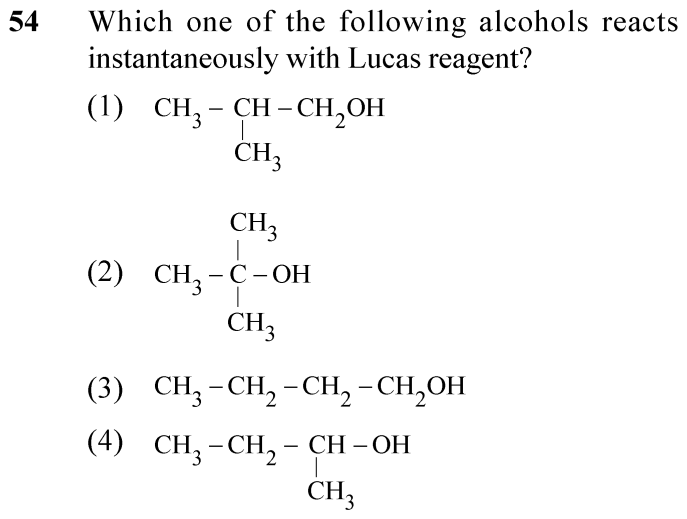
Which one of the following alcohols reacts instantaneously with Lucas reagent?

✓
Verified Against NTA Final Answer Key
Option (2) : CH3-C(CH3)(OH)-CH3 (2-methylpropan-2-ol / tert-butanol)
📚 Alcohols, Phenols and Ethers Easy
📋 Given Parameters & Problem Setup
Reagent Lucas reagent (concentrated HCl + anhydrous ZnCl2)
Observation condition Reacts instantaneously at room temperature
⚡

The 30-Second Exam Hall Shortcut: ⚡ Lucas Turbidity Speed Rule

⏱️ Save ~30 seconds

3° Alcohol = Instant Turbidity (Immediate); 2° = ~5 minutes; 1° = Turbidity only on heating!

1 Lucas test differentiates alcohols based on the rate of formation of an insoluble alkyl chloride via an SN1 pathway.
2 Rate depends directly on the stability of the carbocation intermediate: 3° > 2° > 1°.
3 Inspect options: Option (1) is 1° isobutanol; Option (3) is 1° n-butanol; Option (4) is 2° sec-butanol.
4 Option (2) is tert-butanol (2-methylpropan-2-ol), a tertiary (3°) alcohol.
5 3° alcohol forms the stable tert-butyl cation immediately -> instantaneous turbidity -> Option (2) in 3 seconds!
🛡️
Why You Can 100% Trust This Shortcut: NCERT Chemistry · Alcohols, Phenols and Ethers (Reactions involving cleavage of C-O bond and Lucas reagent).
📐

Step-by-Step Rigorous Workflow & Mathematical Proof

Step 1

Mechanism of the Lucas Reaction

Lucas reagent consists of equimolar anhydrous ZnCl2 (a strong Lewis acid) and concentrated hydrochloric acid. The alcohol coordinates with ZnCl2, turning the poor leaving group -OH into a good leaving group [-O(ZnCl2)H]:

R−OH+ZnCl2⇌R−O⊕(ZnCl2⊖)HR{-}OH + \text{ZnCl}_2 \rightleftharpoons R{-}\overset{\oplus}{\text{O}}(\text{ZnCl}_2^\ominus)H
Step 2

Carbocation Generation (Rate-Determining Step)

In an SN1 pathway, departure of the leaving group produces a carbocation intermediate. The activation energy is lowest for tertiary carbocations owing to inductive stabilization (+I) and hyperconjugation (9 α-hydrogens in the tert-butyl cation):

(CH3)3C−OH→ZnCl2/HCl(CH3)3C⊕+[ZnCl2OH]⊖(CH_3)_3C{-}OH \xrightarrow{\text{ZnCl}_2 / \text{HCl}} (CH_3)_3C^\oplus + [\text{ZnCl}_2\text{OH}]^\ominus
Step 3

Formation of Insoluble Alkyl Halide Layer

Rapid attack by chloride ion yields tert-butyl chloride, which is immiscible in aqueous solution, producing immediate cloudiness / turbidity:

(CH3)3C⊕+Cl⊖→fast(CH3)3C−Cl↓  (immediate oily cloudiness)(CH_3)_3C^\oplus + Cl^\ominus \xrightarrow{\text{fast}} (CH_3)_3C{-}Cl \downarrow \; (\text{immediate oily cloudiness})
⭐

360° Option Elimination Engine Key Feature

Diagnose every choice: Know exactly why the right option works and why distractors fail.

4-Option Deep Scan
1 (1)
✗ Incorrect
Verdict & Scientific Reason:

Primary (1°) alcohol; does not produce cloudiness at room temperature without prolonged heating.

⚠️
Student Fallacy (Why candidates pick this trap): Focusing on the branched isopropyl group instead of the reacting carbinol carbon.
2 (2)
✓ 100% Correct
Verdict & Scientific Reason:

Tertiary (3°) alcohol reacting instantaneously at room temperature.

💡
Why this is airtight: None.
3 (3)
✗ Incorrect
Verdict & Scientific Reason:

Primary alcohol; requires heating to react.

⚠️
Student Fallacy (Why candidates pick this trap): Assuming all 4-carbon alcohols react similarly.
4 (4)
✗ Incorrect
Verdict & Scientific Reason:

Secondary (2°) alcohol; turbidity appears only after ~5 minutes.

⚠️
Student Fallacy (Why candidates pick this trap): Confusing secondary reactivity (~5 min) with instantaneous reactivity.
⚠️

NTA Trap Alert: Counting Total Carbons Instead of Carbinol Degree

Option (1) has an isopropyl group that confuses students into thinking it is secondary or tertiary. Always examine the carbon directly bonded to -OH!

🛡️ How to avoid the -1 mark: Identify the carbinol carbon: if attached to 3 carbons -> 3° (instant); 2 carbons -> 2° (5 min); 1 carbon -> 1° (heat only).
📖

Core NEET Syllabus Standard

Chemistry Core Organic Chemistry · Alcohols, Phenols and Ethers Standard Benchmark
Core Scientific Principle Tested:

"Tertiary alcohols react instantaneously with Lucas reagent via an SN1 carbocation mechanism, producing an insoluble layer of alkyl chloride."

Syllabus Focus: Distinction between Primary, Secondary, and Tertiary Alcohols (Lucas Test)
✓ Core NEET UG Syllabus Anchor Syllabus & Academic Standards ↗
Three-degree is lightning quick, two-degree takes five to stick, one-degree needs fire to kick!

Ready to attempt under real exam pressure?

Test your speed and accuracy in the authentic 200-minute timed NTA simulator.

Launch NEET 2024 CBT Test →

Spotted a mistake in this solution? Report an error (support@mycompetitiveexams.com)

⚖️ Legal & Fair Dealing Notice: Sourced from publicly released NEET 2024 question papers and NEET answer keys for private study, research, and non-commercial educational practice under Fair Dealing (Section 52(1)(a) of the Indian Copyright Act, 1957). Not affiliated with or endorsed by NTA or NMC.

Solve 4 NEET Questions a Day — One per Subject

Cover all 1,140 official NEET questions in 285 days at your own pace. Progress is saved on your device. No login needed.