NEET 2024 Physics Question 17 Solution
Question
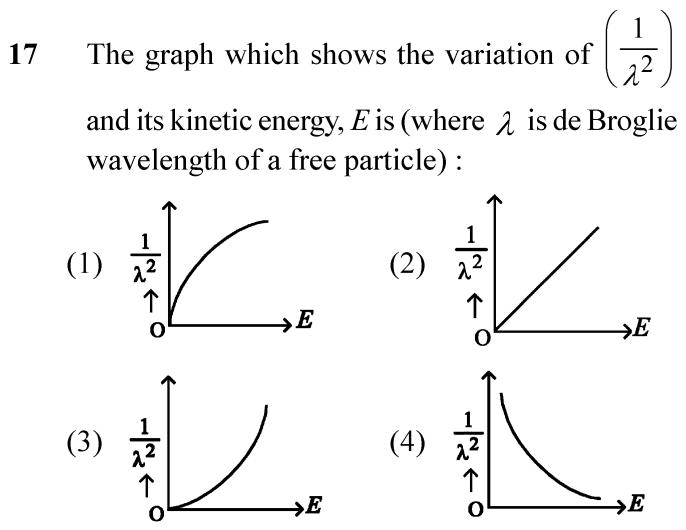
The graph which shows the variation of (1/λ²) and its kinetic energy, E is (where λ is de Broglie wavelength of a free particle):
Dynamic 180-question full-length simulator mixed dynamically from all 6 years for 2027 & 2026 aspirants.
The graph which shows the variation of (1/λ²) and its kinetic energy, E is (where λ is de Broglie wavelength of a free particle):
λ = h / √(2mE) -> λ² = h² / (2mE) -> 1/λ² = (2m/h²) · E => Form y = kx -> Straight line through origin!
For a non-relativistic free particle of mass m moving with momentum p and kinetic energy E, the momentum is expressed in terms of kinetic energy as p = √(2mE). The de Broglie wavelength is:
Squaring both sides of the relation:
Taking the reciprocal gives the function plotted on the vertical axis (1/λ²) in terms of the horizontal axis variable E:
Since 2m/h² is a positive constant, the relation has the mathematical form y = k · x with zero intercept (c = 0). The corresponding graph is a straight line passing through the origin with positive slope.
Diagnose every choice: Know exactly why the right option works and why distractors fail.
Incorrect; describes y ∝ √x (which would represent 1/λ vs E, not 1/λ² vs E).
Exact linear dependence: 1/λ² = (2m/h²) E.
Represents y ∝ x².
Represents y ∝ 1/x (which would describe λ² vs E, not 1/λ² vs E).
Students frequently remember λ ∝ 1/√E and sketch a hyperbolic or curved graph, forgetting that the y-axis is explicitly 1/λ².
"The reciprocal of the square of de Broglie wavelength is directly proportional to kinetic energy: 1/λ² = (2m/h²) E."
Test your speed and accuracy in the authentic 200-minute timed NTA simulator.
Spotted a mistake in this solution? Report an error (support@mycompetitiveexams.com)
Cover all 1,140 official NEET questions in 285 days at your own pace. Progress is saved on your device. No login needed.