MyCompetitiveExams Logo MyCompetitiveExams
Search 1,140+ Questions
Chapters, formulas, speed tricks
→
⚡ Brahmastra NEET 2027
720 MARKS

Dynamic 180-question full-length simulator mixed dynamically from all 6 years for 2027 & 2026 aspirants.

Launch Brahmastra 2027 Test →
Start Practice →
100% Free · No Login Required
Q.86 Chemistry · Section B ⭐ 360° Option Elimination Active
Vault ↗

NEET 2024 Chemistry Question 86 Solution

Topic: Haloalkanes and Haloarenes · Official NTA Booklet Code T1
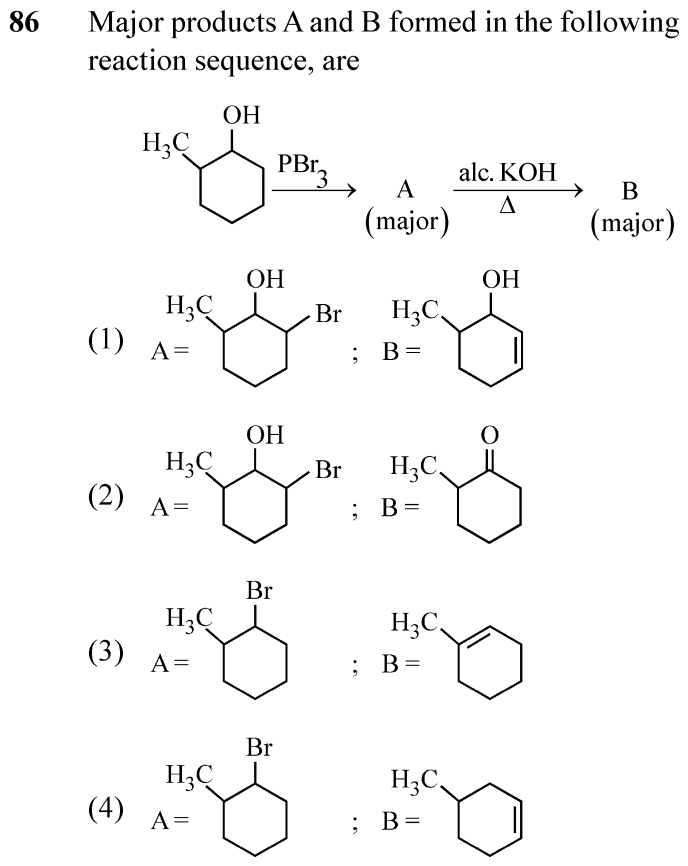
NEET 2024 Chemistry Question 86: Halogenation of Alcohols followed by Dehydrohalogenation (Saytzeff Elimination)

Question

Major products A and B formed in the following reaction sequence, are: 2-methylcyclohexan-1-ol → (PBr₃) A (major) → (alc. KOH, Δ) B (major)

✓
Verified Against NTA Final Answer Key
Option (3) : A = 1-bromo-2-methylcyclohexane ; B = 1-methylcyclohexene
📚 Haloalkanes and Haloarenes Medium
📋 Given Parameters & Problem Setup
Starting reactant 2-methylcyclohexan-1-ol
Reagent 1 PBr3 (Phosphorus tribromide)
Reagent 2 Alcoholic KOH / Δ (Dehydrohalogenation)
⚡

The 30-Second Exam Hall Shortcut: ⚡ Saytzeff Major Alkene Elimination Hack

⏱️ Save ~45 seconds

PBr3 substitutes -OH with -Br to give 1-bromo-2-methylcyclohexane (A). alc. KOH/Δ eliminates HBr following Saytzeff’s rule to form the MORE SUBSTITUTED alkene: 1-methylcyclohexene (B)!

1 Reaction with PBr3: 2-methylcyclohexan-1-ol is converted into 1-bromo-2-methylcyclohexane via nucleophilic substitution of -OH by Br (Product A).
2 Reaction with alcoholic KOH and heat: Base abstracts a β-hydrogen with departure of bromide in an E2 elimination.
3 There are two potential β-carbons: C-2 (tertiary with 1 H) and C-6 (secondary with 2 H).
4 Zaitsev’s (Saytzeff’s) rule dictates elimination of hydrogen from the β-carbon with fewer hydrogens to yield the most stable, most highly substituted alkene.
5 Elimination from C-2 yields a trisubstituted alkene (1-methylcyclohexene), which is more stable than the disubstituted 3-methylcyclohexene from C-6.
6 Match: Product A = 1-bromo-2-methylcyclohexane, Product B = 1-methylcyclohexene -> Option (3) in 10 seconds!
🛡️
Why You Can 100% Trust This Shortcut: NCERT Chemistry · Haloalkanes and Haloarenes (Elimination reactions: β-elimination and Zaitsev’s rule for alkyl halides).
📐

Step-by-Step Rigorous Workflow & Mathematical Proof

Step 1

Substitution of Hydroxyl Group by Phosphorus Tribromide (Formation of A)

Reaction of secondary alcohols with phosphorus tribromide (PBr3) cleanly converts the -OH into a bromide leaving group without carbocation rearrangement, yielding 1-bromo-2-methylcyclohexane:

3  R-OH+PBr3⟶3  R-Br+H3PO3  ⟹  Product A=1-bromo-2-methylcyclohexane3\;\text{R-OH} + \text{PBr}_3 \longrightarrow 3\;\text{R-Br} + \text{H}_3\text{PO}_3 \implies \text{Product A} = \text{1-bromo-2-methylcyclohexane}
Step 2

Base-Induced E2 Elimination (Formation of B)

Alcoholic potassium hydroxide (alc. KOH) is a strong dehydrohalogenating reagent. Upon heating, the ethoxide/hydroxide base abstracts a proton from a β-carbon concurrent with the expulsion of the bromide ion in a concerted anti-coplanar E2 pathway:

R-CH2CH(Br)R→alc. KOH, ΔAlkene+KBr+H2O\text{R-CH}_2\text{CH(Br)R} \xrightarrow{\text{alc. KOH, } \Delta} \text{Alkene} + \text{KBr} + \text{H}_2\text{O}
Step 3

Regioselectivity via Saytzeff’s Rule

The base can abstract a proton from either: - The tertiary β-carbon (C-2): Abstraction of the single tertiary hydrogen yields 1-methylcyclohex-1-ene (a trisubstituted alkene with endocyclic double bond). - The secondary β-carbon (C-6): Abstraction yields 3-methylcyclohex-1-ene (a disubstituted alkene). By Zaitsev’s rule, the more substituted alkene possesses more hyperconjugative α-hydrogens and is thermodynamically more stable, predominating as the major product B:

Major Product B=1-methylcyclohexene (trisubstituted alkene)\text{Major Product B} = \text{1-methylcyclohexene (trisubstituted alkene)}
⭐

360° Option Elimination Engine Key Feature

Diagnose every choice: Know exactly why the right option works and why distractors fail.

4-Option Deep Scan
1 (1)
✗ Incorrect
Verdict & Scientific Reason:

PBr3 replaces -OH, it does not add to the ring while retaining -OH.

⚠️
Student Fallacy (Why candidates pick this trap): Believing PBr3 acts as an addition reagent.
2 (2)
✗ Incorrect
Verdict & Scientific Reason:

alc. KOH does not oxidize alcohols to ketones.

⚠️
Student Fallacy (Why candidates pick this trap): Confusing basic elimination with oxidation.
3 (3)
✓ 100% Correct
Verdict & Scientific Reason:

Accurate substitution by PBr3 followed by Saytzeff E2 elimination to the more substituted alkene.

💡
Why this is airtight: None.
4 (4)
✗ Incorrect
Verdict & Scientific Reason:

Forms the minor Hofmann-type disubstituted alkene instead of the major Saytzeff product.

⚠️
Student Fallacy (Why candidates pick this trap): Choosing the less substituted alkene.
⚠️

NTA Trap Alert: Hofmann vs Saytzeff Regiochemistry

With unhindered bases like alcoholic KOH, elimination strictly obeys Saytzeff’s rule yielding the more substituted alkene (Option 3). Option (4) gives the less substituted alkene (Hofmann product), which only forms with bulky bases like t-BuOK.

🛡️ How to avoid the -1 mark: alc. KOH = Saytzeff (more substituted double bond).
📖

Core NEET Syllabus Standard

Chemistry Core Organic Chemistry · Haloalkanes and Haloarenes Standard Benchmark
Core Scientific Principle Tested:

"In dehydrohalogenation of secondary alkyl halides with alcoholic KOH, the preferred product is that alkene which has the greater number of alkyl groups attached to the doubly bonded carbon atoms."

Syllabus Focus: Elimination Reactions: Zaitsev’s Rule and Alkene Stability
✓ Core NEET UG Syllabus Anchor Syllabus & Academic Standards ↗
PBr3 trades OH for Br; Saytzeff puts the double bond right where the methyls are!

Ready to attempt under real exam pressure?

Test your speed and accuracy in the authentic 200-minute timed NTA simulator.

Launch NEET 2024 CBT Test →

Spotted a mistake in this solution? Report an error (support@mycompetitiveexams.com)

⚖️ Legal & Fair Dealing Notice: Sourced from publicly released NEET 2024 question papers and NEET answer keys for private study, research, and non-commercial educational practice under Fair Dealing (Section 52(1)(a) of the Indian Copyright Act, 1957). Not affiliated with or endorsed by NTA or NMC.

Solve 4 NEET Questions a Day — One per Subject

Cover all 1,140 official NEET questions in 285 days at your own pace. Progress is saved on your device. No login needed.