MyCompetitiveExams Logo MyCompetitiveExams
Search 1,140+ Questions
Chapters, formulas, speed tricks
→
⚡ Brahmastra NEET 2027
720 MARKS

Dynamic 180-question full-length simulator mixed dynamically from all 6 years for 2027 & 2026 aspirants.

Launch Brahmastra 2027 Test →
Start Practice →
100% Free · No Login Required
Q.81 Chemistry · Section A ⭐ 360° Option Elimination Active
Vault ↗

NEET 2024 Chemistry Question 81 Solution

Topic: Coordination Compounds · Official NTA Booklet Code T1
NEET 2024 Chemistry Question 81: Octahedral Geometry and Magnetic Properties of Co(III) Complexes

Question

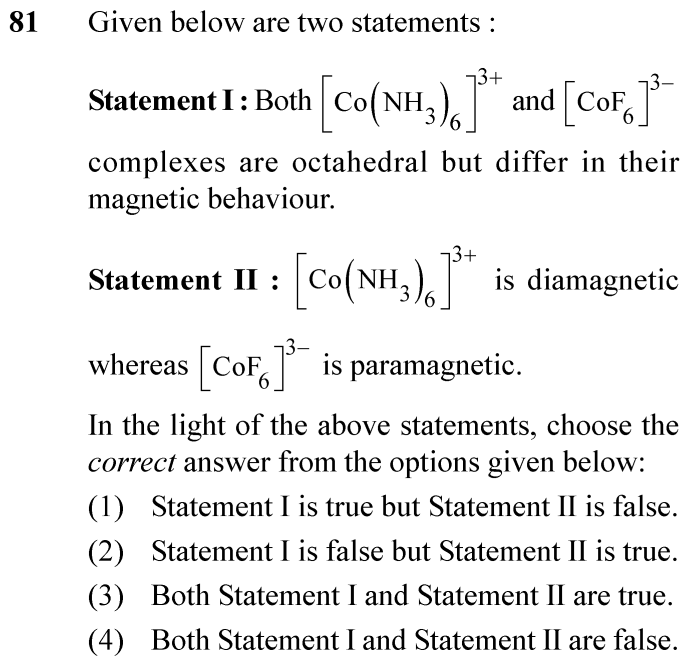
Given below are two statements: Statement I: Both [Co(NH₃)₆]³⁺ and [CoF₆]³⁻ complexes are octahedral but differ in their magnetic behaviour. Statement II: [Co(NH₃)₆]³⁺ is diamagnetic whereas [CoF₆]³⁻ is paramagnetic. In the light of the above statements, choose the correct answer from the options given below:

✓
Verified Against NTA Final Answer Key
Option (3) : Both Statement I and Statement II are true.
📚 Coordination Compounds Easy
📋 Given Parameters & Problem Setup
Complex 1 [Co(NH3)6]³⁺ (hexaamminecobalt(III) ion)
Complex 2 [CoF6]³⁻ (hexafluoridocobaltate(III) ion)
Statement I Both complexes are octahedral but differ in their magnetic behaviour
Statement II [Co(NH3)6]³⁺ is diamagnetic whereas [CoF6]³⁻ is paramagnetic
⚡

The 30-Second Exam Hall Shortcut: ⚡ Strong Field vs Weak Field Spectrochemical Hack

⏱️ Save ~40 seconds

Co³⁺ is d⁶. NH3 is a strong field ligand -> Δ_o > P -> pairing -> t_2g⁶ e_g⁰ (n=0, diamagnetic)! F⁻ is a weak field ligand -> Δ_o < P -> t_2g⁴ e_g² (n=4, paramagnetic)!

1 Both complexes have coordination number 6 -> Both are Octahedral geometry -> Statement I part 1 is TRUE.
2 Oxidation state of Co is +3 in both: Co³⁺ = [Ar] 3d⁶.
3 In [Co(NH3)6]³⁺, NH3 is a strong field ligand. Crystal field splitting Δ_o exceeds pairing energy P (Δ_o > P), causing complete pairing into t_2g⁶ e_g⁰ -> n = 0 unpaired electrons -> DIAMAGNETIC.
4 In [CoF6]³⁻, F⁻ is a weak field ligand (Δ_o < P), leading to high-spin configuration t_2g⁴ e_g² -> n = 4 unpaired electrons -> PARAMAGNETIC.
5 Therefore, both are octahedral, differ in magnetic behavior (Statement I is TRUE), and [Co(NH3)6]³⁺ is diamagnetic while [CoF6]³⁻ is paramagnetic (Statement II is TRUE).
6 Both statements are true -> Option (3) in 5 seconds!
🛡️
Why You Can 100% Trust This Shortcut: NCERT Chemistry · Coordination Compounds (Crystal field theory in octahedral complexes: [Co(NH3)6]3+ diamagnetic low-spin vs [CoF6]3- paramagnetic high-spin).
📐

Step-by-Step Rigorous Workflow & Mathematical Proof

Step 1

Coordination Number and Geometry

Both [Co(NH3)6]³⁺ and [CoF6]³⁻ possess a central cobalt ion surrounded by six monodentate ligands (coordination number = 6). Coordination number 6 uniquely dictates an Octahedral coordination polyhedral geometry for both complexes:

CN=6  ⟹  Octahedral Geometry for both complexes\text{CN} = 6 \implies \text{Octahedral Geometry for both complexes}
Step 2

Crystal Field Analysis of [Co(NH3)6]³⁺

Cobalt(III) has a 3d⁶ valence electron configuration. NH3 occupies a high position in the spectrochemical series and behaves as a strong field ligand with Co³⁺. Because Δo > P (pairing energy), electrons fully pair in the lower energy t2g orbitals:

Configuration: t2g6 eg0,n=0  ⟹  Diamagnetic (Low-spin / inner orbital complex)\text{Configuration: } t_{2g}^6\,e_g^0, \quad n = 0 \implies \text{Diamagnetic (Low-spin / inner orbital complex)}
Step 3

Crystal Field Analysis of [CoF6]³⁻

Fluoride ion (F⁻) lies at the weak field end of the spectrochemical series. The crystal field splitting is smaller than the pairing energy (Δo < P), so electrons follow Hund’s rule of maximum multiplicity across both t2g and eg sets:

Configuration: t2g4 eg2,n=4  ⟹  μ=4(6)=4.90  B.M.  (Paramagnetic / high-spin)\text{Configuration: } t_{2g}^4\,e_g^2, \quad n = 4 \implies \mu = \sqrt{4(6)} = 4.90\;\text{B.M.} \; (\text{Paramagnetic / high-spin})
Step 4

Evaluating Statements

Statement I correctly asserts that both are octahedral but differ in magnetic behavior. Statement II correctly specifies that [Co(NH3)6]³⁺ is diamagnetic and [CoF6]³⁻ is paramagnetic. Both statements are factually and theoretically correct.

Both Statement I and Statement II are true (Option 3)\text{Both Statement I and Statement II are true (Option 3)}
⭐

360° Option Elimination Engine Key Feature

Diagnose every choice: Know exactly why the right option works and why distractors fail.

4-Option Deep Scan
1 (1)
✗ Incorrect
Verdict & Scientific Reason:

Statement II is the precise textbook statement of their magnetic properties.

⚠️
Student Fallacy (Why candidates pick this trap): Thinking [CoF6]3- is diamagnetic.
2 (2)
✗ Incorrect
Verdict & Scientific Reason:

Statement I is true: both complexes are octahedral.

⚠️
Student Fallacy (Why candidates pick this trap): Thinking they have different geometries.
3 (3)
✓ 100% Correct
Verdict & Scientific Reason:

Both statements reflect canonical crystal field theory and empirical magnetic measurements.

💡
Why this is airtight: None.
4 (4)
✗ Incorrect
Verdict & Scientific Reason:

Both statements are completely verified truths.

⚠️
Student Fallacy (Why candidates pick this trap): Total rejection of CFT.
⚠️

NTA Trap Alert: Assuming All Co(III) Complexes Have Identical Magnetism

Students frequently remember Co³⁺ as diamagnetic from [Co(NH3)6]³⁺, forgetting that weak field ligands like F⁻ produce high-spin paramagnetic complexes (n = 4).

🛡️ How to avoid the -1 mark: Always check ligand strength: NH3 = strong (diamagnetic); F⁻ = weak (paramagnetic).
📖

Core NEET Syllabus Standard

Chemistry Core Inorganic Chemistry · Coordination Compounds Standard Benchmark
Core Scientific Principle Tested:

"In octahedral field, d6 forms diamagnetic t2g⁶ eg⁰ with strong field ligands (NH3) and paramagnetic t2g⁴ eg² with weak field ligands (F⁻)."

Syllabus Focus: Crystal Field Theory: Electronic Configurations of d6 Ions
✓ Core NEET UG Syllabus Anchor Syllabus & Academic Standards ↗
Ammonia pairs them all (diamagnetic zero); Fluoride spreads them wide (paramagnetic hero)!

Ready to attempt under real exam pressure?

Test your speed and accuracy in the authentic 200-minute timed NTA simulator.

Launch NEET 2024 CBT Test →

Spotted a mistake in this solution? Report an error (support@mycompetitiveexams.com)

⚖️ Legal & Fair Dealing Notice: Sourced from publicly released NEET 2024 question papers and NEET answer keys for private study, research, and non-commercial educational practice under Fair Dealing (Section 52(1)(a) of the Indian Copyright Act, 1957). Not affiliated with or endorsed by NTA or NMC.

Solve 4 NEET Questions a Day — One per Subject

Cover all 1,140 official NEET questions in 285 days at your own pace. Progress is saved on your device. No login needed.