MyCompetitiveExams Logo MyCompetitiveExams
Search 1,140+ Questions
Chapters, formulas, speed tricks
→
⚡ Brahmastra NEET 2027
720 MARKS

Dynamic 180-question full-length simulator mixed dynamically from all 6 years for 2027 & 2026 aspirants.

Launch Brahmastra 2027 Test →
Start Practice →
100% Free · No Login Required
Q.44 Physics · Section B ⭐ 360° Option Elimination Active
Vault ↗

NEET 2024 Physics Question 44 Solution

Topic: Semiconductor Electronics · Official NTA Booklet Code T1
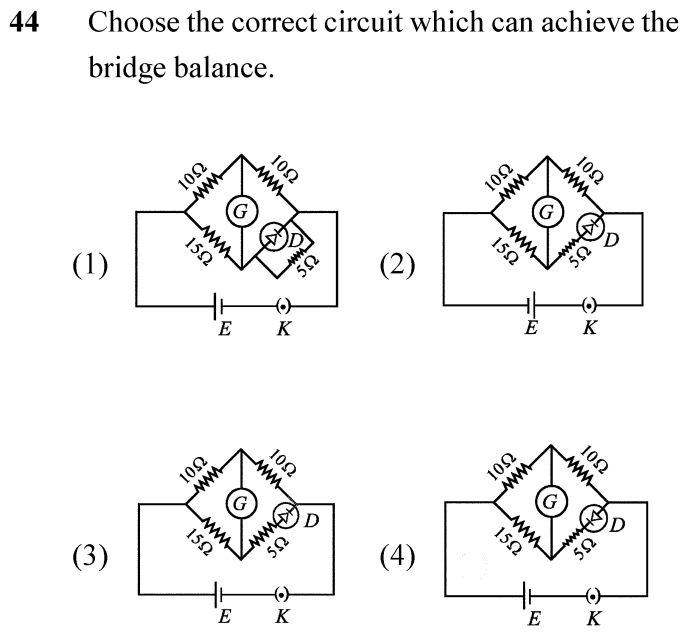
NEET 2024 Physics Question 44: Bridge Balance Condition with a p-n Junction Diode

Question

mT (4) 4.4 T than I flows but can be in any direction. (3) there is no current. 35 A horizontal force 10 Nis applied to a block A as (4) displacement current of magnitude equal to shown infigure.The mass ofblocks A and B are I flows in the same direction as I.

✓
Verified Against NTA Final Answer Key
Option (3) : Circuit (3) with forward-biased diode in series with 5 Ω resistor
📚 Semiconductor Electronics Medium
📋 Given Parameters & Problem Setup
Bridge configuration Wheatstone bridge with battery E having positive terminal on left
Top arms 10 Ω (top-left) and 10 Ω (top-right)
Bottom-left arm 15 Ω
Bottom-right arm Diode D in series/parallel with 5 Ω resistor
⚡

The 30-Second Exam Hall Shortcut: ⚡ Forward-Bias Diode Conduction Rule

⏱️ Save ~40 seconds

For bridge balance, current must flow normally through all arms -> Diode must be FORWARD BIASED in series -> Circuit (3) has diode anode pointing from bottom node to right node!

1 A Wheatstone bridge requires current to establish steady potentials at the galvanometer nodes.
2 Battery positive terminal is on the left: current enters the left junction and flows towards the right junction (negative terminal).
3 In the lower branch, current must flow from the bottom node towards the right junction.
4 For a diode to conduct in this branch, it MUST be forward biased: its anode (triangle) must point towards the cathode (bar) in the direction of current flow (from bottom to right).
5 In Circuit (4), the diode is pointing backward (reverse biased) -> blocks current completely.
6 In Circuit (1) and (2), parallel configurations cannot achieve balance.
7 Circuit (3) correctly forward-biases the series diode, enabling balance -> Option (3)!
🛡️
Why You Can 100% Trust This Shortcut: p-n Junction Diode Unidirectional Conduction & Bridge Balance Principles.
📐

Step-by-Step Rigorous Workflow & Mathematical Proof

Step 1

Principle of Wheatstone Bridge Balance

For a bridge to achieve balance, the potential difference across the galvanometer G must be zero (V_top = V_bottom), which requires continuous current flow through all four resistive branches establishing a stable potential divider.

Vtop=Vbottom  ⟹  IG=0V_{top} = V_{bottom} \implies I_G = 0
Step 2

Direction of Potential Gradient and Current Flow

The DC source E is connected with its positive terminal on the left and negative terminal on the right. Current enters at the left node, divides into the upper and lower arms, and exits at the right node. In the bottom-right arm, the conventional current MUST flow from the lower central junction towards the right-hand junction connected to the negative terminal of the battery.

Vbottom node>Vright node  ⟹  Current flows bottom→rightV_{bottom\,node} > V_{right\,node} \implies \text{Current flows bottom} \rightarrow \text{right}
Step 3

Diode Biasing Requirement

A p-n junction diode conducts current only when it is forward biased (p-side/anode at higher potential than n-side/cathode). In Circuit (3), the anode is connected to the bottom junction and cathode to the right junction, so it is forward biased and conducts freely. In Circuit (4), the diode is reverse biased, presenting near-infinite resistance and preventing current flow.

Forward Bias: Anode (+)→Cathode (−)\text{Forward Bias: Anode } (+) \rightarrow \text{Cathode } (-)
Step 4

Selection of Circuit (3)

Therefore, only Circuit (3) allows proper forward-biased conduction through the diode in series with the 5 Ω resistor, making it the only circuit that can establish the required currents and achieve bridge balance.

Circuit (3) achieves bridge balance\text{Circuit (3) achieves bridge balance}
⭐

360° Option Elimination Engine Key Feature

Diagnose every choice: Know exactly why the right option works and why distractors fail.

4-Option Deep Scan
1 (1)
✗ Incorrect
Verdict & Scientific Reason:

Parallel diode clamps voltage and prevents linear bridge balance.

⚠️
Student Fallacy (Why candidates pick this trap): Assuming parallel bypass diode can balance the arm.
2 (2)
✗ Incorrect
Verdict & Scientific Reason:

Cannot achieve balance.

⚠️
Student Fallacy (Why candidates pick this trap): Misinterpreting diode behavior.
3 (3)
✓ 100% Correct
Verdict & Scientific Reason:

Diode is properly forward-biased in the direction of conventional current flow.

💡
Why this is airtight: None.
4 (4)
✗ Incorrect
Verdict & Scientific Reason:

Diode is reverse biased and acts as an open circuit (I = 0).

⚠️
Student Fallacy (Why candidates pick this trap): Overlooking diode polarity.
⚠️

NTA Trap Alert: Ignoring Diode Arrow Direction

Students look at the resistor values and treat the diode as a plain wire, failing to check whether the diode arrow points with or against the battery current.

🛡️ How to avoid the -1 mark: Trace current from battery (+) to (-). The diode triangle MUST point in the direction the current wants to go!
📖

Core NEET Syllabus Standard

Physics Core Electronics · Semiconductor Electronics: Materials, Devices and Simple Circuits Standard Benchmark
Core Scientific Principle Tested:

"A p-n junction diode conducts when forward-biased and acts as an open circuit when reverse-biased; bridge balance requires all arms to conduct."

Syllabus Focus: p-n Junction Diode as a Circuit Element
✓ Core NEET UG Syllabus Anchor Syllabus & Academic Standards ↗
Follow the current from left to right: Diode must point in the arrow’s light (Circuit 3)!

Ready to attempt under real exam pressure?

Test your speed and accuracy in the authentic 200-minute timed NTA simulator.

Launch NEET 2024 CBT Test →

Spotted a mistake in this solution? Report an error (support@mycompetitiveexams.com)

⚖️ Legal & Fair Dealing Notice: Sourced from publicly released NEET 2024 question papers and NEET answer keys for private study, research, and non-commercial educational practice under Fair Dealing (Section 52(1)(a) of the Indian Copyright Act, 1957). Not affiliated with or endorsed by NTA or NMC.

Solve 4 NEET Questions a Day — One per Subject

Cover all 1,140 official NEET questions in 285 days at your own pace. Progress is saved on your device. No login needed.