MyCompetitiveExams Logo MyCompetitiveExams
Search 1,140+ Questions
Chapters, formulas, speed tricks
→
⚡ Brahmastra NEET 2027
720 MARKS

Dynamic 180-question full-length simulator mixed dynamically from all 6 years for 2027 & 2026 aspirants.

Launch Brahmastra 2027 Test →
Start Practice →
100% Free · No Login Required
Q.57 Chemistry · Section A ⭐ 360° Option Elimination Active
Vault ↗

NEET 2024 Chemistry Question 57 Solution

Topic: Organic Chemistry - Some Basic Principles and Techniques · Official NTA Booklet Code T1
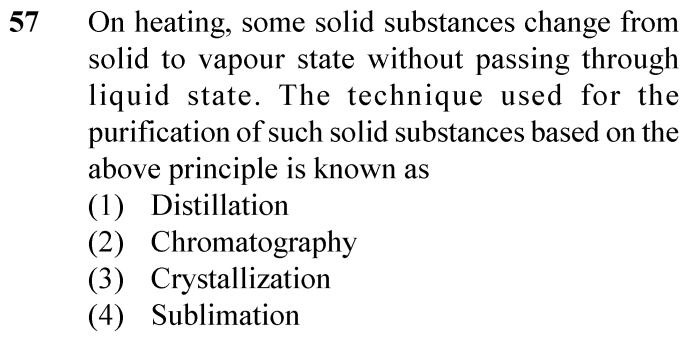
NEET 2024 Chemistry Question 57: Purification of Solids by Sublimation

Question

On heating, some solid substances change from solid to vapour state without passing through liquid state. The technique used for the purification of such solid substances based on the above principle is known as

  1. (1)Distillation
  2. (2)Chromatography
  3. (3)Crystallization
  4. (4)Sublimation
✓
Verified Against NTA Final Answer Key
Option (4) : Sublimation
📚 Organic Chemistry - Some Basic Principles and Techniques Easy
📋 Given Parameters & Problem Setup
Phenomenon Direct phase transformation from solid to vapour on heating without passing through liquid state
Objective Purification technique for such solid substances
⚡

The 30-Second Exam Hall Shortcut: ⚡ Phase Change Direct Definition

⏱️ Save ~30 seconds

Solid to Gas without Liquid = Sublimation! Textbook purification technique for camphor, benzoic acid, naphthalene, iodine, and anthracene!

1 Direct transition from Solid -> Vapour on heating is the physical definition of sublimation.
2 Purification technique based on this principle is Sublimation.
3 Distillation separates liquids based on boiling point differences.
4 Chromatography separates based on differential adsorption/partition.
5 Crystallization relies on solubility differences in a suitable solvent.
6 Direct match: Option (4) in 2 seconds!
🛡️
Why You Can 100% Trust This Shortcut: NCERT Chemistry · Organic Chemistry - Some Basic Principles and Techniques (Purification of organic compounds: Sublimation).
📐

Step-by-Step Rigorous Workflow & Mathematical Proof

Step 1

Thermodynamic and Physical Basis of Sublimation

Sublimation is a phase transition that occurs at temperatures and pressures below a substance’s triple point in its phase diagram, where the solid phase’s vapour pressure equals atmospheric pressure before melting occurs. When heated, the solid transitions directly into vapour without entering the liquid state:

Solid  ⇌depositionsublimation  Vapour\text{Solid} \;\xrightleftharpoons[\text{deposition}]{\text{sublimation}}\; \text{Vapour}
Step 2

Application in Purification of Organic Solids

Sublimation is employed to separate sublimable solids (e.g., naphthalene, anthracene, benzoic acid, camphor, ammonium chloride, iodine) from non-sublimable impurities. On cooling, the pure vapours condense directly into solid form on a chilled surface (such as an inverted funnel plugged with cotton), leaving non-volatile impurities behind in the dish.

Impure Solid→ΔPure Vapour+Residue (Insoluble Impurities)→CoolingPure Crystal Condensate\text{Impure Solid} \xrightarrow{\Delta} \text{Pure Vapour} + \text{Residue (Insoluble Impurities)} \xrightarrow{\text{Cooling}} \text{Pure Crystal Condensate}
⭐

360° Option Elimination Engine Key Feature

Diagnose every choice: Know exactly why the right option works and why distractors fail.

4-Option Deep Scan
1 (1)
✗ Incorrect
Verdict & Scientific Reason:

Distillation is used to separate volatile liquids from non-volatile impurities or liquid mixtures with different boiling points.

⚠️
Student Fallacy (Why candidates pick this trap): Confusing vaporization of liquids with sublimation of solids.
2 (2)
✗ Incorrect
Verdict & Scientific Reason:

Chromatography is a separation technique based on differential partitioning between stationary and mobile phases.

⚠️
Student Fallacy (Why candidates pick this trap): Equating phase transition with chromatographic separation.
3 (3)
✗ Incorrect
Verdict & Scientific Reason:

Crystallization is based on the differential solubility of a compound and its impurities in a chosen solvent.

⚠️
Student Fallacy (Why candidates pick this trap): Assuming crystal formation involves direct vapour-solid transition.
4 (4)
✓ 100% Correct
Verdict & Scientific Reason:

Verbatim physical and textbook definition of sublimation purification.

💡
Why this is airtight: None.
⚠️

NTA Trap Alert: Distillation vs Sublimation

Both involve vapor formation on heating, but distillation starts from a liquid, whereas sublimation starts directly from a solid.

🛡️ How to avoid the -1 mark: Check the starting phase: Solid directly to vapour without melting = Sublimation.
📖

Core NEET Syllabus Standard

Chemistry Core Organic Techniques · Organic Chemistry - Some Basic Principles and Techniques Standard Benchmark
Core Scientific Principle Tested:

"Sublimation is used to separate sublimable substances that pass directly from solid to vapour on heating from non-sublimable impurities."

Syllabus Focus: Methods of Purification of Organic Compounds
✓ Core NEET UG Syllabus Anchor Syllabus & Academic Standards ↗
Skip the liquid, leap the station: Solid to gas is Sublimation!

Ready to attempt under real exam pressure?

Test your speed and accuracy in the authentic 200-minute timed NTA simulator.

Launch NEET 2024 CBT Test →

Spotted a mistake in this solution? Report an error (support@mycompetitiveexams.com)

⚖️ Legal & Fair Dealing Notice: Sourced from publicly released NEET 2024 question papers and NEET answer keys for private study, research, and non-commercial educational practice under Fair Dealing (Section 52(1)(a) of the Indian Copyright Act, 1957). Not affiliated with or endorsed by NTA or NMC.

Solve 4 NEET Questions a Day — One per Subject

Cover all 1,140 official NEET questions in 285 days at your own pace. Progress is saved on your device. No login needed.