MyCompetitiveExams Logo MyCompetitiveExams
Search 1,140+ Questions
Chapters, formulas, speed tricks
→
⚡ Brahmastra NEET 2027
720 MARKS

Dynamic 180-question full-length simulator mixed dynamically from all 6 years for 2027 & 2026 aspirants.

Launch Brahmastra 2027 Test →
Start Practice →
100% Free · No Login Required
Q.73 Chemistry · Section A ⭐ 360° Option Elimination Active
Vault ↗

NEET 2024 Chemistry Question 73 Solution

Topic: Haloalkanes and Haloarenes · Official NTA Booklet Code T1
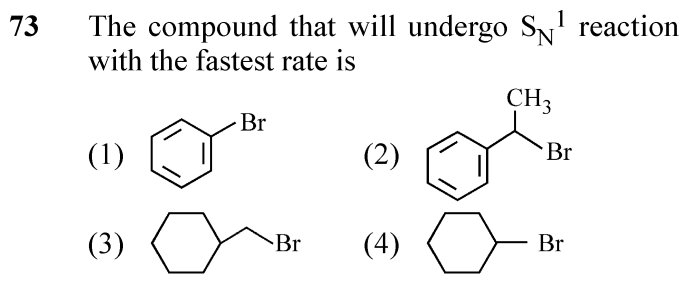
NEET 2024 Chemistry Question 73: Relative Rates of SN1 Reactions and Carbocation Stability

Question

The compound that will undergo Sₙ1 reaction with the fastest rate is

✓
Verified Against NTA Final Answer Key
Option (2) : (1-bromoethyl)benzene (PhCH(Br)CH3)
📚 Haloalkanes and Haloarenes Easy
📋 Given Parameters & Problem Setup
Substrate 1 Bromobenzene (PhBr)
Substrate 2 (1-bromoethyl)benzene (PhCH(CH3)Br)
Substrate 3 (Bromomethyl)cyclohexane (Cyclohexyl-CH2Br)
Substrate 4 Bromocyclohexane (Cyclohexyl-Br)
⚡

The 30-Second Exam Hall Shortcut: ⚡ Carbocation Stability SN1 Speed Rule

⏱️ Save ~35 seconds

SN1 rate ∝ Carbocation Stability! Secondary benzylic carbocation [PhCH⁺CH3] has resonance stabilization from the benzene ring PLUS 3 α-hydrogens -> Fastest SN1!

1 Rate-determining step of an SN1 reaction is the ionization to form a carbocation intermediate.
2 Inspect carbocations formed by each substrate:
3 - Substrate 1: Phenyl cation (sp² hybridized, extremely unstable; zero SN1 rate).
4 - Substrate 2: Secondary benzylic carbocation Ph-C⁺H-CH3 (resonance delocalized across all 3 ortho/para positions of the aromatic ring + 3 hyperconjugative α-hydrogens). Exceptionally stable!
5 - Substrate 3: Primary aliphatic carbocation Cyclohexyl-CH2⁺ (very unstable).
6 - Substrate 4: Secondary aliphatic carbocation Cyclohexyl⁺ (moderately stable, but lacks resonance).
7 Benzylic carbocation stability dominates all aliphatic cations.
8 Option (2) undergoes SN1 with the fastest rate in 5 seconds!
🛡️
Why You Can 100% Trust This Shortcut: NCERT Chemistry · Haloalkanes and Haloarenes (Reactivity order of alkyl halides in SN1 reactions: allylic and benzylic halides show high reactivity due to resonance stabilization).
📐

Step-by-Step Rigorous Workflow & Mathematical Proof

Step 1

Kinetics and Rate Law of the SN1 Mechanism

The unimolecular nucleophilic substitution (SN1) proceeds through a two-step mechanism. The slow, rate-determining step is the heterolytic cleavage of the C-Br bond to form a planar carbocation:

R−Br→slow, rdsR⊕+Br⊖,Rate=k[R−Br]R{-}\text{Br} \xrightarrow{\text{slow, rds}} R^\oplus + \text{Br}^\ominus, \quad \text{Rate} = k[R{-}\text{Br}]
Step 2

Evaluation of Carbocation Intermediates

Analyzing the stability of the intermediate generated from each given substrate: 1. Bromobenzene: Phenyl cation C6H5⁺ has the positive charge in an sp² orbital orthogonal to the π-system; it cannot be stabilized by resonance and is energetically prohibitive. 2. (1-Bromoethyl)benzene: The resulting carbocation Ph-C⁺H-CH3 is a secondary benzylic carbocation. The positive charge is extensively delocalized into the benzene ring across four contributing resonance structures, enhanced by hyperconjugation from the methyl group. 3. (Bromomethyl)cyclohexane: Generates an unstable 1° carbocation. 4. Bromocyclohexane: Generates a 2° aliphatic carbocation without any resonance stabilization.

Stability: PhCH⊕CH3  (2° benzylic)≫Cyclohexyl⊕  (2° aliphatic)>Cyclohexyl-CH2⊕  (1°)≫C6H5⊕\text{Stability: } \text{PhCH}^\oplus\text{CH}_3 \;(\text{2° benzylic}) \gg \text{Cyclohexyl}^\oplus \;(\text{2° aliphatic}) > \text{Cyclohexyl-CH}_2^\oplus \;(\text{1°}) \gg \text{C}_6\text{H}_5^\oplus
Step 3

Conclusion on Relative Reaction Rates

By the Hammond postulate, the transition state leading to the 2° benzylic carbocation has the lowest activation energy (ΔG‡). Consequently, (1-bromoethyl)benzene undergoes solvolysis/SN1 with the fastest rate.

kSN1∝exp⁡(−ΔG‡RT)  ⟹  Fastest for Substrate (2)k_{SN1} \propto \exp\left(-\frac{\Delta G^\ddagger}{RT}\right) \implies \text{Fastest for Substrate (2)}
⭐

360° Option Elimination Engine Key Feature

Diagnose every choice: Know exactly why the right option works and why distractors fail.

4-Option Deep Scan
1 (1)
✗ Incorrect
Verdict & Scientific Reason:

Does not undergo SN1 due to instability of phenyl cation and partial double bond character of C-Br.

⚠️
Student Fallacy (Why candidates pick this trap): Assuming presence of benzene ring always accelerates SN1.
2 (2)
✓ 100% Correct
Verdict & Scientific Reason:

Forms an exceptionally stable 2° benzylic carbocation with aromatic resonance delocalization.

💡
Why this is airtight: None.
3 (3)
✗ Incorrect
Verdict & Scientific Reason:

Primary aliphatic halide; reacts predominantly via SN2, extremely slow via SN1.

⚠️
Student Fallacy (Why candidates pick this trap): Confusing 1° aliphatic with benzylic.
4 (4)
✗ Incorrect
Verdict & Scientific Reason:

Secondary aliphatic carbocation lacks resonance stabilization.

⚠️
Student Fallacy (Why candidates pick this trap): Believing secondary aliphatic is comparable to secondary benzylic.
⚠️

NTA Trap Alert: Confusing Phenyl Halides with Benzylic Halides

Halogen directly on the ring (Bromobenzene) is INERT to SN1. Halogen on the side-chain carbon adjacent to the ring (Benzylic) is HYPER-REACTIVE to SN1!

🛡️ How to avoid the -1 mark: Check the carbon bearing bromine: on the ring = inert; one carbon away from the ring = benzylic (super fast).
📖

Core NEET Syllabus Standard

Chemistry Core Organic Chemistry · Haloalkanes and Haloarenes Standard Benchmark
Core Scientific Principle Tested:

"Benzylic halides show high reactivity in SN1 reactions because the carbocation formed is stabilized through resonance with the aromatic ring."

Syllabus Focus: Nucleophilic Substitution Reactions: SN1 Reactivity Factors
✓ Core NEET UG Syllabus Anchor Syllabus & Academic Standards ↗
Benzylic carbon shares the charge: ring resonance makes its speed huge and large!

Ready to attempt under real exam pressure?

Test your speed and accuracy in the authentic 200-minute timed NTA simulator.

Launch NEET 2024 CBT Test →

Spotted a mistake in this solution? Report an error (support@mycompetitiveexams.com)

⚖️ Legal & Fair Dealing Notice: Sourced from publicly released NEET 2024 question papers and NEET answer keys for private study, research, and non-commercial educational practice under Fair Dealing (Section 52(1)(a) of the Indian Copyright Act, 1957). Not affiliated with or endorsed by NTA or NMC.

Solve 4 NEET Questions a Day — One per Subject

Cover all 1,140 official NEET questions in 285 days at your own pace. Progress is saved on your device. No login needed.