MyCompetitiveExams Logo MyCompetitiveExams
Search 1,140+ Questions
Chapters, formulas, speed tricks
→
⚡ Brahmastra NEET 2027
720 MARKS

Dynamic 180-question full-length simulator mixed dynamically from all 6 years for 2027 & 2026 aspirants.

Launch Brahmastra 2027 Test →
Start Practice →
100% Free · No Login Required
Q.189 Zoology ⭐ 360° Option Elimination Active
Vault ↗

NEET 2024 Zoology Question 189 Solution

Topic: Biomolecules · Official NTA Booklet Code T1
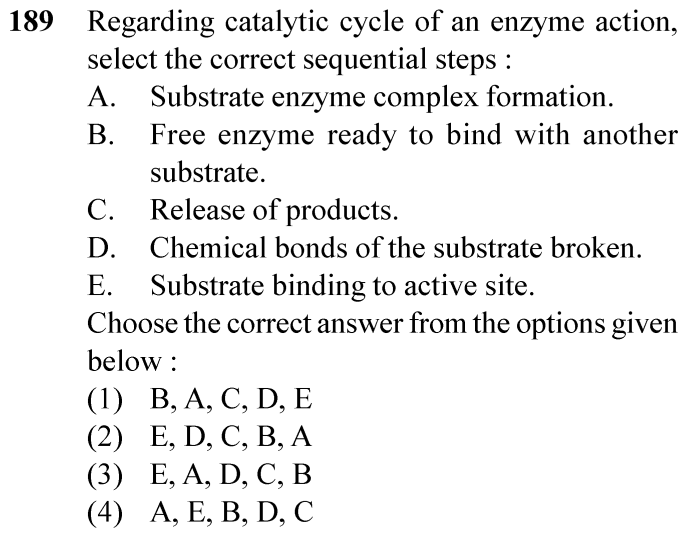
NEET 2024 Zoology Question 189: Catalytic Cycle of an Enzyme: Stepwise Progression

Question

Regarding catalytic cycle of an enzyme action, select the correct sequential steps: A. Substrate enzyme complex formation. B. Free enzyme ready to bind with another substrate. C. Release of products. D. Chemical bonds of the substrate broken. E. Substrate binding to active site. Choose the correct answer from the options given below:

  1. (1)B,A,C,D,E
  2. (2)E,D,C,B,A
  3. (3)E,A,D,C,B
  4. (4)A,E, B,D, C
✓
Verified Against NTA Final Answer Key
Option (3) : E, A, D, C, B
📚 Biomolecules Easy
📋 Given Parameters & Problem Setup
Event Catalytic cycle of an enzyme action
Steps A: Substrate enzyme complex formation; B: Free enzyme ready to bind; C: Release of products; D: Chemical bonds of substrate broken; E: Substrate binding to active site
⚡

The 30-Second Exam Hall Shortcut: ⚡ Catalytic Cycle Sequential Walkthrough

⏱️ Save ~25 seconds

Substrate binds to active site (E) -> ES complex fits tightly (A) -> Bonds broken / EP complex formed (D) -> Products released (C) -> Free enzyme recycled (B)! Sequence: E -> A -> D -> C -> B!

1 Recall the 4 steps of enzyme action in NCERT:
2 Substrate binds to active site of enzyme fitting into the active site (E).
3 Binding induces enzyme to alter shape, forming enzyme-substrate complex tightly (A).
4 Active site breaks chemical bonds of substrate; new enzyme-product complex forms (D).
5 Enzyme releases products of reaction (C).
6 Free enzyme is ready to bind to another molecule of substrate (B).
7 Sequential order: E -> A -> D -> C -> B -> Option (3) / C.
🛡️
Why You Can 100% Trust This Shortcut: NCERT Biology · Biomolecules (Nature of Enzyme Action and Catalytic Cycle)
📐

Step-by-Step Rigorous Workflow & Mathematical Proof

Step 1

Review NCERT Description of Catalytic Cycle

The catalytic cycle of an enzyme action can be described in the following steps: 1. First, the substrate binds to the active site of the enzyme, fitting into the active site (Step E). 2. The binding of the substrate induces the enzyme to alter its shape, fitting more tightly around the substrate, forming the enzyme-substrate complex (Step A).

Step 2

Catalytic Cleavage and Product Release

3. The active site of the enzyme, now in close proximity of the substrate breaks the chemical bonds of the substrate and the new enzyme-product complex is formed (Step D). 4. The enzyme releases the products of the reaction (Step C). 5. The free enzyme is ready to bind to another molecule of the substrate and run through the catalytic cycle once again (Step B).

Step 3

Confirm Sequence

The sequence is E -> A -> D -> C -> B, corresponding to Option (3).

⭐

360° Option Elimination Engine Key Feature

Diagnose every choice: Know exactly why the right option works and why distractors fail.

4-Option Deep Scan
1 (1)
✗ Incorrect
Verdict & Scientific Reason:

Places free enzyme at the beginning before substrate binding.

⚠️
Student Fallacy (Why candidates pick this trap): Places free enzyme at the beginning before substrate binding.
2 (2)
✗ Incorrect
Verdict & Scientific Reason:

Places bond cleavage (D) before enzyme-substrate complex formation (A).

⚠️
Student Fallacy (Why candidates pick this trap): Places bond cleavage (D) before enzyme-substrate complex formation (A).
3 (3)
✓ 100% Correct
Verdict & Scientific Reason:

Accurately outlines the verbatim sequence of enzyme catalysis from binding to active recycling.

💡
Why this is airtight: None.
4 (4)
✗ Incorrect
Verdict & Scientific Reason:

Places complex formation before substrate binding.

⚠️
Student Fallacy (Why candidates pick this trap): Places complex formation before substrate binding.
⚠️

NTA Trap Alert: Active Site Binding vs Complex Formation

Placing ES complex formation (A) before substrate binding to the active site (E).

🛡️ How to avoid the -1 mark: Substrate must first physically bind to the active site (E) before the enzyme alters shape to form the tight ES complex (A).
📖

Core NEET Syllabus Standard

Biology Core Zoology · Biomolecules Standard Benchmark
Core Scientific Principle Tested:

"The catalytic cycle of an enzyme action: (1) First, the substrate binds to the active site... (2) The binding induces the enzyme to alter its shape... (3) The active site breaks the chemical bonds... (4) The enzyme releases the products... free enzyme ready to bind again."

Syllabus Focus: Catalytic Cycle of an Enzyme: Stepwise Progression
✓ Core NEET UG Syllabus Anchor Syllabus & Academic Standards ↗

Ready to attempt under real exam pressure?

Test your speed and accuracy in the authentic 200-minute timed NTA simulator.

Launch NEET 2024 CBT Test →

Spotted a mistake in this solution? Report an error (support@mycompetitiveexams.com)

⚖️ Legal & Fair Dealing Notice: Sourced from publicly released NEET 2024 question papers and NEET answer keys for private study, research, and non-commercial educational practice under Fair Dealing (Section 52(1)(a) of the Indian Copyright Act, 1957). Not affiliated with or endorsed by NTA or NMC.

Solve 4 NEET Questions a Day — One per Subject

Cover all 1,140 official NEET questions in 285 days at your own pace. Progress is saved on your device. No login needed.