NEET 2024 Botany Question 130 Solution
Question
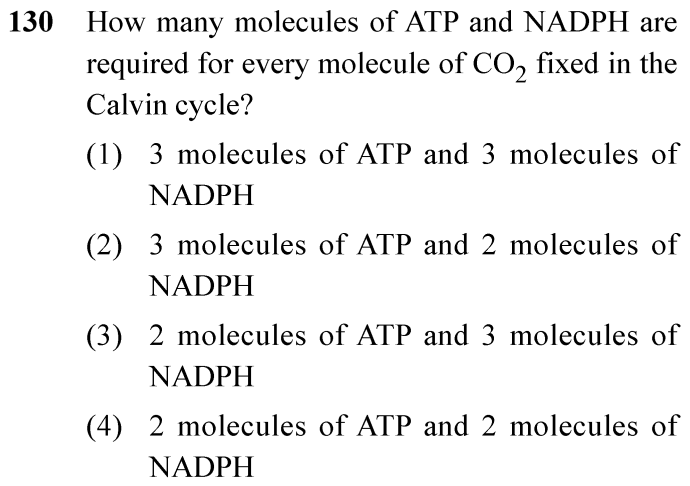
How many molecules of ATP and NADPH are required for every molecule of CO₂ fixed in the Calvin cycle?
Dynamic 180-question full-length simulator mixed dynamically from all 6 years for 2027 & 2026 aspirants.
How many molecules of ATP and NADPH are required for every molecule of CO₂ fixed in the Calvin cycle?
Per CO₂ fixed: 2 ATP + 2 NADPH in Reduction, plus 1 ATP in Regeneration = 3 ATP and 2 NADPH! For 1 Glucose (6 CO₂), it is 18 ATP and 12 NADPH!
The Calvin cycle proceeds in three stages: 1. Carboxylation: RuBP () binds via RuBisCO to form two molecules of 3-PGA (). No ATP or NADPH is consumed.
2. Reduction: Two molecules of ATP for phosphorylation and two of NADPH for reduction are consumed per molecule fixed. 3. Regeneration: Regeneration of the acceptor molecule RuBP requires one phosphorylation step using one ATP. Total Energy Consumed per :
To produce 1 molecule of hexose glucose (), six turns of the cycle are required, consuming and , perfectly matching NCERT Table 13.1.
Diagnose every choice: Know exactly why the right option works and why distractors fail.
Inverts the numbers; NADPH needed is 2, while ATP needed is 3.
Accurately quantifies 3 ATP (2 reduction + 1 regeneration) and 2 NADPH per fixed CO₂.
Considers only the reduction step, omitting the 1 ATP required for RuBP regeneration.
Overestimates NADPH consumption; only 2 molecules are reduced per CO₂.
Counting only the reduction phase (2 ATP and 2 NADPH) and forgetting the regeneration of RuBP.
"For every CO2 molecule entering the Calvin cycle, 3 molecules of ATP and 2 of NADPH are required. It is probably to meet this difference in number of ATP and NADPH used in the dark reaction that the cyclic phosphorylation takes place."
Test your speed and accuracy in the authentic 200-minute timed NTA simulator.
Spotted a mistake in this solution? Report an error (support@mycompetitiveexams.com)
Cover all 1,140 official NEET questions in 285 days at your own pace. Progress is saved on your device. No login needed.