MyCompetitiveExams Logo MyCompetitiveExams
Search 1,140+ Questions
Chapters, formulas, speed tricks
→
⚡ Brahmastra NEET 2027
720 MARKS

Dynamic 180-question full-length simulator mixed dynamically from all 6 years for 2027 & 2026 aspirants.

Launch Brahmastra 2027 Test →
Start Practice →
100% Free · No Login Required
Q.78 Chemistry · Section A ⭐ 360° Option Elimination Active
Vault ↗

NEET 2024 Chemistry Question 78 Solution

Topic: Hydrocarbons · Official NTA Booklet Code T1
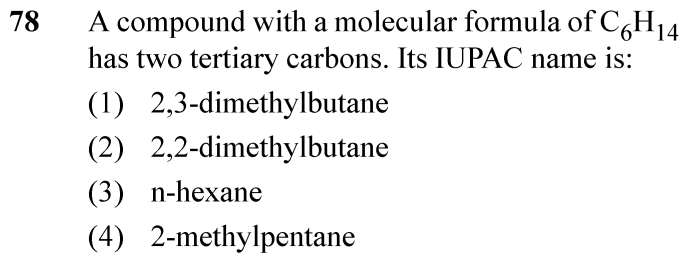
NEET 2024 Chemistry Question 78: Classification of Carbon Atoms (1°, 2°, 3°, 4°) in Hexane Isomers

Question

A compound with a molecular formula of C₆H₁₄ has two tertiary carbons. Its IUPAC name is:

✓
Verified Against NTA Final Answer Key
Option (1) : 2,3-dimethylbutane
📚 Hydrocarbons Easy
📋 Given Parameters & Problem Setup
Molecular formula C6H14 (hexane isomer)
Structural constraint Contains exactly two tertiary (3°) carbon atoms
⚡

The 30-Second Exam Hall Shortcut: ⚡ Carbon Degree Counting Hack

⏱️ Save ~30 seconds

Tertiary (3°) carbon is bonded to THREE other carbons (-CH(CH3)-). 2,3-dimethylbutane has CH3-CH(CH3)-CH(CH3)-CH3 with C2 and C3 both 3° carbons!

1 Tertiary (3°) carbon = a carbon atom directly bonded to 3 other carbon atoms.
2 Examine Option (1) 2,3-dimethylbutane: CH3-CH(CH3)-CH(CH3)-CH3.
3 - C1 and C4 are primary (1°).
4 - Methyl branches on C2 and C3 are primary (1°).
5 - C2 is bonded to C1, C3, and methyl carbon -> 3 carbons attached -> 3° carbon!
6 - C3 is bonded to C2, C4, and methyl carbon -> 3 carbons attached -> 3° carbon!
7 - Exactly TWO tertiary carbons! Matches requirement perfectly.
8 Examine others: Option (2) 2,2-dimethylbutane has one 4° carbon and zero 3° carbons; Option (3) n-hexane has zero 3° carbons; Option (4) 2-methylpentane has only one 3° carbon.
9 Option (1) in 5 seconds!
🛡️
Why You Can 100% Trust This Shortcut: NCERT Chemistry · Hydrocarbons (Classification of carbon atoms in alkanes: primary, secondary, tertiary, and quaternary).
📐

Step-by-Step Rigorous Workflow & Mathematical Proof

Step 1

Definition of Carbon Classification in Organic Molecules

Carbon atoms in an alkane framework are classified based on the number of other carbon atoms attached to them: - Primary (1°): Attached to 1 carbon - Secondary (2°): Attached to 2 carbons - Tertiary (3°): Attached to 3 carbons (possessing a -CH< group) - Quaternary (4°): Attached to 4 carbons

3∘  Carbon  ⟺  R3C−H  (bonded to 3 other carbon atoms)3^\circ \;\text{Carbon} \iff R_3\text{C}-\text{H} \;(\text{bonded to 3 other carbon atoms})
Step 2

Structural Analysis of 2,3-Dimethylbutane

Drawing the expanded structural formula of 2,3-dimethylbutane: CH3 - C²H(CH3) - C³H(CH3) - CH3 - C² is directly bonded to: C¹ (methyl), C³ (methine), and methyl branch -> 3 carbons -> 3° carbon. - C³ is directly bonded to: C² (methine), C⁴ (methyl), and methyl branch -> 3 carbons -> 3° carbon. - Total 3° carbons = 2. - Total 1° carbons = 4. This satisfies the given condition of formula C6H14 with two tertiary carbons.

H3C−C3∘H(CH3)−C3∘H(CH3)−CH3\text{H}_3\text{C}-\overset{3^\circ}{\text{C}}\text{H}(\text{CH}_3)-\overset{3^\circ}{\text{C}}\text{H}(\text{CH}_3)-\text{CH}_3
Step 3

Analysis of Other Isomeric Candidates

Evaluating the remaining isomers: - 2,2-Dimethylbutane: (CH3)3C-CH2-CH3 contains one 4° carbon (C2), one 2° carbon (C3), and four 1° carbons. Zero 3° carbons. - n-Hexane: CH3-CH2-CH2-CH2-CH2-CH3 contains four 2° carbons and two 1° carbons. Zero 3° carbons. - 2-Methylpentane: (CH3)2CH-CH2-CH2-CH3 contains one 3° carbon (C2), two 2° carbons (C3, C4), and three 1° carbons. Only ONE 3° carbon.

Count of 3∘ carbons: 2,3-DMB(2)>2-MP(1)>2,2-DMB(0)=n-hexane(0)\text{Count of } 3^\circ \text{ carbons: } \text{2,3-DMB} (2) > \text{2-MP} (1) > \text{2,2-DMB} (0) = n\text{-hexane} (0)
⭐

360° Option Elimination Engine Key Feature

Diagnose every choice: Know exactly why the right option works and why distractors fail.

4-Option Deep Scan
1 (1)
✓ 100% Correct
Verdict & Scientific Reason:

Has exactly two tertiary carbons (C2 and C3) with formula C6H14.

💡
Why this is airtight: None.
2 (2)
✗ Incorrect
Verdict & Scientific Reason:

Contains one quaternary (4°) carbon and zero tertiary carbons.

⚠️
Student Fallacy (Why candidates pick this trap): Confusing quaternary carbon with tertiary carbon.
3 (3)
✗ Incorrect
Verdict & Scientific Reason:

Contains only primary and secondary carbons.

⚠️
Student Fallacy (Why candidates pick this trap): Assuming straight chain has tertiary carbons.
4 (4)
✗ Incorrect
Verdict & Scientific Reason:

Contains only one tertiary carbon (C2).

⚠️
Student Fallacy (Why candidates pick this trap): Failing to notice it only has a single branch.
⚠️

NTA Trap Alert: Confusing Quaternary with Tertiary in 2,2-Dimethylbutane

Students often see two methyl branches in 2,2-dimethylbutane and assume it has two tertiary carbons, but both branches are on the same carbon, making it quaternary!

🛡️ How to avoid the -1 mark: Two branches on different carbons (2,3) = two 3° carbons. Two branches on same carbon (2,2) = one 4° carbon.
📖

Core NEET Syllabus Standard

Chemistry Core Organic Chemistry · Hydrocarbons Standard Benchmark
Core Scientific Principle Tested:

"A tertiary carbon is attached to three other carbon atoms; 2,3-dimethylbutane contains two methine (3°) carbons at positions 2 and 3."

Syllabus Focus: Alkanes: Structural Isomerism and Carbon Classification
✓ Core NEET UG Syllabus Anchor Syllabus & Academic Standards ↗
Branches on two and three: two tertiary carbons for you and me!

Ready to attempt under real exam pressure?

Test your speed and accuracy in the authentic 200-minute timed NTA simulator.

Launch NEET 2024 CBT Test →

Spotted a mistake in this solution? Report an error (support@mycompetitiveexams.com)

⚖️ Legal & Fair Dealing Notice: Sourced from publicly released NEET 2024 question papers and NEET answer keys for private study, research, and non-commercial educational practice under Fair Dealing (Section 52(1)(a) of the Indian Copyright Act, 1957). Not affiliated with or endorsed by NTA or NMC.

Solve 4 NEET Questions a Day — One per Subject

Cover all 1,140 official NEET questions in 285 days at your own pace. Progress is saved on your device. No login needed.