MyCompetitiveExams Logo MyCompetitiveExams
Search 1,140+ Questions
Chapters, formulas, speed tricks
→
⚡ Brahmastra NEET 2027
720 MARKS

Dynamic 180-question full-length simulator mixed dynamically from all 6 years for 2027 & 2026 aspirants.

Launch Brahmastra 2027 Test →
Start Practice →
100% Free · No Login Required
Q.190 Zoology ⭐ 360° Option Elimination Active
Vault ↗

NEET 2024 Zoology Question 190 Solution

Topic: Body Fluids and Circulation · Official NTA Booklet Code T1
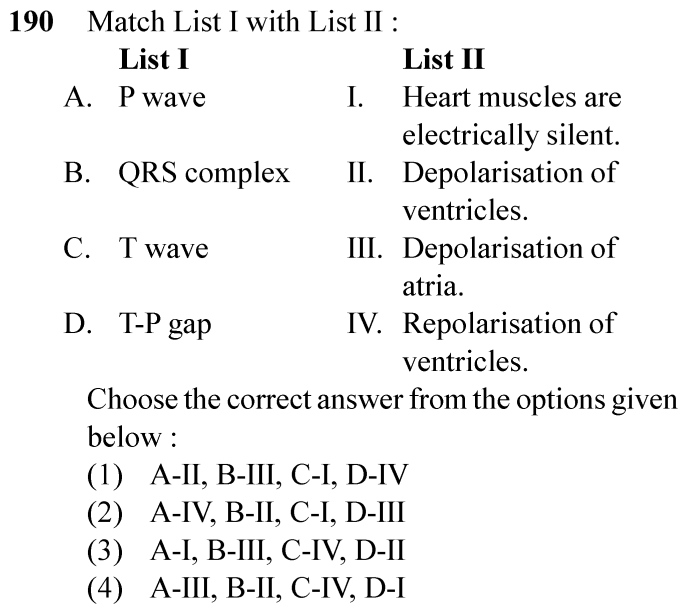
NEET 2024 Zoology Question 190: Standard ECG Deflection Waves and Corresponding Cardiac Phases

Question

Match List I with List II. List I: A. P wave; B. QRS complex; C. T wave; D. T-P gap. List II: I. Heart muscles are electrically silent; II. Depolarisation of ventricles; III. Depolarisation of atria; IV. Repolarisation of ventricles. Choose the correct answer from the options given below:

✓
Verified Against NTA Final Answer Key
Option (4) : A-III, B-II, C-IV, D-I
📚 Body Fluids and Circulation Easy
📋 Given Parameters & Problem Setup
List I (ECG Deflections) A: P wave; B: QRS complex; C: T wave; D: T-P gap
List II (Electrophysiological Events) I: Heart muscles are electrically silent; II: Depolarisation of ventricles; III: Depolarisation of atria; IV: Repolarisation of ventricles
⚡

The 30-Second Exam Hall Shortcut: ⚡ ECG Wave Diagnostic Match

⏱️ Save ~25 seconds

P wave = Atrial depolarisation (III); QRS = Ventricular depolarisation (II); T wave = Ventricular repolarisation (IV); T-P gap = Electrical silence / diastole (I)! Match: A-III, B-II, C-IV, D-I!

1 A. P wave: Electrical excitation / Depolarisation of the atria (III).
2 B. QRS complex: Depolarisation of the ventricles initiating ventricular systole (II).
3 C. T wave: Return of ventricles from excited to normal state / Repolarisation of ventricles (IV).
4 D. T-P gap: Period between ventricular repolarisation and next atrial depolarisation during which the heart is in joint diastole / electrically silent (I).
5 Matching order: A-III, B-II, C-IV, D-I -> Option (4) / D.
🛡️
Why You Can 100% Trust This Shortcut: NCERT Biology · Body Fluids and Circulation (Electrocardiograph and ECG Waves)
📐

Step-by-Step Rigorous Workflow & Mathematical Proof

Step 1

Review Classical Electrocardiogram (ECG) Waves

Each peak in the ECG is identified with a letter from P to T that corresponds to a specific electrical activity of the heart: - The P-wave represents the electrical excitation (or depolarisation) of the atria, which leads to the contraction of both the atria (A -> III). - The QRS complex represents the depolarisation of the ventricles, which initiates the ventricular contraction (B -> II). - The T-wave represents the return of the ventricles from excited to normal state (repolarisation) (C -> IV).

Step 2

Define the T-P Interval / Gap

The interval between the end of the T wave and the beginning of the next P wave (T-P segment) represents the period of complete cardiac relaxation (joint diastole) during which ventricles and atria are relaxing and the heart is electrically silent (D -> I).

Step 3

Select Matching Combination

A-III, B-II, C-IV, D-I corresponds to Option (4).

⭐

360° Option Elimination Engine Key Feature

Diagnose every choice: Know exactly why the right option works and why distractors fail.

4-Option Deep Scan
1 (1)
✗ Incorrect
Verdict & Scientific Reason:

Mismatches P wave with ventricular depolarisation.

⚠️
Student Fallacy (Why candidates pick this trap): Mismatches P wave with ventricular depolarisation.
2 (2)
✗ Incorrect
Verdict & Scientific Reason:

Mismatches P wave with ventricular repolarisation.

⚠️
Student Fallacy (Why candidates pick this trap): Mismatches P wave with ventricular repolarisation.
3 (3)
✗ Incorrect
Verdict & Scientific Reason:

Mismatches P wave with electrical silence.

⚠️
Student Fallacy (Why candidates pick this trap): Mismatches P wave with electrical silence.
4 (4)
✓ 100% Correct
Verdict & Scientific Reason:

Accurately pairs all four ECG features with their definitive electrophysiological events.

💡
Why this is airtight: None.
⚠️

NTA Trap Alert: T Wave vs QRS Repolarisation

Confusing atrial repolarisation with the T wave.

🛡️ How to avoid the -1 mark: Atrial repolarisation is buried inside the large QRS complex; the T wave specifically represents VENTRICULAR repolarisation.
📖

Core NEET Syllabus Standard

Biology Core Zoology · Body Fluids and Circulation Standard Benchmark
Core Scientific Principle Tested:

"The P-wave represents the electrical excitation (or depolarisation) of the atria... The QRS complex represents the depolarisation of the ventricles... The T-wave represents the return of the ventricles from excited to normal state (repolarisation)."

Syllabus Focus: Standard ECG Deflection Waves and Corresponding Cardiac Phases
✓ Core NEET UG Syllabus Anchor Syllabus & Academic Standards ↗

Ready to attempt under real exam pressure?

Test your speed and accuracy in the authentic 200-minute timed NTA simulator.

Launch NEET 2024 CBT Test →

Spotted a mistake in this solution? Report an error (support@mycompetitiveexams.com)

⚖️ Legal & Fair Dealing Notice: Sourced from publicly released NEET 2024 question papers and NEET answer keys for private study, research, and non-commercial educational practice under Fair Dealing (Section 52(1)(a) of the Indian Copyright Act, 1957). Not affiliated with or endorsed by NTA or NMC.

Solve 4 NEET Questions a Day — One per Subject

Cover all 1,140 official NEET questions in 285 days at your own pace. Progress is saved on your device. No login needed.