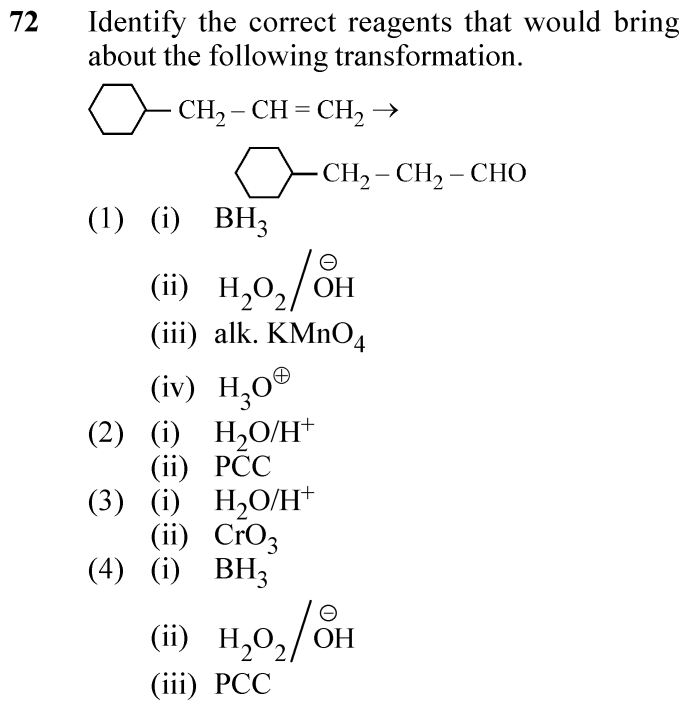
Terminal Alkene -> Primary Alcohol via Hydroboration-Oxidation (BH3, then H2O2/OH⁻), followed by PCC to halt oxidation at the ALDEHYDE stage!
1 The transformation converts a terminal alkene (-CH=CH2) into an aldehyde (-CH2-CHO).
2 Step 1 must install an -OH group at the TERMINAL carbon (anti-Markovnikov addition of water).
3 Acid-catalyzed hydration (H2O / H⁺) would give a secondary alcohol via Markovnikov rule (ruling out Options 2 and 3).
4 Hydroboration-oxidation: (i) BH3 followed by (ii) alkaline H2O2 produces the primary alcohol 3-cyclohexylpropan-1-ol.
5 Step 2 requires selective oxidation of the 1° alcohol to an aldehyde. Alkaline KMnO4 in Option (1) over-oxidizes it to a carboxylic acid!
6 Pyridinium chlorochromate (PCC) cleanly stops oxidation at the aldehyde.
7 Sequence: (i) BH3, (ii) H2O2/OH⁻, (iii) PCC -> Option (4) in 10 seconds!
🛡️ Why You Can 100% Trust This Shortcut: NCERT Chemistry · Aldehydes, Ketones and Carboxylic Acids (Preparation of aldehydes by oxidation of primary alcohols using PCC and hydroboration-oxidation).
⚠️
To obtain an aldehyde from an alkene, the oxygen must attach to the terminal carbon. Only hydroboration-oxidation gives anti-Markovnikov addition of water.
🛡️ How to avoid the -1 mark: Terminal alkene -> Aldehyde requires BH3/H2O2 + PCC. Terminal alkene -> Ketone uses H3O+ + oxidant.
📖
Chemistry Core Organic Chemistry · Aldehydes, Ketones and Carboxylic Acids Standard Benchmark
Core Scientific Principle Tested:
"Hydroboration-oxidation converts terminal alkenes into primary alcohols, which are selectively converted into aldehydes using PCC in non-aqueous medium."
Syllabus Focus: Selective Oxidation of Alcohols to Aldehydes (PCC Reagent)
Hydroborate to terminal OH, PCC stops oxidation at the CHO!