MyCompetitiveExams Logo MyCompetitiveExams
Search 1,140+ Questions
Chapters, formulas, speed tricks
→
⚡ Brahmastra NEET 2027
720 MARKS

Dynamic 180-question full-length simulator mixed dynamically from all 6 years for 2027 & 2026 aspirants.

Launch Brahmastra 2027 Test →
Start Practice →
100% Free · No Login Required
Q.192 Zoology ⭐ 360° Option Elimination Active
Vault ↗

NEET 2024 Zoology Question 192 Solution

Topic: Structural Organisation in Animals · Official NTA Booklet Code T1
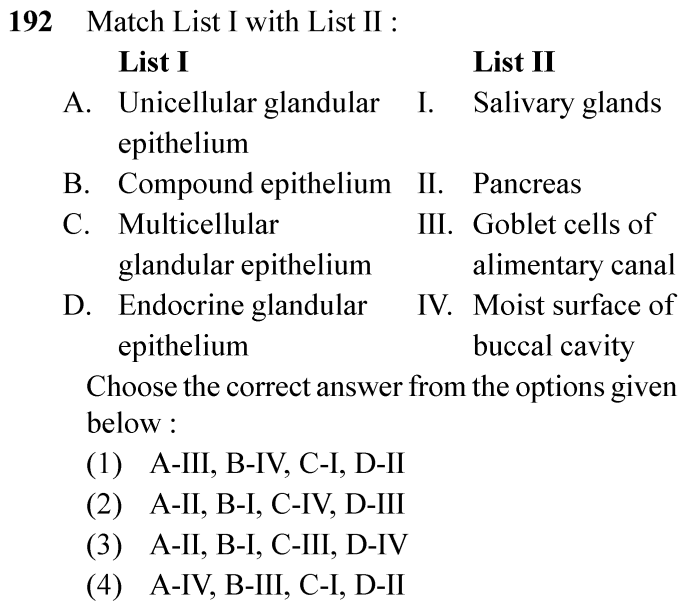
NEET 2024 Zoology Question 192: Classification of Glandular and Compound Epithelial Tissues

Question

Match List I with List II. List I: A. Unicellular glandular epithelium; B. Compound epithelium; C. Multicellular glandular epithelium; D. Endocrine glandular epithelium. List II: I. Salivary glands; II. Pancreas; III. Goblet cells of alimentary canal; IV. Moist surface of buccal cavity. Choose the correct answer from the options given below:

✓
Verified Against NTA Final Answer Key
Option (1) : A-III, B-IV, C-I, D-II
📚 Structural Organisation in Animals Easy
📋 Given Parameters & Problem Setup
List I (Epithelial Types) A: Unicellular glandular epithelium; B: Compound epithelium; C: Multicellular glandular epithelium; D: Endocrine glandular epithelium
List II (Anatomical Locations / Examples) I: Salivary glands; II: Pancreas; III: Goblet cells of alimentary canal; IV: Moist surface of buccal cavity
⚡

The 30-Second Exam Hall Shortcut: ⚡ Epithelial Tissue Classification Match

⏱️ Save ~25 seconds

Unicellular glands = Goblet cells (III); Compound epithelium = Buccal cavity (protection IV); Multicellular glands = Salivary glands (I); Endocrine glands = Pancreas (islets II)! Match: A-III, B-IV, C-I, D-II!

1 A. Unicellular glandular epithelium: Isolated glandular cells such as Goblet cells of alimentary canal (III).
2 B. Compound epithelium: Multi-layered protective tissue covering moist surface of buccal cavity and pharynx (IV).
3 C. Multicellular glandular epithelium: Cluster of cells forming salivary glands (I).
4 D. Endocrine glandular epithelium: Ductless hormone-secreting tissue, e.g., endocrine pancreas (Islets of Langerhans) (II).
5 Matching order: A-III, B-IV, C-I, D-II -> Option (1) / A.
🛡️
Why You Can 100% Trust This Shortcut: NCERT Biology · Structural Organisation in Animals (Epithelial Tissue Classification)
📐

Step-by-Step Rigorous Workflow & Mathematical Proof

Step 1

Review Glandular Epithelium Classification

Glandular epithelium is classified into two types based on the number of cells: - Unicellular: consisting of isolated glandular cells, like goblet cells of the alimentary canal (A -> III). - Multicellular: consisting of cluster of cells, like salivary glands (C -> I).

Step 2

Review Compound and Endocrine Epithelium

Compound epithelium is made of more than one layer (multi-layered) of cells and thus has a limited role in secretion and absorption. Its main function is to provide protection against chemical and mechanical stresses. They cover the dry surface of the skin, the moist surface of buccal cavity, pharynx, inner lining of ducts of salivary glands and of pancreatic ducts (B -> IV). Endocrine glands do not have ducts; their products called hormones are secreted directly into the fluid bathing the gland, exemplified by the endocrine islets of the pancreas (D -> II).

Step 3

Confirm Match

A-III, B-IV, C-I, D-II corresponds to Option (1).

⭐

360° Option Elimination Engine Key Feature

Diagnose every choice: Know exactly why the right option works and why distractors fail.

4-Option Deep Scan
1 (1)
✓ 100% Correct
Verdict & Scientific Reason:

Accurately pairs all four epithelial configurations with their precise histological locations from NCERT.

💡
Why this is airtight: None.
2 (2)
✗ Incorrect
Verdict & Scientific Reason:

Mismatches Unicellular gland with Pancreas and Compound epithelium with Salivary glands.

⚠️
Student Fallacy (Why candidates pick this trap): Mismatches Unicellular gland with Pancreas and Compound epithelium with Salivary glands.
3 (3)
✗ Incorrect
Verdict & Scientific Reason:

Mismatches Unicellular gland with Pancreas.

⚠️
Student Fallacy (Why candidates pick this trap): Mismatches Unicellular gland with Pancreas.
4 (4)
✗ Incorrect
Verdict & Scientific Reason:

Mismatches Unicellular gland with buccal cavity.

⚠️
Student Fallacy (Why candidates pick this trap): Mismatches Unicellular gland with buccal cavity.
⚠️

NTA Trap Alert: Goblet Cells vs Salivary Glands Cellularity

Confusing unicellular vs multicellular glandular structures.

🛡️ How to avoid the -1 mark: Goblet cells are UNICELLULAR; Salivary glands are MULTICELLULAR.
📖

Core NEET Syllabus Standard

Biology Core Zoology · Structural Organisation in Animals Standard Benchmark
Core Scientific Principle Tested:

"Glandular epithelium is mainly of two types: unicellular, consisting of isolated glandular cells (goblet cells of alimentary canal), and multicellular, consisting of cluster of cells (salivary gland)... Compound epithelium covers the moist surface of buccal cavity."

Syllabus Focus: Classification of Glandular and Compound Epithelial Tissues
✓ Core NEET UG Syllabus Anchor Syllabus & Academic Standards ↗

Ready to attempt under real exam pressure?

Test your speed and accuracy in the authentic 200-minute timed NTA simulator.

Launch NEET 2024 CBT Test →

Spotted a mistake in this solution? Report an error (support@mycompetitiveexams.com)

⚖️ Legal & Fair Dealing Notice: Sourced from publicly released NEET 2024 question papers and NEET answer keys for private study, research, and non-commercial educational practice under Fair Dealing (Section 52(1)(a) of the Indian Copyright Act, 1957). Not affiliated with or endorsed by NTA or NMC.

Solve 4 NEET Questions a Day — One per Subject

Cover all 1,140 official NEET questions in 285 days at your own pace. Progress is saved on your device. No login needed.