📋 Given Parameters & Problem Setup
Isomers n-pentane, isopentane (2-methylbutane), neopentane (2,2-dimethylpropane)
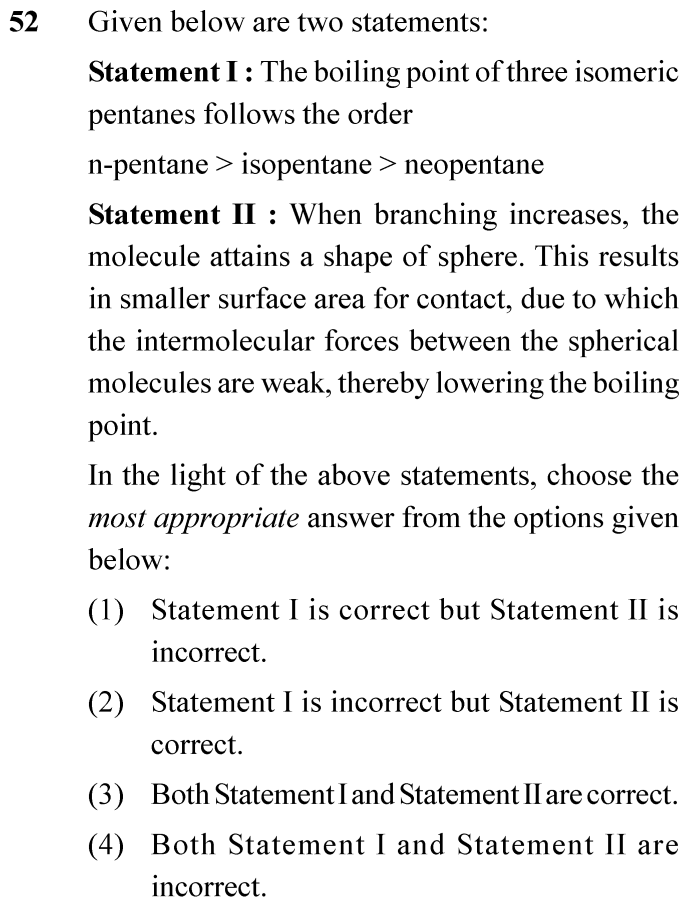
Statement I Boiling point order: n-pentane > isopentane > neopentane
Statement II Branching gives spherical shape, smaller surface area, weaker intermolecular forces, lowering boiling point
More Branches -> More Spherical -> Minimum Surface Area -> Weakest van der Waals forces -> Lowest Boiling Point!
1 n-pentane has a continuous straight chain with maximal surface area of contact (b.p. = 309.1 K).
2 isopentane has one methyl branch (b.p. = 301 K).
3 neopentane is highly branched and symmetrical, adopting a nearly spherical shape with minimal surface area (b.p. = 282.5 K).
4 Boiling point sequence: n-pentane > isopentane > neopentane -> Statement I is TRUE.
5 Statement II provides the exact theoretical rationale -> Statement II is TRUE.
6 Both statements are correct -> Option (3)!
🛡️ Why You Can 100% Trust This Shortcut: NCERT Chemistry · Hydrocarbons (Intermolecular forces and physical properties of isomeric alkanes).
⚠️
Neopentane has a high melting point (256.5 K) due to crystal packing symmetry, but its boiling point is the lowest (282.5 K) due to low surface area.
🛡️ How to avoid the -1 mark: Distinguish liquid vaporization (surface contact area governs boiling point) from crystal lattice packing (symmetry governs melting point).
📖
Chemistry Core Organic Chemistry · Hydrocarbons Standard Benchmark
Core Scientific Principle Tested:
"Among isomeric alkanes, straight-chain isomers have higher boiling points than branched-chain isomers due to greater van der Waals contact area."
Syllabus Focus: Alkanes: Physical Properties and Intermolecular Forces
Branches make a ball, balls touch the least, boiling drops fast when branches increase!