MyCompetitiveExams Logo MyCompetitiveExams
Search 1,140+ Questions
Chapters, formulas, speed tricks
→
⚡ Brahmastra NEET 2027
720 MARKS

Dynamic 180-question full-length simulator mixed dynamically from all 6 years for 2027 & 2026 aspirants.

Launch Brahmastra 2027 Test →
Start Practice →
100% Free · No Login Required
Q.41 Physics · Section B ⭐ 360° Option Elimination Active
Vault ↗

NEET 2024 Physics Question 41 Solution

Topic: Motion in a Straight Line · Official NTA Booklet Code T1
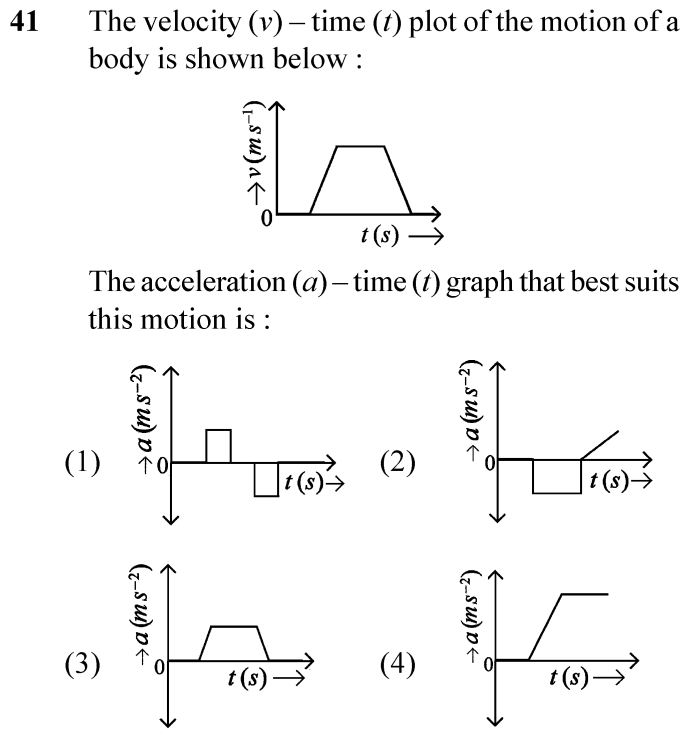
NEET 2024 Physics Question 41: Converting a Velocity-Time Plot into an Acceleration-Time Graph

Question

The velocity (v) – time (t) plot of the motion of a body is shown below. The acceleration (a) – time (t) graph that best suits this motion is:

✓
Verified Against NTA Final Answer Key
Option (1) : Graph showing zero, positive rectangular pulse, zero, negative rectangular pulse, zero
📚 Motion in a Straight Line Easy
📋 Given Parameters & Problem Setup
Initial stage v = 0 for initial time interval
Stage 1 Linear increase in v (positive constant slope)
Stage 2 Flat plateau (constant velocity, zero slope)
Stage 3 Linear decrease in v (negative constant slope)
Final stage v = 0
⚡

The 30-Second Exam Hall Shortcut: ⚡ Slope-to-Acceleration Step Rule

⏱️ Save ~40 seconds

Acceleration is the slope of v-t curve! Slope is (+const) -> zero -> (-const) -> Matches Graph (1) with positive pulse, zero, negative pulse!

1 Recall that acceleration is the derivative (slope) of the velocity-time graph: a = dv/dt.
2 First segment: v increases at a constant rate -> Slope is a POSITIVE constant (rectangular block above axis).
3 Second segment: v is constant (horizontal line) -> Slope dv/dt = 0 (a = 0 on axis).
4 Third segment: v decreases at a constant rate -> Slope is a NEGATIVE constant (rectangular block below axis).
5 Only Graph (1) displays this sequence: positive pulse, zero, negative pulse!
6 Option (1) in under 5 seconds!
🛡️
Why You Can 100% Trust This Shortcut: Calculus Definition of Linear Acceleration (a = dv/dt = instantaneous slope of v-t graph).
📐

Step-by-Step Rigorous Workflow & Mathematical Proof

Step 1

Mathematical Relation Between v-t and a-t Graphs

The instantaneous acceleration a(t) is the first time derivative of velocity, which corresponds graphically to the slope of the tangent to the velocity-time graph at that instant:

a(t)=dvdta(t) = \frac{dv}{dt}
Step 2

Segment-by-Segment Slope Analysis

Analyzing the given trapezoidal v-t curve: 1. 0≤t<t10 \le t < t_1: v=0  ⟹  a=0v = 0 \implies a = 0. 2. t1≤t<t2t_1 \le t < t_2: vv is an upward inclined straight line with constant positive slope: a=dvdt=+a0=constant>0a = \frac{dv}{dt} = +a_0 = \text{constant} > 0 3. t2≤t<t3t_2 \le t < t_3: vv is a horizontal plateau with zero slope: a=dvdt=0a = \frac{dv}{dt} = 0 4. t3≤t<t4t_3 \le t < t_4: vv is a downward inclined straight line with constant negative slope: a=dvdt=−a0=constant<0a = \frac{dv}{dt} = -a_0 = \text{constant} < 0 5. t≥t4t \ge t_4: v=0  ⟹  a=0v = 0 \implies a = 0.

a(t)={+a0t1≤t<t20t2≤t<t3−a0t3≤t<t4a(t) = \begin{cases} +a_0 & t_1 \le t < t_2 \\ 0 & t_2 \le t < t_3 \\ -a_0 & t_3 \le t < t_4 \end{cases}
Step 3

Matching with Option Graphs

The corresponding a-t graph consists of a positive rectangular pulse, followed by a flat zero line, followed by an equal negative rectangular pulse below the time axis. This uniquely matches Graph (1).

Graph (1) is the exact match\text{Graph (1) is the exact match}
⭐

360° Option Elimination Engine Key Feature

Diagnose every choice: Know exactly why the right option works and why distractors fail.

4-Option Deep Scan
1 (1)
✓ 100% Correct
Verdict & Scientific Reason:

Accurately represents the piecewise constant slopes of the v-t graph.

💡
Why this is airtight: None.
2 (2)
✗ Incorrect
Verdict & Scientific Reason:

Inverts the sign of the initial acceleration.

⚠️
Student Fallacy (Why candidates pick this trap): Assuming initial motion is retarding.
3 (3)
✗ Incorrect
Verdict & Scientific Reason:

This would represent the derivative of a cubic velocity profile, not piecewise linear.

⚠️
Student Fallacy (Why candidates pick this trap): Copying the shape of the v-t graph directly onto the a-t graph.
4 (4)
✗ Incorrect
Verdict & Scientific Reason:

Entirely above axis; ignores deceleration.

⚠️
Student Fallacy (Why candidates pick this trap): Failing to realize that slowing down produces negative acceleration.
⚠️

NTA Trap Alert: Shape-Copying Fallacy

Untrained students often pick Graph (3) because its trapezoidal shape resembles the given v-t curve.

🛡️ How to avoid the -1 mark: The derivative of a linear ramp (slope) is a FLAT CONSTANT (rectangle), not another ramp!
📖

Core NEET Syllabus Standard

Physics Core Kinematics · Motion in a Straight Line Standard Benchmark
Core Scientific Principle Tested:

"The acceleration-time graph is the derivative of the velocity-time graph; straight-line segments with constant slope become constant horizontal steps in the a-t graph."

Syllabus Focus: Kinematic Graphs and Slope Relationships
✓ Core NEET UG Syllabus Anchor Syllabus & Academic Standards ↗
Ramp up is positive block; Flat is zero clock; Ramp down is negative shock!

Ready to attempt under real exam pressure?

Test your speed and accuracy in the authentic 200-minute timed NTA simulator.

Launch NEET 2024 CBT Test →

Spotted a mistake in this solution? Report an error (support@mycompetitiveexams.com)

⚖️ Legal & Fair Dealing Notice: Sourced from publicly released NEET 2024 question papers and NEET answer keys for private study, research, and non-commercial educational practice under Fair Dealing (Section 52(1)(a) of the Indian Copyright Act, 1957). Not affiliated with or endorsed by NTA or NMC.

Solve 4 NEET Questions a Day — One per Subject

Cover all 1,140 official NEET questions in 285 days at your own pace. Progress is saved on your device. No login needed.