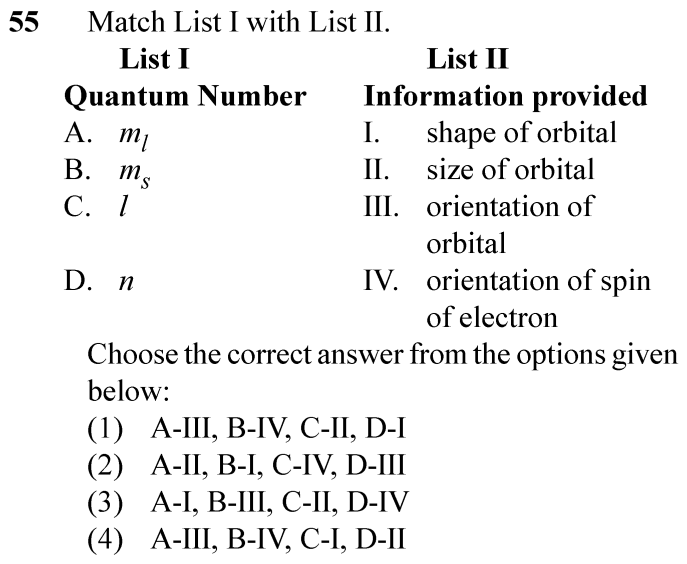
📋 Given Parameters & Problem Setup
Quantum Number A m_l (magnetic quantum number)
Quantum Number B m_s (spin quantum number)
Quantum Number C l (azimuthal / orbital angular momentum quantum number)
Quantum Number D n (principal quantum number)
n = Size & energy (II); l = Shape of subshell (I); m_l = Spatial orientation of orbital (III); m_s = Electron spin direction (IV)!
1 Principal quantum number n determines shell size and primary energy level -> D-II.
2 Azimuthal quantum number l determines orbital angular momentum and three-dimensional shape (s=sphere, p=dumbbell, d=cloverleaf) -> C-I.
3 Magnetic quantum number m_l determines spatial orientation of the orbital in space relative to coordinate axes -> A-III.
4 Spin quantum number m_s determines the orientation of intrinsic electron spin (+1/2 or -1/2) -> B-IV.
5 Perfect match: A-III, B-IV, C-I, D-II -> Option (4) in 5 seconds!
🛡️ Why You Can 100% Trust This Shortcut: NCERT Chemistry · Structure of Atom (Quantum numbers and their physical significance).
⚠️
Both ml and ms use the word "orientation". ml is the orientation of the orbital in space, while ms is the orientation of the electron’s intrinsic spin axis.
🛡️ How to avoid the -1 mark: Check the object being oriented: orbital orientation = ml; electron spin orientation = ms.
📖
Chemistry Core Physical Chemistry · Structure of Atom Standard Benchmark
Core Scientific Principle Tested:
"The state of an electron in an atom is completely described by four quantum numbers: n (size/shell), l (shape/subshell), ml (spatial orientation), and ms (spin orientation)."
Syllabus Focus: Quantum Mechanical Model of the Atom: Quantum Numbers
n = Number (Size), l = Lines (Shape), ml = Magnetic alignment (Orientation), ms = Spin!