MyCompetitiveExams Logo MyCompetitiveExams
Search 1,140+ Questions
Chapters, formulas, speed tricks
→
⚡ Brahmastra NEET 2027
720 MARKS

Dynamic 180-question full-length simulator mixed dynamically from all 6 years for 2027 & 2026 aspirants.

Launch Brahmastra 2027 Test →
Start Practice →
100% Free · No Login Required
Q.49 Physics · Section B ⭐ 360° Option Elimination Active
Vault ↗

NEET 2024 Physics Question 49 Solution

Topic: Magnetism and Matter · Official NTA Booklet Code T1
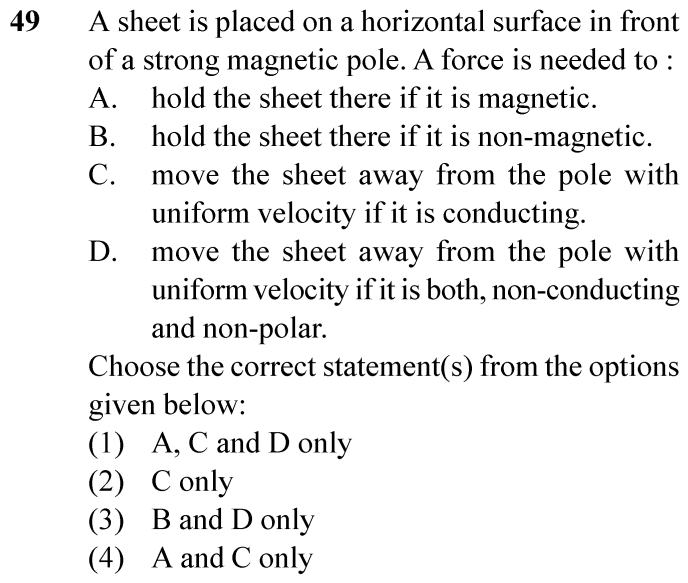
NEET 2024 Physics Question 49: Forces on Magnetic, Conducting, and Non-Conducting Sheets Near a Magnetic Pole

Question

A sheet is placed on a horizontal surface in front of a strong magnetic pole. A force is needed to: A. hold the sheet there if it is magnetic. B. hold the sheet there if it is non-magnetic. C. move the sheet away from the pole with uniform velocity if it is conducting. D. move the sheet away from the pole with uniform velocity if it is both, non-conducting and non-polar. Choose the correct statement(s) from the options given below:

✓
Verified Against NTA Final Answer Key
Option (4) : A and C only
📚 Magnetism and Matter Medium
📋 Given Parameters & Problem Setup
Setup Sheet placed on a horizontal surface in front of a strong magnetic pole
Statement A Force is needed to hold the sheet there if it is magnetic.
Statement B Force is needed to hold the sheet there if it is non-magnetic.
Statement C Force is needed to move the sheet away from the pole with uniform velocity if it is conducting.
Statement D Force is needed to move the sheet away from the pole with uniform velocity if it is both, non-conducting and non-polar.
⚡

The 30-Second Exam Hall Shortcut: ⚡ Magnetic Attraction & Eddy Damping Rule

⏱️ Save ~45 seconds

Magnetic sheet gets attracted -> needs force to hold (A is TRUE). Moving a conductor in magnetic field induces opposing eddy currents -> needs force to maintain uniform velocity (C is TRUE) -> A and C only!

1 If sheet is magnetic (ferromagnetic/paramagnetic), the strong pole attracts it. To keep it stationary, an external holding force is required -> Statement A is TRUE.
2 If sheet is non-magnetic, magnetic attraction is zero -> No force needed to hold it -> Statement B is FALSE.
3 If sheet is conducting and moved away, magnetic flux decreases -> Eddy currents are induced.
4 By Lenz’s law, eddy currents exert an opposing retarding drag force -> To move it with uniform velocity, an external pulling force MUST be applied to balance this drag -> Statement C is TRUE.
5 If sheet is non-conducting and non-polar, no eddy currents and no polarization forces exist -> No force needed for uniform velocity -> Statement D is FALSE.
6 Correct combination is A and C only -> Option (4) in under 20 seconds!
🛡️
Why You Can 100% Trust This Shortcut: Faraday-Lenz Law of Induction & Eddy Current Damping Mechanics.
📐

Step-by-Step Rigorous Workflow & Mathematical Proof

Step 1

Analysis of Statement A (Holding a Magnetic Sheet)

A magnetic sheet (such as iron or ferromagnetic alloy) in the non-uniform magnetic field of a strong magnetic pole experiences a strong net attractive force directed toward the pole. To hold the sheet at rest, an external restraining force must be applied in the opposite direction to balance this magnetic attraction:

F⃗ext=−F⃗magnetic≠0  ⟹  Statement A is True\vec{F}_{ext} = -\vec{F}_{magnetic} \ne 0 \implies \text{Statement A is True}
Step 2

Analysis of Statement B (Holding a Non-Magnetic Sheet)

A non-magnetic sheet experiences no static magnetic force in the field. In the absence of friction on the horizontal surface, no external force is needed to keep it stationary:

F⃗magnetic=0  ⟹  F⃗ext=0  ⟹  Statement B is False\vec{F}_{magnetic} = 0 \implies \vec{F}_{ext} = 0 \implies \text{Statement B is False}
Step 3

Analysis of Statement C (Moving a Conducting Sheet)

When a conducting sheet is moved away from the magnetic pole, the magnetic flux penetrating the sheet decreases with time (dΦ_B/dt ≠ 0). By Faraday’s law of induction and Lenz’s law, circulating eddy currents are induced in the metallic sheet. These eddy currents interact with the magnetic field to produce an opposing magnetic Lorentz drag force (electromagnetic damping) opposing the motion. To maintain a uniform velocity (zero net acceleration), an external force must be continuously exerted to overcome this eddy current drag:

F⃗eddy∝−v⃗  ⟹  F⃗ext=−F⃗eddy≠0  ⟹  Statement C is True\vec{F}_{eddy} \propto -\vec{v} \implies \vec{F}_{ext} = -\vec{F}_{eddy} \ne 0 \implies \text{Statement C is True}
Step 4

Analysis of Statement D (Moving a Non-Conducting, Non-Polar Sheet)

In a non-conducting and non-polar sheet, free charge carriers are absent, so no eddy currents can flow. Furthermore, absence of permanent or induced dipole moments means no electromagnetic retarding force acts. By Newton’s first law, the sheet moves at uniform velocity without any external force:

F⃗ext=0  ⟹  Statement D is False\vec{F}_{ext} = 0 \implies \text{Statement D is False}
Step 5

Synthesis

Statements A and C are correct, which corresponds directly to Option (4).

Statements A and C only\text{Statements A and C only}
⭐

360° Option Elimination Engine Key Feature

Diagnose every choice: Know exactly why the right option works and why distractors fail.

4-Option Deep Scan
1 (1)
✗ Incorrect
Verdict & Scientific Reason:

Statement D is false; non-conducting non-polar sheets experience no drag.

⚠️
Student Fallacy (Why candidates pick this trap): Believing all moving objects in magnetic fields experience drag.
2 (2)
✗ Incorrect
Verdict & Scientific Reason:

Omit Statement A, which is an indisputable static magnetic fact.

⚠️
Student Fallacy (Why candidates pick this trap): Focusing exclusively on dynamic electromagnetic induction.
3 (3)
✗ Incorrect
Verdict & Scientific Reason:

Both B and D are completely false.

⚠️
Student Fallacy (Why candidates pick this trap): Total inversion of physical concepts.
4 (4)
✓ 100% Correct
Verdict & Scientific Reason:

Rigorous physics: Static magnetic attraction requires holding force (A); Eddy current damping requires pulling force (C).

💡
Why this is airtight: None.
⚠️

NTA Trap Alert: Forgetting Eddy Current Drag on Non-Magnetic Conductors

Students frequently think copper or aluminum sheets experience no force because they are non-magnetic, forgetting that moving conductors generate EDDY CURRENTS!

🛡️ How to avoid the -1 mark: A moving conductor always cuts flux lines -> Eddy currents oppose motion (electromagnetic braking).
📖

Core NEET Syllabus Standard

Physics Core Electromagnetism · Electromagnetic Induction Standard Benchmark
Core Scientific Principle Tested:

"Movement of a conductor across magnetic flux gradients induces eddy currents that oppose motion (Lenz’s law); static magnetic materials experience attractive force."

Syllabus Focus: Eddy Currents and Electromagnetic Damping
✓ Core NEET UG Syllabus Anchor Syllabus & Academic Standards ↗
Static magnet pulls (A); Moving metal brakes (C) -> A and C make no mistake!

Ready to attempt under real exam pressure?

Test your speed and accuracy in the authentic 200-minute timed NTA simulator.

Launch NEET 2024 CBT Test →

Spotted a mistake in this solution? Report an error (support@mycompetitiveexams.com)

⚖️ Legal & Fair Dealing Notice: Sourced from publicly released NEET 2024 question papers and NEET answer keys for private study, research, and non-commercial educational practice under Fair Dealing (Section 52(1)(a) of the Indian Copyright Act, 1957). Not affiliated with or endorsed by NTA or NMC.

Solve 4 NEET Questions a Day — One per Subject

Cover all 1,140 official NEET questions in 285 days at your own pace. Progress is saved on your device. No login needed.