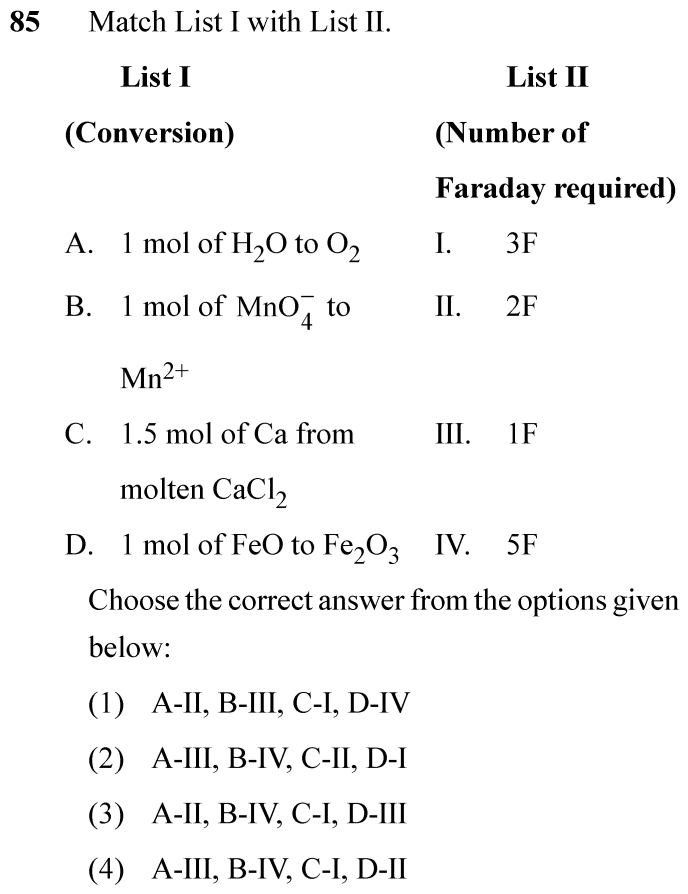
📋 Given Parameters & Problem Setup
Conversion A 1 mol of H2O to O2
Conversion B 1 mol of MnO4⁻ to Mn²⁺
Conversion C 1.5 mol of Ca from molten CaCl2
Conversion D 1 mol of FeO to Fe2O3
Faradays required = (moles) × (electron transfer n)! H2O -> 1/2 O2 (2e⁻ -> 2F, II); MnO4⁻ -> Mn²⁺ (5e⁻ -> 5F, IV); 1.5 mol Ca²⁺ (1.5 × 2e⁻ -> 3F, I); 1 mol Fe²⁺ -> Fe³⁺ (1e⁻ -> 1F, III)!
1 Formula: Q = n_electrons × F for 1 mole of reaction.
2 Conversion A: H2O -> 1/2 O2 + 2 H⁺ + 2e⁻. Exactly 2 moles of electrons -> 2F (A-II).
3 Conversion B: Mn(+7)O4⁻ + 5e⁻ -> Mn²⁺. Oxidation state changes from +7 to +2 (5e⁻ transfer) -> 5F (B-IV).
4 Conversion C: Ca²⁺ + 2e⁻ -> Ca. 1 mole Ca requires 2F. For 1.5 moles Ca: 1.5 × 2 = 3F (C-I).
5 Conversion D: FeO (Fe²⁺) -> 1/2 Fe2O3 (Fe³⁺) + e⁻. Fe(+2) to Fe(+3) transfers 1e⁻ per mole of FeO -> 1F (D-III).
6 Match: A-II, B-IV, C-I, D-III -> Option (3) in 10 seconds!
🛡️ Why You Can 100% Trust This Shortcut: NCERT Chemistry · Electrochemistry (Faraday’s laws of electrolysis and charge required for oxidation/reduction).
⚠️
Producing 1 mol of O2 requires 4 F (from 2 mol H2O). But the question specifies 1 mol of H2O to O2 (which produces 1/2 mol O2), requiring exactly 2 F!
🛡️ How to avoid the -1 mark: Check the starting material: 1 mol of H2O has 1 oxygen atom (-2 -> 0), which releases 2 electrons = 2 F.
📖
Chemistry Core Physical Chemistry · Electrochemistry Standard Benchmark
Core Scientific Principle Tested:
"The quantity of electricity required for oxidation or reduction is given by Q = n × z × F, where z is the number of electrons involved in the half-reaction."
Syllabus Focus: Faraday’s Laws of Electrolysis: Quantitative Aspects of Electrolysis
H2O gives two, MnO4 gives five; Ca times one-and-a-half gives three, Fe gives one to thrive!