NEET 2024 Physics Question 23 Solution
Question
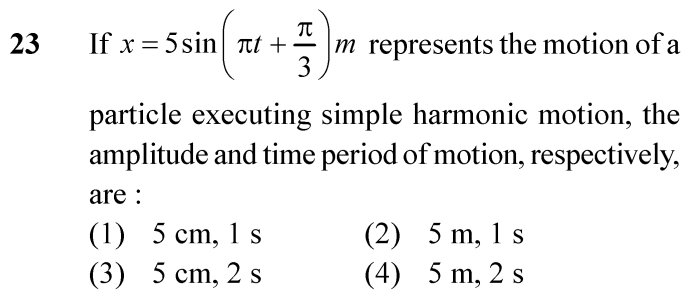
If x = 5 sin(πt + π/3) m represents the motion of a particle executing simple harmonic motion, the amplitude and time period of motion, respectively, are:
Dynamic 180-question full-length simulator mixed dynamically from all 6 years for 2027 & 2026 aspirants.
If x = 5 sin(πt + π/3) m represents the motion of a particle executing simple harmonic motion, the amplitude and time period of motion, respectively, are:
Compare x = A sin(ωt + φ): Amplitude A = 5 m; ω = π rad/s -> T = 2π/ω = 2π/π = 2 s -> (5 m, 2 s)!
The general displacement equation of a particle executing simple harmonic motion (SHM) along the x-axis is given by:
Comparing the given equation x = 5 sin(πt + π/3) m with the standard form: - Amplitude A = 5 m - Angular frequency ω = π rad/s - Initial phase angle φ = π/3 rad
The time period T for one complete oscillation is related to the angular frequency ω by:
Diagnose every choice: Know exactly why the right option works and why distractors fail.
Unit of amplitude is meters (m), not cm; period is 2 s, not 1 s.
Calculates period as 1 s instead of 2 s.
Amplitude unit error: writes 5 cm instead of 5 m.
Exact identification: Amplitude = 5 m, Time period = 2 s.
Options (1) and (3) set a trap with "5 cm" because students frequently skim past the unit "m" printed outside the bracket.
"In x = A sin(ωt + φ), A is the amplitude, ω is the angular frequency, and the period is T = 2π/ω."
Test your speed and accuracy in the authentic 200-minute timed NTA simulator.
Spotted a mistake in this solution? Report an error (support@mycompetitiveexams.com)
Cover all 1,140 official NEET questions in 285 days at your own pace. Progress is saved on your device. No login needed.