MyCompetitiveExams Logo MyCompetitiveExams
Search 1,140+ Questions
Chapters, formulas, speed tricks
→
⚡ Brahmastra NEET 2027
720 MARKS

Dynamic 180-question full-length simulator mixed dynamically from all 6 years for 2027 & 2026 aspirants.

Launch Brahmastra 2027 Test →
Start Practice →
100% Free · No Login Required
Q.15 Physics · Section A ⭐ 360° Option Elimination Active
Vault ↗

NEET 2024 Physics Question 15 Solution

Topic: Atoms · Official NTA Booklet Code T1
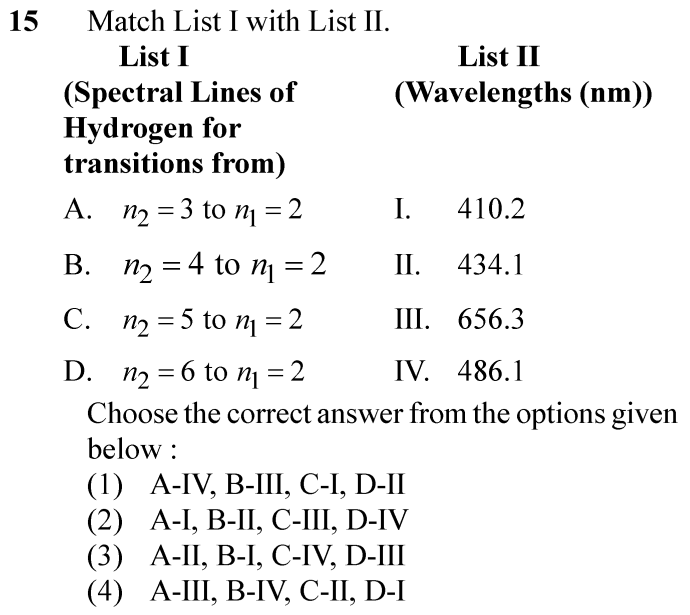
NEET 2024 Physics Question 15: Wavelengths of Balmer Spectral Lines in Hydrogen

Question

Match List I (Spectral Lines of Hydrogen for transitions from) with List II (Wavelengths (nm)). List I: A. n₂ = 3 to n₁ = 2; B. n₂ = 4 to n₁ = 2; C. n₂ = 5 to n₁ = 2; D. n₂ = 6 to n₁ = 2. List II: I. 410.2; II. 434.1; III. 656.3; IV. 486.1. Choose the correct answer from the options given below:

✓
Verified Against NTA Final Answer Key
Option (4) : A-III, B-IV, C-II, D-I
📚 Atoms Easy
📋 Given Parameters & Problem Setup
Spectral Series Balmer series with lower state n1 = 2
Transition A n2 = 3 to n1 = 2 (H-α line)
Transition B n2 = 4 to n1 = 2 (H-β line)
Transition C n2 = 5 to n1 = 2 (H-γ line)
Transition D n2 = 6 to n1 = 2 (H-δ line)
⚡

The 30-Second Exam Hall Shortcut: ⚡ Energy-Wavelength Inverse Ordering Hack

⏱️ Save ~50 seconds

Larger jump = higher photon energy = SHORTER wavelength! n2=3 is longest (656.3 nm) -> A-III -> Instant single-match!

1 In the Balmer series, transitions from higher n2 represent larger energy drops ΔE.
2 Since λ = hc / ΔE, higher n2 yields SHORTER wavelengths.
3 Transition A (n2 = 3 to 2) has the smallest energy gap, hence the LONGEST wavelength: 656.3 nm -> A must match III.
4 Looking at the options grid: Only Option (4) has A-III!
5 Solved in 5 seconds without calculating anything else!
🛡️
Why You Can 100% Trust This Shortcut: Rydberg Formula for Hydrogen Transitions (1/λ = R_H [1/n1² - 1/n2²]).
📐

Step-by-Step Rigorous Workflow & Mathematical Proof

Step 1

Governing Formula (Rydberg Formula)

For transitions in the hydrogen atom ending at n1 = 2 (the Balmer series in the visible spectrum), the wavelength λ is given by the Rydberg formula:

1λ=RH(122−1n22)=RH(14−1n22)\frac{1}{\lambda} = R_H \left(\frac{1}{2^2} - \frac{1}{n_2^2}\right) = R_H \left(\frac{1}{4} - \frac{1}{n_2^2}\right)
Step 2

Calculation for Transition A (n2 = 3 to n1 = 2, H-α line)

The transition from n2 = 3 to n1 = 2 has the smallest energy difference:

1λA=RH(14−19)=536RH  ⟹  λA=365RH≈656.3 nm  ⟹  A-III\frac{1}{\lambda_A} = R_H \left(\frac{1}{4} - \frac{1}{9}\right) = \frac{5}{36} R_H \implies \lambda_A = \frac{36}{5 R_H} \approx 656.3\,\text{nm} \implies \text{A-III}
Step 3

Calculation for Transition B (n2 = 4 to n1 = 2, H-β line)

The transition from n2 = 4 to n1 = 2 has intermediate energy:

1λB=RH(14−116)=316RH  ⟹  λB=163RH≈486.1 nm  ⟹  B-IV\frac{1}{\lambda_B} = R_H \left(\frac{1}{4} - \frac{1}{16}\right) = \frac{3}{16} R_H \implies \lambda_B = \frac{16}{3 R_H} \approx 486.1\,\text{nm} \implies \text{B-IV}
Step 4

Calculation for Transition C (n2 = 5 to n1 = 2, H-γ line)

The transition from n2 = 5 to n1 = 2:

1λC=RH(14−125)=21100RH  ⟹  λC≈434.1 nm  ⟹  C-II\frac{1}{\lambda_C} = R_H \left(\frac{1}{4} - \frac{1}{25}\right) = \frac{21}{100} R_H \implies \lambda_C \approx 434.1\,\text{nm} \implies \text{C-II}
Step 5

Calculation for Transition D (n2 = 6 to n1 = 2, H-δ line)

The highest energy transition in the set from n2 = 6 to n1 = 2 produces the shortest wavelength:

λD≈410.2 nm  ⟹  D-I\lambda_D \approx 410.2\,\text{nm} \implies \text{D-I}
⭐

360° Option Elimination Engine Key Feature

Diagnose every choice: Know exactly why the right option works and why distractors fail.

4-Option Deep Scan
1 (1)
✗ Incorrect
Verdict & Scientific Reason:

Mismatched wavelengths.

⚠️
Student Fallacy (Why candidates pick this trap): Associating A with the second longest wavelength.
2 (2)
✗ Incorrect
Verdict & Scientific Reason:

Inverts the wavelength relationship (assigns shortest wavelength to smallest transition).

⚠️
Student Fallacy (Why candidates pick this trap): Confusing wavelength with frequency/energy.
3 (3)
✗ Incorrect
Verdict & Scientific Reason:

Completely jumbled matching.

⚠️
Student Fallacy (Why candidates pick this trap): Guesswork without checking ordering.
4 (4)
✓ 100% Correct
Verdict & Scientific Reason:

Perfect monotonic match: smallest gap (n=3) has longest λ (656.3 nm), largest gap (n=6) has shortest λ (410.2 nm).

💡
Why this is airtight: None.
⚠️

NTA Trap Alert: Energy vs Wavelength Inverse Proportionality

Students frequently assign the highest wavelength to the highest energy transition (n=6 to 2).

🛡️ How to avoid the -1 mark: Always recite: E = hc / λ. Big energy gap = Tiny wavelength!
📖

Core NEET Syllabus Standard

Physics Core Modern Physics · Atoms Standard Benchmark
Core Scientific Principle Tested:

"The Balmer series corresponds to electron transitions to n1 = 2; wavelengths lie in the visible region from 656.3 nm (red, n2=3) to 364.6 nm (series limit)."

Syllabus Focus: Bohr’s Model of the Hydrogen Atom and Spectral Series
✓ Core NEET UG Syllabus Anchor Syllabus & Academic Standards ↗
Red (n=3) is Longest (656 nm); Violet (n=6) is Shortest (410 nm)!

Ready to attempt under real exam pressure?

Test your speed and accuracy in the authentic 200-minute timed NTA simulator.

Launch NEET 2024 CBT Test →

Spotted a mistake in this solution? Report an error (support@mycompetitiveexams.com)

⚖️ Legal & Fair Dealing Notice: Sourced from publicly released NEET 2024 question papers and NEET answer keys for private study, research, and non-commercial educational practice under Fair Dealing (Section 52(1)(a) of the Indian Copyright Act, 1957). Not affiliated with or endorsed by NTA or NMC.

Solve 4 NEET Questions a Day — One per Subject

Cover all 1,140 official NEET questions in 285 days at your own pace. Progress is saved on your device. No login needed.