MyCompetitiveExams Logo MyCompetitiveExams
Search 1,140+ Questions
Chapters, formulas, speed tricks
→
⚡ Brahmastra NEET 2027
720 MARKS

Dynamic 180-question full-length simulator mixed dynamically from all 6 years for 2027 & 2026 aspirants.

Launch Brahmastra 2027 Test →
Start Practice →
100% Free · No Login Required
Q.61 Chemistry · Section A ⭐ 360° Option Elimination Active
Vault ↗

NEET 2024 Chemistry Question 61 Solution

Topic: The p-Block Elements · Official NTA Booklet Code T1
NEET 2024 Chemistry Question 61: Boiling Points of Group 16 Hydrides and Anomalous Properties of Water

Question

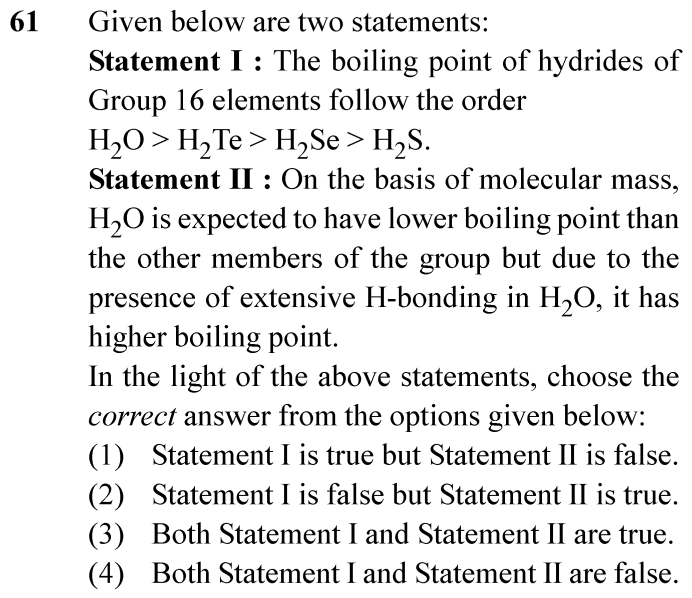
Given below are two statements: Statement I: The boiling point of hydrides of Group 16 elements follow the order H₂O > H₂Te > H₂Se > H₂S. Statement II: On the basis of molecular mass, H₂O is expected to have lower boiling point than the other members of the group but due to the presence of extensive H-bonding in H₂O, it has higher boiling point. In the light of the above statements, choose the correct answer from the options given below:

✓
Verified Against NTA Final Answer Key
Option (3) : Both Statement I and Statement II are true.
📚 The p-Block Elements Easy
📋 Given Parameters & Problem Setup
Group 16 Hydrides H2O, H2S, H2Se, H2Te
Statement I Boiling point order: H2O > H2Te > H2Se > H2S
Statement II On basis of molecular mass H2O is expected lower, but extensive H-bonding gives higher boiling point
⚡

The 30-Second Exam Hall Shortcut: ⚡ Group 16 Hydride Boiling Point V-Shape Hack

⏱️ Save ~35 seconds

H2O is anomalously highest due to strong intermolecular H-bonding; from H2S to H2Te boiling point increases with molar mass: H2O > H2Te > H2Se > H2S!

1 Experimental boiling points: H2O (373 K) >> H2Te (269 K) > H2Se (232 K) > H2S (213 K).
2 Statement I accurately reflects this exact sequence -> Statement I is TRUE.
3 H2O has the lowest molecular mass (18 g/mol) in the group, so London forces alone would predict the lowest boiling point.
4 However, high electronegativity and small size of oxygen produce extensive 3D intermolecular hydrogen bonding, raising boiling point anomalously to 373 K.
5 Statement II gives the exact canonical reason -> Statement II is TRUE.
6 Both statements are true -> Option (3) in 5 seconds!
🛡️
Why You Can 100% Trust This Shortcut: NCERT Chemistry · The p-Block Elements (Group 16 hydrides and physical property trends).
📐

Step-by-Step Rigorous Workflow & Mathematical Proof

Step 1

Analysis of Statement I (Empirical Boiling Point Values)

The measured boiling points of Group 16 hydrides are: - Water (H2O): 373 K - Hydrogen telluride (H2Te): 269 K - Hydrogen selenide (H2Se): 232 K - Hydrogen sulphide (H2S): 213 K The observed sequence is strictly: H2O > H2Te > H2Se > H2S. Statement I is correct.

Tb(H2O)  [373 K]>Tb(H2Te)  [269 K]>Tb(H2Se)  [232 K]>Tb(H2S)  [213 K]T_b(\text{H}_2\text{O}) \;[373\,\text{K}] > T_b(\text{H}_2\text{Te}) \;[269\,\text{K}] > T_b(\text{H}_2\text{Se}) \;[232\,\text{K}] > T_b(\text{H}_2\text{S}) \;[213\,\text{K}]
Step 2

Analysis of Statement II (Mechanistic Explanation)

For non-hydrogen bonding hydrides (H2S, H2Se, H2Te), boiling points increase regularly down the group as molecular mass and electron cloud polarizability increase, strengthening London dispersion forces. Based purely on molecular mass (18 g/mol), H2O should possess the weakest dispersion forces and lowest boiling point. However, each H2O molecule forms up to four strong intermolecular hydrogen bonds in a tetrahedral network, requiring substantial thermal energy to disrupt. Statement II is correct.

Extensive H-bonding in H2O  ⟹  ΔHvap≫Dispersion forces of heavier homologues\text{Extensive H-bonding in H}_2\text{O} \implies \Delta H_{vap} \gg \text{Dispersion forces of heavier homologues}
⭐

360° Option Elimination Engine Key Feature

Diagnose every choice: Know exactly why the right option works and why distractors fail.

4-Option Deep Scan
1 (1)
✗ Incorrect
Verdict & Scientific Reason:

Statement II is the standard textbook explanation for the anomalous boiling point of water.

⚠️
Student Fallacy (Why candidates pick this trap): Denying the role of hydrogen bonding.
2 (2)
✗ Incorrect
Verdict & Scientific Reason:

Statement I is factually accurate.

⚠️
Student Fallacy (Why candidates pick this trap): Assuming boiling points follow a monotonic increase H2S < H2Se < H2Te < H2O without checking relative positions.
3 (3)
✓ 100% Correct
Verdict & Scientific Reason:

Both the empirical order and physical explanation are 100% verified.

💡
Why this is airtight: None.
4 (4)
✗ Incorrect
Verdict & Scientific Reason:

Both statements are scientifically accurate.

⚠️
Student Fallacy (Why candidates pick this trap): Rejecting both statements.
⚠️

NTA Trap Alert: Assuming H2S has Higher Boiling Point than H2Te

Students sometimes think hydrogen bonding is present throughout the group. Only oxygen is electronegative enough for significant H-bonding; from S to Te, dispersion forces dominate (Te > Se > S).

🛡️ How to avoid the -1 mark: Remember the trend: H2O is at the peak, then the rest rise with molar mass: H2S (lowest) < H2Se < H2Te < H2O.
📖

Core NEET Syllabus Standard

Chemistry Core Inorganic Chemistry · The p-Block Elements Standard Benchmark
Core Scientific Principle Tested:

"H2O exhibits an anomalously high boiling point due to extensive intermolecular hydrogen bonding; for H2S, H2Se, and H2Te, boiling point increases with molecular mass."

Syllabus Focus: Group 16 Elements: Hydrides and Hydrogen Bonding
✓ Core NEET UG Syllabus Anchor Syllabus & Academic Standards ↗
Water leads the pack by far; then heavy Tellurium beats Selenium and Sulfur by molar mass star!

Ready to attempt under real exam pressure?

Test your speed and accuracy in the authentic 200-minute timed NTA simulator.

Launch NEET 2024 CBT Test →

Spotted a mistake in this solution? Report an error (support@mycompetitiveexams.com)

⚖️ Legal & Fair Dealing Notice: Sourced from publicly released NEET 2024 question papers and NEET answer keys for private study, research, and non-commercial educational practice under Fair Dealing (Section 52(1)(a) of the Indian Copyright Act, 1957). Not affiliated with or endorsed by NTA or NMC.

Solve 4 NEET Questions a Day — One per Subject

Cover all 1,140 official NEET questions in 285 days at your own pace. Progress is saved on your device. No login needed.