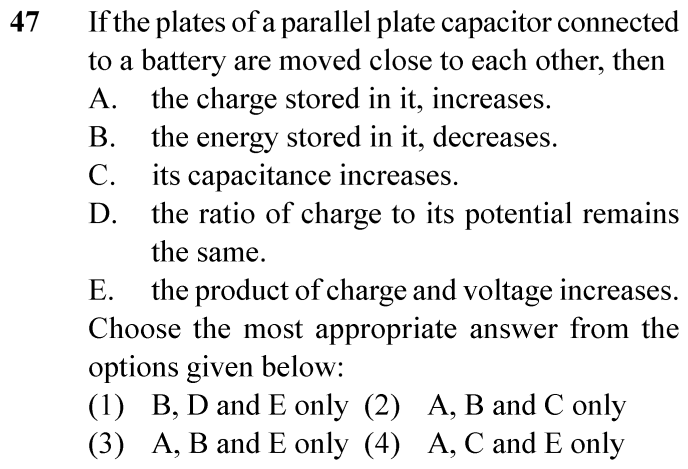
d decreases -> C = ε₀A/d INCREASES (C is true). V is constant -> Q = CV INCREASES (A is true). Q·V = CV² INCREASES (E is true). Energy U = ½CV² INCREASES (B is false) -> A, C and E only!
1 Battery connected means potential difference V is FIXED (V = const).
2 Plates moved closer: separation d decreases => Capacitance C = ε₀A/d INCREASES -> Statement C is TRUE.
3 Charge stored Q = CV: since C increases, Q INCREASES -> Statement A is TRUE.
4 Energy stored U = ½ C V²: since C increases and V is constant, U INCREASES (does NOT decrease) -> Statement B is FALSE.
5 Ratio of charge to potential Q/V = C: since C increases, this ratio INCREASES (does not remain same) -> Statement D is FALSE.
6 Product Q × V = C V²: INCREASES -> Statement E is TRUE.
7 Correct statements are A, C and E only -> Option (4) in under 15 seconds!
🛡️ Why You Can 100% Trust This Shortcut: Parallel Plate Capacitor Dynamics at Constant Voltage (C = ε₀A/d, Q = CV, U = ½CV²).
⚠️
When battery is DISCONNECTED, Q is constant so U = Q²/(2C) decreases as C increases. Students use this formula here and erroneously think energy decreases.
🛡️ How to avoid the -1 mark: When battery remains CONNECTED, V is constant: use U = ½CV²! Since C increases, U MUST increase.
📖
Physics Core Electrostatics · Electrostatic Potential and Capacitance Standard Benchmark
Core Scientific Principle Tested:
"With battery connected, V remains constant; decreasing plate separation increases C, Q, and stored energy U."
Syllabus Focus: Capacitors and Capacitance Variation
Battery on keeps Voltage neat: C, Q, and Energy all increase sweet (A, C, E)!