MyCompetitiveExams Logo MyCompetitiveExams
Search 1,140+ Questions
Chapters, formulas, speed tricks
→
⚡ Brahmastra NEET 2027
720 MARKS

Dynamic 180-question full-length simulator mixed dynamically from all 6 years for 2027 & 2026 aspirants.

Launch Brahmastra 2027 Test →
Start Practice →
100% Free · No Login Required
Q.138 Botany ⭐ 360° Option Elimination Active
Vault ↗

NEET 2024 Botany Question 138 Solution

Topic: Sexual Reproduction in Flowering Plants · Official NTA Booklet Code T1
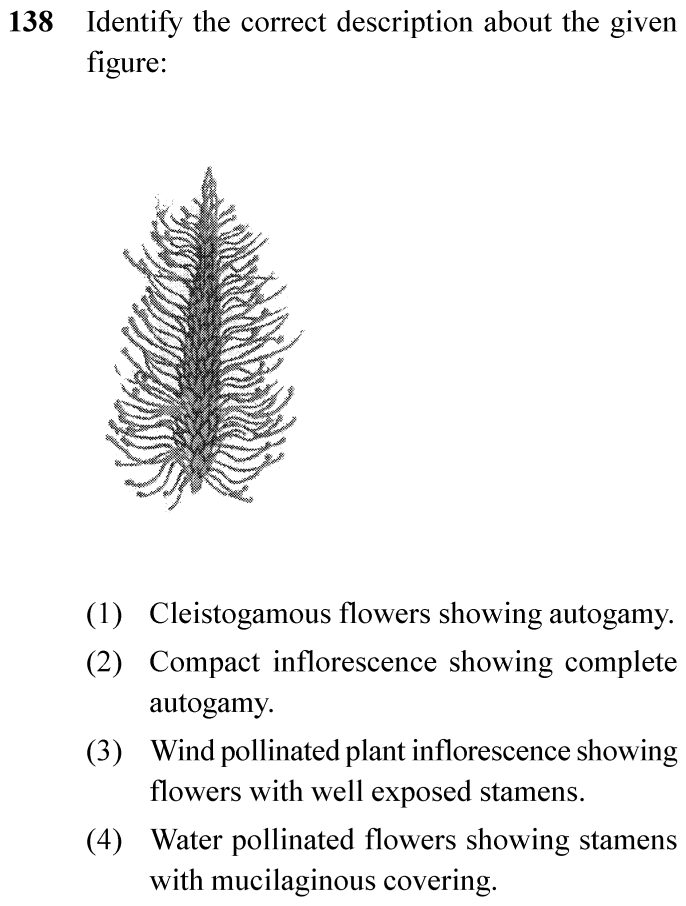
NEET 2024 Botany Question 138: Anemophily (Wind Pollination): Inflorescence and Exposed Stamens

Question

Identify the correct description about the given figure:

✓
Verified Against NTA Final Answer Key
Option (3) : Wind pollinated plant inflorescence showing flowers with well exposed stamens
📚 Sexual Reproduction in Flowering Plants Easy
📋 Given Parameters & Problem Setup
Figure Figure 2.10 (b) from NCERT Biology Sexual Reproduction in Flowering Plants
Structure Dense, brush-like inflorescence with projecting filaments and stamens
⚡

The 30-Second Exam Hall Shortcut: ⚡ NCERT Diagram Figure 2.10 Recognition

⏱️ Save ~25 seconds

The figure illustrates a wind-pollinated plant inflorescence featuring compact flowers with well-exposed stamens to easily disperse pollen into air currents!

1 Recognize the classic diagram from NCERT Sexual Reproduction in Flowering Plants:
2 - Caption in NCERT reads: "A wind-pollinated plant showing compact infloresence and well-exposed stamens".
3 - Stamens protrude outwards so pollen grains can be swept away easily by wind currents.
4 Matches Option (3) / C directly!
🛡️
Why You Can 100% Trust This Shortcut: NCERT Biology · Sexual Reproduction in Flowering Plants (Wind Pollination Adaptations)
📐

Step-by-Step Rigorous Workflow & Mathematical Proof

Step 1

Analyze Structural Features in the Figure

The figure displays a spike-like compact inflorescence where numerous flowers are closely aggregated. Long filaments project out from the axis, exposing stamens to the surrounding air currents.

Step 2

Review Adaptations of Anemophilous Flowers

Wind pollination requires that pollen grains are light and non-sticky so that they can be transported in wind currents. They often possess well-exposed stamens so that the pollens are easily dispersed into wind currents, and large feathery stigmas to easily trap airborne pollen grains.

Step 3

Select Matching Description

Option (3) provides the exact descriptive caption from NCERT Biology.

⭐

360° Option Elimination Engine Key Feature

Diagnose every choice: Know exactly why the right option works and why distractors fail.

4-Option Deep Scan
1 (1)
✗ Incorrect
Verdict & Scientific Reason:

Cleistogamous flowers do not open at all, whereas this inflorescence shows highly exposed reproductive organs.

⚠️
Student Fallacy (Why candidates pick this trap): Cleistogamous flowers do not open at all, whereas this inflorescence shows highly exposed reproductive organs.
2 (2)
✗ Incorrect
Verdict & Scientific Reason:

Well-exposed stamens in wind-pollinated plants are adapted for anemophilous cross-pollination, not obligate autogamy.

⚠️
Student Fallacy (Why candidates pick this trap): Well-exposed stamens in wind-pollinated plants are adapted for anemophilous cross-pollination, not obligate autogamy.
3 (3)
✓ 100% Correct
Verdict & Scientific Reason:

Directly reproduces the NCERT caption and morphological description for wind pollination.

💡
Why this is airtight: None.
4 (4)
✗ Incorrect
Verdict & Scientific Reason:

Mucilaginous coverings protect pollen in submerged hydrophilous plants (e.g., Zostera), not terrestrial wind-pollinated tassels.

⚠️
Student Fallacy (Why candidates pick this trap): Mucilaginous coverings protect pollen in submerged hydrophilous plants (e.g., Zostera), not terrestrial wind-pollinated tassels.
⚠️

NTA Trap Alert: Autogamy Assumption in Dense Spikes

Assuming clustered spike flowers must be self-pollinating.

🛡️ How to avoid the -1 mark: Compact spikes with projecting stamens (like corn cob tassels) are classic anemophilous adaptations for cross-pollination.
📖

Core NEET Syllabus Standard

Biology Core Botany · Sexual Reproduction in Flowering Plants Standard Benchmark
Core Scientific Principle Tested:

"Wind pollination also requires that the pollen grains are light and non-sticky so that they can be transported in wind currents. They often possess well-exposed stamens so that the pollens are easily dispersed into wind currents (Figure 2.10b)."

Syllabus Focus: Anemophily (Wind Pollination): Inflorescence and Exposed Stamens
✓ Core NEET UG Syllabus Anchor Syllabus & Academic Standards ↗

Ready to attempt under real exam pressure?

Test your speed and accuracy in the authentic 200-minute timed NTA simulator.

Launch NEET 2024 CBT Test →

Spotted a mistake in this solution? Report an error (support@mycompetitiveexams.com)

⚖️ Legal & Fair Dealing Notice: Sourced from publicly released NEET 2024 question papers and NEET answer keys for private study, research, and non-commercial educational practice under Fair Dealing (Section 52(1)(a) of the Indian Copyright Act, 1957). Not affiliated with or endorsed by NTA or NMC.

Solve 4 NEET Questions a Day — One per Subject

Cover all 1,140 official NEET questions in 285 days at your own pace. Progress is saved on your device. No login needed.