MyCompetitiveExams Logo MyCompetitiveExams
Search 1,140+ Questions
Chapters, formulas, speed tricks
→
⚡ Brahmastra NEET 2027
720 MARKS

Dynamic 180-question full-length simulator mixed dynamically from all 6 years for 2027 & 2026 aspirants.

Launch Brahmastra 2027 Test →
Start Practice →
100% Free · No Login Required
Q.63 Chemistry · Section A ⭐ 360° Option Elimination Active
Vault ↗

NEET 2024 Chemistry Question 63 Solution

Topic: Classification of Elements and Periodicity in Properties · Official NTA Booklet Code T1
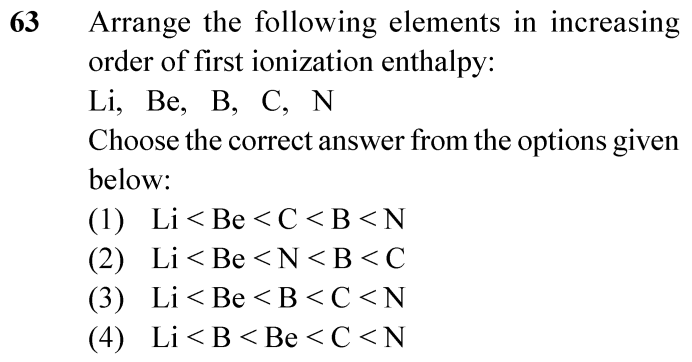
NEET 2024 Chemistry Question 63: First Ionization Enthalpy Trends in Second Period Elements

Question

Arrange the following elements in increasing order of first ionization enthalpy: Li, Be, B, C, N Choose the correct answer from the options given below:

✓
Verified Against NTA Final Answer Key
Option (4) : Li < B < Be < C < N
📚 Classification of Elements and Periodicity in Properties Easy
📋 Given Parameters & Problem Setup
Elements Li, Be, B, C, N (Period 2)
Required order Increasing order of first ionization enthalpy (Δ_i H_1)
⚡

The 30-Second Exam Hall Shortcut: ⚡ Period 2 Ionization Enthalpy Anomaly Rule

⏱️ Save ~30 seconds

Across Period 2, IE generally increases with Z_eff, BUT Be (2s² full subshell) > B (2s² 2p¹ single outer p-electron)! Order: Li < B < Be < C < N!

1 General periodic trend across Period 2: IE increases from left to right.
2 Check subshell stability anomaly between Be (Z=4) and B (Z=5):
3 - Be: 1s² 2s² (fully filled stable 2s subshell, high penetration).
4 - B: 1s² 2s² 2p¹ (electron removed from higher energy 2p orbital, easily shielded by 2s).
5 - Hence, IE of Be (899 kJ/mol) > IE of B (801 kJ/mol)!
6 For C (Z=6, 1086 kJ/mol) and N (Z=7, 1402 kJ/mol half-filled 2p³), IE continues increasing.
7 Ascending sequence: Li (520) < B (801) < Be (899) < C (1086) < N (1402).
8 Option (4) in 5 seconds!
🛡️
Why You Can 100% Trust This Shortcut: NCERT Chemistry · Classification of Elements and Periodicity in Properties (Ionization enthalpy anomalies: Be vs B and N vs O).
📐

Step-by-Step Rigorous Workflow & Mathematical Proof

Step 1

Electronic Configurations of Period 2 Elements

Writing ground-state electronic configurations: - Li (Z = 3): 1s² 2s¹ - Be (Z = 4): 1s² 2s² (completely filled 2s orbital) - B (Z = 5): 1s² 2s² 2p¹ - C (Z = 6): 1s² 2s² 2p² - N (Z = 7): 1s² 2s² 2p³ (half-filled, stable 2p subshell)

Be: [He] 2s2;B: [He] 2s2 2p1\text{Be: } [\text{He}]\,2s^2; \quad \text{B: } [\text{He}]\,2s^2\,2p^1
Step 2

Explanation of the Beryllium versus Boron Anomaly

Although nuclear charge increases from Be (+4) to B (+5), the 2p electron in boron is shielded from the nucleus by the inner 2s electrons and occupies a higher energy level than 2s electrons. Furthermore, removing an electron from Be disrupts a completely filled 2s² subshell with greater penetration power. As a consequence, it requires less energy to remove the 2p¹ electron of boron than the 2s² electron of beryllium:

ΔiH1(Be)=899  kJ/mol>ΔiH1(B)=801  kJ/mol\Delta_i H_1(\text{Be}) = 899\;\text{kJ/mol} > \Delta_i H_1(\text{B}) = 801\;\text{kJ/mol}
Step 3

Comprehensive Ordering Across the Period

Comparing all values: - Li: 520 kJ/mol - B: 801 kJ/mol - Be: 899 kJ/mol - C: 1086 kJ/mol - N: 1402 kJ/mol Arranging in strictly increasing order:

Li<B<Be<C<N\text{Li} < \text{B} < \text{Be} < \text{C} < \text{N}
⭐

360° Option Elimination Engine Key Feature

Diagnose every choice: Know exactly why the right option works and why distractors fail.

4-Option Deep Scan
1 (1)
✗ Incorrect
Verdict & Scientific Reason:

Places B after C, which completely violates effective nuclear charge trends.

⚠️
Student Fallacy (Why candidates pick this trap): Random placement of boron.
2 (2)
✗ Incorrect
Verdict & Scientific Reason:

Places N before B and C.

⚠️
Student Fallacy (Why candidates pick this trap): Misunderstanding nitrogen’s half-filled extra stability.
3 (3)
✗ Incorrect
Verdict & Scientific Reason:

Classic straight-line periodic trend trap ignoring the 2s² penetration anomaly between Be and B.

⚠️
Student Fallacy (Why candidates pick this trap): Assuming ionization enthalpy increases monotonically across a period without subshell exceptions.
4 (4)
✓ 100% Correct
Verdict & Scientific Reason:

Correctly accounts for the Be > B subshell anomaly.

💡
Why this is airtight: None.
⚠️

NTA Trap Alert: Option (3) Monotonic Trend Trap

Option (3) arranges elements strictly by atomic number (Li < Be < B < C < N). This is the most common trap in periodic properties questions!

🛡️ How to avoid the -1 mark: Always flag the two famous Period 2 anomalies: Be > B (full 2s² vs 2p¹) and N > O (half-filled 2p³ vs 2p⁴).
📖

Core NEET Syllabus Standard

Chemistry Core Inorganic Chemistry · Classification of Elements and Periodicity in Properties Standard Benchmark
Core Scientific Principle Tested:

"First ionization enthalpy generally increases across a period, but Be is higher than B because the 2s electron has higher penetration and belongs to a completely filled subshell."

Syllabus Focus: Periodic Trends in Chemical Properties: Ionization Enthalpy
✓ Core NEET UG Syllabus Anchor Syllabus & Academic Standards ↗
Boron dips below Beryllium’s full shell: Li < B < Be < C < N rings the bell!

Ready to attempt under real exam pressure?

Test your speed and accuracy in the authentic 200-minute timed NTA simulator.

Launch NEET 2024 CBT Test →

Spotted a mistake in this solution? Report an error (support@mycompetitiveexams.com)

⚖️ Legal & Fair Dealing Notice: Sourced from publicly released NEET 2024 question papers and NEET answer keys for private study, research, and non-commercial educational practice under Fair Dealing (Section 52(1)(a) of the Indian Copyright Act, 1957). Not affiliated with or endorsed by NTA or NMC.

Solve 4 NEET Questions a Day — One per Subject

Cover all 1,140 official NEET questions in 285 days at your own pace. Progress is saved on your device. No login needed.