MyCompetitiveExams Logo MyCompetitiveExams
Search 1,140+ Questions
Chapters, formulas, speed tricks
→
⚡ Brahmastra NEET 2027
720 MARKS

Dynamic 180-question full-length simulator mixed dynamically from all 6 years for 2027 & 2026 aspirants.

Launch Brahmastra 2027 Test →
Start Practice →
100% Free · No Login Required
Q.127 Botany ⭐ 360° Option Elimination Active
Vault ↗

NEET 2024 Botany Question 127 Solution

Topic: Photosynthesis in Higher Plants · Official NTA Booklet Code T1
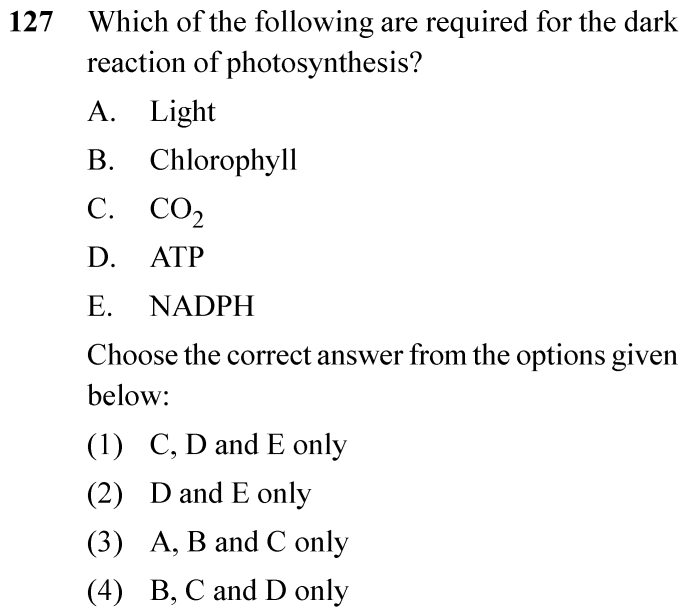
NEET 2024 Botany Question 127: Substrates and Energy Intermediates for the Dark Reaction (Calvin Cycle)

Question

Which of the following are required for the dark reaction of photosynthesis? A. Light B. Chlorophyll C. CO₂ D. ATP E. NADPH Choose the correct answer from the options given below:

✓
Verified Against NTA Final Answer Key
Option (1) : C, D and E only
📚 Photosynthesis in Higher Plants Easy
📋 Given Parameters & Problem Setup
Pathway Dark reaction (biosynthetic phase / Calvin cycle) of photosynthesis
Candidate Inputs A: Light; B: Chlorophyll; C: CO2; D: ATP; E: NADPH
⚡

The 30-Second Exam Hall Shortcut: ⚡ Biosynthetic Phase Essential Inputs

⏱️ Save ~25 seconds

The dark reaction directly assimilates CO₂ (C) using assimilatory power generated during light reaction: ATP (D) and NADPH (E)! Light (A) is not directly required!

1 Dark reaction (Calvin cycle) is enzymatically driven in the stroma.
2 It synthesizes sugars from CO₂ (C).
3 It consumes chemical energy generated by light reaction: ATP (D) and NADPH (E).
4 Direct light (A) is not required (hence "dark reaction").
5 Chlorophyll (B) is located in thylakoid membranes for light harvesting, not a soluble stromal reactant for dark reaction.
6 Thus, directly required reactants are C, D and E only -> Option (1) / A.
🛡️
Why You Can 100% Trust This Shortcut: NCERT Biology · Photosynthesis in Higher Plants (The Biosynthetic Phase)
📐

Step-by-Step Rigorous Workflow & Mathematical Proof

Step 1

Understand the Light vs Dark Reaction Coupling

Photosynthesis consists of two phases: light reactions (photochemical phase) occurring in thylakoids, producing ATP, NADPH, and O₂; and dark reactions (biosynthetic phase) occurring in the stroma, where sugars are synthesized.

Step 2

Identify Inputs of the Biosynthetic Phase

The dark reaction does not directly require light. It requires: 1. Atmospheric carbon dioxide (CO2CO_2) as the carbon source (C). 2. ATPATP to supply energy for reduction and regeneration (D). 3. NADPHNADPH to supply reducing equivalents (H+H^+ and electrons) for reduction of 3-PGA to G3P (E).

Step 3

Conclude Required Set

C, D, and E are the indispensable chemical requirements, corresponding to Option (1).

⭐

360° Option Elimination Engine Key Feature

Diagnose every choice: Know exactly why the right option works and why distractors fail.

4-Option Deep Scan
1 (1)
✓ 100% Correct
Verdict & Scientific Reason:

CO₂, ATP, and NADPH are the specific chemical reactants utilized during the Calvin cycle in the stroma.

💡
Why this is airtight: None.
2 (2)
✗ Incorrect
Verdict & Scientific Reason:

Omits NADPH (E), which is mandatory for the reduction phase of PGA.

⚠️
Student Fallacy (Why candidates pick this trap): Omits NADPH (E), which is mandatory for the reduction phase of PGA.
3 (3)
✗ Incorrect
Verdict & Scientific Reason:

Dark reactions do not directly require light (A) or thylakoid chlorophyll (B).

⚠️
Student Fallacy (Why candidates pick this trap): Dark reactions do not directly require light (A) or thylakoid chlorophyll (B).
4 (4)
✗ Incorrect
Verdict & Scientific Reason:

Omits CO₂ (C), without which carbon fixation cannot take place.

⚠️
Student Fallacy (Why candidates pick this trap): Omits CO₂ (C), without which carbon fixation cannot take place.
⚠️

NTA Trap Alert: Role of Chlorophyll in Stroma

Assuming chlorophyll is directly needed in the stroma for dark reaction enzymes.

🛡️ How to avoid the -1 mark: Chlorophyll traps light in thylakoids to make ATP/NADPH; it plays no direct enzymatic role in the stromal Calvin cycle.
📖

Core NEET Syllabus Standard

Biology Core Botany · Photosynthesis in Higher Plants Standard Benchmark
Core Scientific Principle Tested:

"The products of light reaction are ATP, NADPH and O2... The phase of photosynthesis that results in the synthesis of food (sugar) is called the biosynthetic phase. This process does not directly depend on the presence of light but is dependent on the products of the light reaction, i.e., ATP and NADPH, besides CO2 and H2O."

Syllabus Focus: Substrates and Energy Intermediates for the Dark Reaction (Calvin Cycle)
✓ Core NEET UG Syllabus Anchor Syllabus & Academic Standards ↗

Ready to attempt under real exam pressure?

Test your speed and accuracy in the authentic 200-minute timed NTA simulator.

Launch NEET 2024 CBT Test →

Spotted a mistake in this solution? Report an error (support@mycompetitiveexams.com)

⚖️ Legal & Fair Dealing Notice: Sourced from publicly released NEET 2024 question papers and NEET answer keys for private study, research, and non-commercial educational practice under Fair Dealing (Section 52(1)(a) of the Indian Copyright Act, 1957). Not affiliated with or endorsed by NTA or NMC.

Solve 4 NEET Questions a Day — One per Subject

Cover all 1,140 official NEET questions in 285 days at your own pace. Progress is saved on your device. No login needed.