MyCompetitiveExams Logo MyCompetitiveExams
Search 1,140+ Questions
Chapters, formulas, speed tricks
→
⚡ Brahmastra NEET 2027
720 MARKS

Dynamic 180-question full-length simulator mixed dynamically from all 6 years for 2027 & 2026 aspirants.

Launch Brahmastra 2027 Test →
Start Practice →
100% Free · No Login Required
Q.20 Physics · Section A ⭐ 360° Option Elimination Active
Vault ↗

NEET 2024 Physics Question 20 Solution

Topic: Motion in a Plane · Official NTA Booklet Code T1
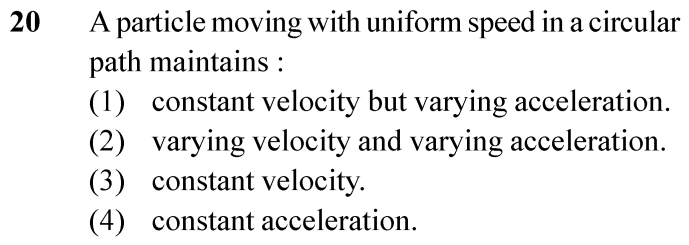
NEET 2024 Physics Question 20: Vectors in Uniform Circular Motion

Question

A particle moving with uniform speed in a circular path maintains:

✓
Verified Against NTA Final Answer Key
Option (2) : varying velocity and varying acceleration.
📚 Motion in a Plane Easy
📋 Given Parameters & Problem Setup
Motion Particle moving in a circular path
Speed Uniform speed (constant magnitude |v| = constant)
⚡

The 30-Second Exam Hall Shortcut: ⚡ Vector Directionality Test

⏱️ Save ~35 seconds

Speed is scalar (constant), but velocity and acceleration vectors continuously turn in space -> BOTH vary in direction!

1 Uniform circular motion has constant speed: |v| = v_0 = constant.
2 The velocity vector v is always tangential: as the particle moves around the circle, the direction of the tangent changes continuously -> Velocity is VARYING.
3 The centripetal acceleration vector a_c = (v²/R) points towards the center: its direction rotates continuously as the particle moves -> Acceleration is VARYING.
4 Therefore, both velocity and acceleration are varying vectors.
5 Option (2) in under 5 seconds!
🛡️
Why You Can 100% Trust This Shortcut: Fundamental Kinematics · Vector Definition of Velocity and Acceleration in Curved Paths.
📐

Step-by-Step Rigorous Workflow & Mathematical Proof

Step 1

Velocity Vector Analysis

Velocity is a vector quantity having both magnitude and direction. In uniform circular motion of radius R and angular velocity ω, the magnitude of velocity (speed) is constant, but its direction is along the instantaneous tangent to the circle:

v⃗(t)=−ωRsin⁡(ωt) i^+ωRcos⁡(ωt) j^\vec{v}(t) = -\omega R \sin(\omega t)\,\hat{i} + \omega R \cos(\omega t)\,\hat{j}
Step 2

Evaluation of Velocity Constancy

Because the unit vector direction changes at every instant of time, the velocity vector is NOT constant:

dv⃗dt≠0  ⟹  Velocity is varying\frac{d\vec{v}}{dt} \ne 0 \implies \text{Velocity is varying}
Step 3

Acceleration Vector Analysis

Differentiating the velocity vector with respect to time yields the centripetal acceleration vector:

a⃗(t)=dv⃗dt=−ω2Rcos⁡(ωt) i^−ω2Rsin⁡(ωt) j^=−ω2r⃗(t)\vec{a}(t) = \frac{d\vec{v}}{dt} = -\omega^2 R \cos(\omega t)\,\hat{i} - \omega^2 R \sin(\omega t)\,\hat{j} = -\omega^2 \vec{r}(t)
Step 4

Evaluation of Acceleration Constancy

While the magnitude of centripetal acceleration is constant (|a| = v²/R = ω²R), its direction always points radially towards the instantaneous position of the center, which rotates in space. Because its direction changes continuously:

da⃗dt≠0  ⟹  Acceleration is varying\frac{d\vec{a}}{dt} \ne 0 \implies \text{Acceleration is varying}
⭐

360° Option Elimination Engine Key Feature

Diagnose every choice: Know exactly why the right option works and why distractors fail.

4-Option Deep Scan
1 (1)
✗ Incorrect
Verdict & Scientific Reason:

Velocity cannot be constant along a curved path.

⚠️
Student Fallacy (Why candidates pick this trap): Confusing constant speed with constant velocity.
2 (2)
✓ 100% Correct
Verdict & Scientific Reason:

Both vectors continuously rotate, so both are varying.

💡
Why this is airtight: None.
3 (3)
✗ Incorrect
Verdict & Scientific Reason:

Constant velocity implies zero acceleration and straight-line motion.

⚠️
Student Fallacy (Why candidates pick this trap): Ignoring directional change.
4 (4)
✗ Incorrect
Verdict & Scientific Reason:

Constant acceleration vector implies parabolic projectile motion, not circular motion.

⚠️
Student Fallacy (Why candidates pick this trap): Confusing constant magnitude of centripetal acceleration with constant vector.
⚠️

NTA Trap Alert: Vector vs Magnitude (Scalar) Ambiguity

Aspirants often choose "constant acceleration" because its magnitude (v²/R) is constant.

🛡️ How to avoid the -1 mark: Acceleration without qualification ALWAYS means the full vector. A vector is constant ONLY IF both its magnitude AND direction are constant!
📖

Core NEET Syllabus Standard

Physics Core Kinematics · Motion in a Plane Standard Benchmark
Core Scientific Principle Tested:

"In uniform circular motion, speed and acceleration magnitude are constant, but the velocity and acceleration vectors are both continuously changing direction."

Syllabus Focus: Uniform Circular Motion
✓ Core NEET UG Syllabus Anchor Syllabus & Academic Standards ↗
Curved path turns the arrow around: Both V and A are varying bound!

Ready to attempt under real exam pressure?

Test your speed and accuracy in the authentic 200-minute timed NTA simulator.

Launch NEET 2024 CBT Test →

Spotted a mistake in this solution? Report an error (support@mycompetitiveexams.com)

⚖️ Legal & Fair Dealing Notice: Sourced from publicly released NEET 2024 question papers and NEET answer keys for private study, research, and non-commercial educational practice under Fair Dealing (Section 52(1)(a) of the Indian Copyright Act, 1957). Not affiliated with or endorsed by NTA or NMC.

Solve 4 NEET Questions a Day — One per Subject

Cover all 1,140 official NEET questions in 285 days at your own pace. Progress is saved on your device. No login needed.