MyCompetitiveExams Logo MyCompetitiveExams
Search 1,140+ Questions
Chapters, formulas, speed tricks
→
⚡ Brahmastra NEET 2027
720 MARKS

Dynamic 180-question full-length simulator mixed dynamically from all 6 years for 2027 & 2026 aspirants.

Launch Brahmastra 2027 Test →
Start Practice →
100% Free · No Login Required
Q.50 Physics · Section B ⭐ 360° Option Elimination Active
Vault ↗

NEET 2024 Physics Question 50 Solution

Topic: Magnetism and Matter · Official NTA Booklet Code T1
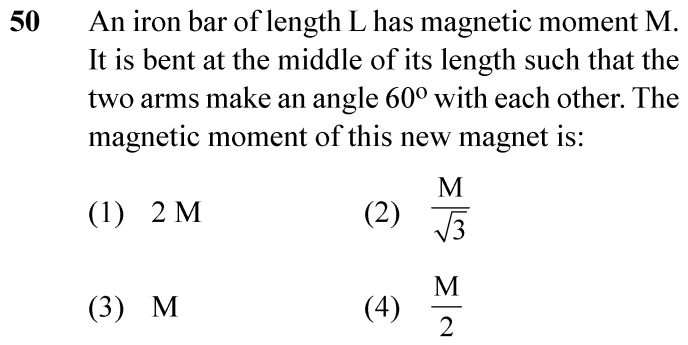
NEET 2024 Physics Question 50: Magnetic Moment of an Iron Bar Bent into an Angle of 60°

Question

π2 (2)1280π² (1) 20.7cm (2) 72.0 cm (3) 5π2 (4) 128π2 (3) 8.5 cm (4) 17.5 cm 10 If c is the velocity oflight in free space, the correct 14 In a vernier calipers, (N + 1) divisions of vernier statements about photon among the following scale coincidewithN divisions of mainscale.If

✓
Verified Against NTA Final Answer Key
Option (4) : M / 2
📚 Magnetism and Matter Easy
📋 Given Parameters & Problem Setup
Initial bar magnet Length L, magnetic dipole moment M
Pole strength m (unchanged upon bending)
Bending location Bent at the exact midpoint (each arm has length L / 2)
Angle between arms 60°
⚡

The 30-Second Exam Hall Shortcut: ⚡ Equilateral Triangle Vector Shortcut

⏱️ Save ~40 seconds

Two arms of length L/2 at 60° form an EQUILATERAL triangle -> Distance between the two poles is simply L/2 -> M’ = m × (L/2) = M / 2!

1 Original dipole moment: M = m × L, where m is the magnetic pole strength.
2 The bar is bent in the middle into two arms, each of length L/2, with an angle of 60° between them.
3 An isosceles triangle with an included angle of 60° is an EQUILATERAL triangle!
4 Therefore, the straight-line distance between the two poles (effective length L’) is identically L/2.
5 New magnetic moment: M’ = m × L’ = m × (L/2) = M / 2.
6 Option (4) in under 5 seconds!
🛡️
Why You Can 100% Trust This Shortcut: Magnetic Dipole Moment Vector Definition (M = m · L_effective, where L_effective is the straight-line displacement between poles).
📐

Step-by-Step Rigorous Workflow & Mathematical Proof

Step 1

Definition of Initial Magnetic Dipole Moment

For a straight iron bar magnet of length L with pole strengths -m (South pole) and +m (North pole), the magnetic dipole moment is defined as the product of pole strength and magnetic length:

M=m⋅LM = m \cdot L
Step 2

Geometry After Bending at Midpoint

When the bar is bent at its midpoint, it forms two straight segments of equal length l_1 = l_2 = L/2 meeting at an angle θ = 60°. Bending the magnet does not alter the intrinsic pole strength m at the ends.

l1=l2=L2,θ=60∘l_1 = l_2 = \frac{L}{2}, \quad \theta = 60^\circ
Step 3

Determination of Effective Separation L’

The effective magnetic dipole moment depends on the direct straight-line distance L’ between the South pole and the North pole at the ends of the bent arms. Applying the law of cosines or isosceles geometry:

L′=2(L2)sin⁡(θ2)=Lsin⁡(30∘)=L(12)=L2L' = 2 \left(\frac{L}{2}\right) \sin\left(\frac{\theta}{2}\right) = L \sin(30^\circ) = L \left(\frac{1}{2}\right) = \frac{L}{2}
Step 4

Calculation of New Magnetic Moment M’

The new magnetic dipole moment M’ is the product of pole strength m and effective separation L’:

M′=m⋅L′=m⋅(L2)=mL2=M2M' = m \cdot L' = m \cdot \left(\frac{L}{2}\right) = \frac{m L}{2} = \frac{M}{2}
⭐

360° Option Elimination Engine Key Feature

Diagnose every choice: Know exactly why the right option works and why distractors fail.

4-Option Deep Scan
1 (1)
✗ Incorrect
Verdict & Scientific Reason:

Bending can never increase the effective distance between poles.

⚠️
Student Fallacy (Why candidates pick this trap): Multiplying by 2 instead of dividing.
2 (2)
✗ Incorrect
Verdict & Scientific Reason:

Incorrect trigonometric factor.

⚠️
Student Fallacy (Why candidates pick this trap): Using tan(30°) or cot(60°).
3 (3)
✗ Incorrect
Verdict & Scientific Reason:

Ignores the geometrical reduction in distance between the poles.

⚠️
Student Fallacy (Why candidates pick this trap): Assuming magnetic moment is a scalar conserved quantity like mass.
4 (4)
✓ 100% Correct
Verdict & Scientific Reason:

Exact equilateral triangle result: L’ = L/2 -> M’ = M/2.

💡
Why this is airtight: None.
⚠️

NTA Trap Alert: Treating Magnetic Moment as a Conserved Scalar

Students often believe that because no mass is lost, the magnetic moment remains M (Option 3).

🛡️ How to avoid the -1 mark: Magnetic moment is a VECTOR pointing from S to N. Bending brings the poles closer together, strictly decreasing the effective vector length!
📖

Core NEET Syllabus Standard

Physics Core Magnetism · Magnetism and Matter Standard Benchmark
Core Scientific Principle Tested:

"The magnetic moment of a bent bar magnet is M’ = 2(M/2) sin(θ/2) = M sin(θ/2)."

Syllabus Focus: The Magnetic Dipole and Dipole Moment
✓ Core NEET UG Syllabus Anchor Syllabus & Academic Standards ↗
60 degrees gives equilateral side: Effective length is halved in stride (M / 2)!

Ready to attempt under real exam pressure?

Test your speed and accuracy in the authentic 200-minute timed NTA simulator.

Launch NEET 2024 CBT Test →

Spotted a mistake in this solution? Report an error (support@mycompetitiveexams.com)

⚖️ Legal & Fair Dealing Notice: Sourced from publicly released NEET 2024 question papers and NEET answer keys for private study, research, and non-commercial educational practice under Fair Dealing (Section 52(1)(a) of the Indian Copyright Act, 1957). Not affiliated with or endorsed by NTA or NMC.

Solve 4 NEET Questions a Day — One per Subject

Cover all 1,140 official NEET questions in 285 days at your own pace. Progress is saved on your device. No login needed.