MyCompetitiveExams Logo MyCompetitiveExams
Search 1,140+ Questions
Chapters, formulas, speed tricks
→
⚡ Brahmastra NEET 2027
720 MARKS

Dynamic 180-question full-length simulator mixed dynamically from all 6 years for 2027 & 2026 aspirants.

Launch Brahmastra 2027 Test →
Start Practice →
100% Free · No Login Required
Q.64 Chemistry · Section A ⭐ 360° Option Elimination Active
Vault ↗

NEET 2024 Chemistry Question 64 Solution

Topic: Classification of Elements and Periodicity in Properties · Official NTA Booklet Code T1
NEET 2024 Chemistry Question 64: Electronegativity Trends Across Periods and Groups

Question

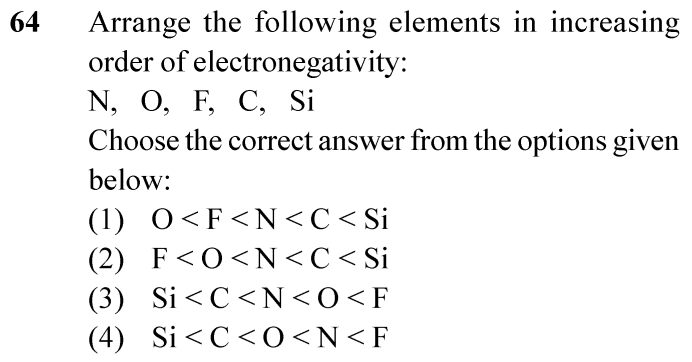
Arrange the following elements in increasing order of electronegativity: N, O, F, C, Si Choose the correct answer from the options given below:

✓
Verified Against NTA Final Answer Key
Option (3) : Si < C < N < O < F
📚 Classification of Elements and Periodicity in Properties Easy
📋 Given Parameters & Problem Setup
Elements to arrange N, O, F, C, Si
Required order Increasing order of electronegativity (Pauling scale)
⚡

The 30-Second Exam Hall Shortcut: ⚡ Pauling Electronegativity Ladder Hack

⏱️ Save ~30 seconds

FON Cl N Br I C S H P Si! Flourine is king (4.0), Oxygen is 3.5, Nitrogen is 3.0, Carbon is 2.5, Silicon is 1.8 -> Si < C < N < O < F!

1 Electronegativity increases across a period (left to right) and decreases down a group.
2 Second period non-metals: C (2.5) < N (3.0) < O (3.5) < F (4.0).
3 Silicon (Si) lies in Period 3 directly below Carbon (Group 14). Since electronegativity decreases down the group: Si (1.8) < C (2.5).
4 Combining both trends: Si < C < N < O < F.
5 Match Option (3) in 3 seconds!
🛡️
Why You Can 100% Trust This Shortcut: NCERT Chemistry · Classification of Elements and Periodicity in Properties (Electronegativity trends and Pauling scale values).
📐

Step-by-Step Rigorous Workflow & Mathematical Proof

Step 1

Periodic Trends in Electronegativity

Electronegativity is the qualitative measure of an atom’s ability in a chemical compound to attract shared electrons towards itself. Across a period, increasing effective nuclear charge and decreasing atomic radius attract valence electrons more strongly. Down a group, increased shielding and greater atomic radius reduce electronegativity.

χ∝Zeffr\chi \propto \frac{Z_{eff}}{r}
Step 2

Evaluation of Values on the Pauling Scale

On the Pauling electronegativity scale: - Silicon (Si, Period 3, Group 14): χ = 1.8 - Carbon (C, Period 2, Group 14): χ = 2.5 - Nitrogen (N, Period 2, Group 15): χ = 3.0 - Oxygen (O, Period 2, Group 16): χ = 3.5 - Fluorine (F, Period 2, Group 17): χ = 4.0 (most electronegative element in the periodic table)

χ(Si)=1.8<χ(C)=2.5<χ(N)=3.0<χ(O)=3.5<χ(F)=4.0\chi(\text{Si}) = 1.8 < \chi(\text{C}) = 2.5 < \chi(\text{N}) = 3.0 < \chi(\text{O}) = 3.5 < \chi(\text{F}) = 4.0
Step 3

Ordering

Arranging in strictly increasing order yields: Si < C < N < O < F, perfectly matching Option (3).

Si<C<N<O<F\text{Si} < \text{C} < \text{N} < \text{O} < \text{F}
⭐

360° Option Elimination Engine Key Feature

Diagnose every choice: Know exactly why the right option works and why distractors fail.

4-Option Deep Scan
1 (1)
✗ Incorrect
Verdict & Scientific Reason:

Completely inverted and chaotic order.

⚠️
Student Fallacy (Why candidates pick this trap): Scrambled order.
2 (2)
✗ Incorrect
Verdict & Scientific Reason:

Completely reverses the order (decreasing instead of increasing).

⚠️
Student Fallacy (Why candidates pick this trap): Reading "increasing order" as decreasing order.
3 (3)
✓ 100% Correct
Verdict & Scientific Reason:

Exact monotonic increasing order based on Pauling values (1.8 < 2.5 < 3.0 < 3.5 < 4.0).

💡
Why this is airtight: None.
4 (4)
✗ Incorrect
Verdict & Scientific Reason:

Inverts nitrogen and oxygen.

⚠️
Student Fallacy (Why candidates pick this trap): Thinking nitrogen is more electronegative than oxygen.
⚠️

NTA Trap Alert: Decreasing vs Increasing Direction

Option (2) gives F > O > N > C > Si in reverse order. Always verify the inequality signs: "increasing" requires the smallest on the left (<).

🛡️ How to avoid the -1 mark: Double check the "<" signs: Si is least electronegative, Fluorine is most electronegative.
📖

Core NEET Syllabus Standard

Chemistry Core Inorganic Chemistry · Classification of Elements and Periodicity in Properties Standard Benchmark
Core Scientific Principle Tested:

"Electronegativity increases across a period from left to right and decreases down a group; Fluorine is the most electronegative element."

Syllabus Focus: Periodic Trends: Electronegativity
✓ Core NEET UG Syllabus Anchor Syllabus & Academic Standards ↗
Si climbs to C, then FON takes the lead: Si < C < N < O < F indeed!

Ready to attempt under real exam pressure?

Test your speed and accuracy in the authentic 200-minute timed NTA simulator.

Launch NEET 2024 CBT Test →

Spotted a mistake in this solution? Report an error (support@mycompetitiveexams.com)

⚖️ Legal & Fair Dealing Notice: Sourced from publicly released NEET 2024 question papers and NEET answer keys for private study, research, and non-commercial educational practice under Fair Dealing (Section 52(1)(a) of the Indian Copyright Act, 1957). Not affiliated with or endorsed by NTA or NMC.

Solve 4 NEET Questions a Day — One per Subject

Cover all 1,140 official NEET questions in 285 days at your own pace. Progress is saved on your device. No login needed.