MyCompetitiveExams Logo MyCompetitiveExams
Search 1,140+ Questions
Chapters, formulas, speed tricks
→
⚡ Brahmastra NEET 2027
720 MARKS

Dynamic 180-question full-length simulator mixed dynamically from all 6 years for 2027 & 2026 aspirants.

Launch Brahmastra 2027 Test →
Start Practice →
100% Free · No Login Required
Q.117 Botany ⭐ 360° Option Elimination Active
Vault ↗

NEET 2024 Botany Question 117 Solution

Topic: Sexual Reproduction in Flowering Plants · Official NTA Booklet Code T1
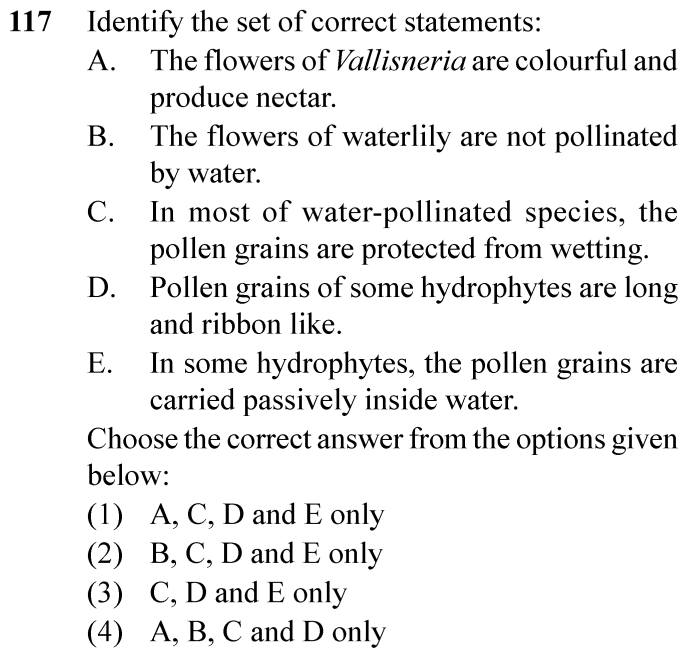
NEET 2024 Botany Question 117: Hydrophily: Water Pollination Adaptations and Exceptions

Question

Identify the set of correct statements: A. The flowers of Vallisneria are colourful and produce nectar. B. The flowers of waterlily are not pollinated by water. C. In most of water-pollinated species, the pollen grains are protected from wetting. D. Pollen grains of some hydrophytes are long and ribbon like. E. In some hydrophytes, the pollen grains are carried passively inside water. Choose the correct answer from the options given below:

✓
Verified Against NTA Final Answer Key
Option (2) : B, C, D and E only
📚 Sexual Reproduction in Flowering Plants Medium
📋 Given Parameters & Problem Setup
Phenomenon Hydrophily (pollination by water)
Candidate Statements A: Common in flowering plants; B: Water lily pollinated by insects/wind; C: Mucilaginous covering prevents wetting; D: Ribbon-like pollen in some; E: Carried passively
⚡

The 30-Second Exam Hall Shortcut: ⚡ Hydrophily Rarity Rule

⏱️ Save ~35 seconds

Statement A says pollination by water is 'quite common' in flowering plants. NCERT explicitly states hydrophily is QUITE RARE (limited to about 30 genera, mostly monocots)! Eliminate A immediately!

1 Evaluate Statement A: "Pollination by water is quite common in flowering plants" -> False! It is quite rare (~30 genera).
2 Check remaining statements:
3 - B: Water lily and lotus emerge above water and are pollinated by insects or wind -> True!
4 - C: Mucilaginous covering protects pollen from wetting -> True!
5 - D: In seagrasses (e.g., Zostera), pollen grains are long and ribbon-like -> True!
6 - E: Pollen grains are carried passively by water currents -> True!
7 Therefore, B, C, D and E only -> Option (2) / B.
🛡️
Why You Can 100% Trust This Shortcut: NCERT Biology · Sexual Reproduction in Flowering Plants (Hydrophily and Aquatic Plants)
📐

Step-by-Step Rigorous Workflow & Mathematical Proof

Step 1

Evaluate Prevalence of Hydrophily

NCERT states: "Pollination by water is quite rare in flowering plants and is limited to about 30 genera, mostly monocotyledons." Therefore, Statement A is incorrect.

Step 2

Analyze Aquatic Plants Exceptions

In a majority of aquatic plants such as water hyacinth and water lily, the flowers emerge above the level of water and are pollinated by insects or wind as in most of the land plants. Statement B is true.

Step 3

Examine Adaptations in True Hydrophilous Plants

In seagrasses such as Zostera, female flowers remain submerged and pollen grains are long, ribbon-like and carried passively inside the water. In most water-pollinated species, pollen grains are protected from wetting by a mucilaginous covering. Statements C, D, and E are all true.

Step 4

Conclude Valid Option

The correct set of statements is B, C, D and E only, matching Option (2).

⭐

360° Option Elimination Engine Key Feature

Diagnose every choice: Know exactly why the right option works and why distractors fail.

4-Option Deep Scan
1 (1)
✗ Incorrect
Verdict & Scientific Reason:

Incorrectly includes Statement A (hydrophily is rare, not common).

⚠️
Student Fallacy (Why candidates pick this trap): Incorrectly includes Statement A (hydrophily is rare, not common).
2 (2)
✓ 100% Correct
Verdict & Scientific Reason:

Accurately includes all correct features and exceptions while excluding the false statement A.

💡
Why this is airtight: None.
3 (3)
✗ Incorrect
Verdict & Scientific Reason:

Incorrectly includes Statement A.

⚠️
Student Fallacy (Why candidates pick this trap): Incorrectly includes Statement A.
4 (4)
✗ Incorrect
Verdict & Scientific Reason:

Incorrectly includes Statement A and omits mucilaginous protection (C).

⚠️
Student Fallacy (Why candidates pick this trap): Incorrectly includes Statement A and omits mucilaginous protection (C).
⚠️

NTA Trap Alert: Water Lily Pollination Mode

Assuming all aquatic plants are pollinated by water.

🛡️ How to avoid the -1 mark: Water lily and water hyacinth emerge above water and rely on insects or wind, NOT water.
📖

Core NEET Syllabus Standard

Biology Core Botany · Sexual Reproduction in Flowering Plants Standard Benchmark
Core Scientific Principle Tested:

"Pollination by water is quite rare in flowering plants and is limited to about 30 genera, mostly monocotyledons... In majority of aquatic plants such as water hyacinth and water lily, the flowers emerge above the level of water and are pollinated by insects or wind."

Syllabus Focus: Hydrophily: Water Pollination Adaptations and Exceptions
✓ Core NEET UG Syllabus Anchor Syllabus & Academic Standards ↗

Ready to attempt under real exam pressure?

Test your speed and accuracy in the authentic 200-minute timed NTA simulator.

Launch NEET 2024 CBT Test →

Spotted a mistake in this solution? Report an error (support@mycompetitiveexams.com)

⚖️ Legal & Fair Dealing Notice: Sourced from publicly released NEET 2024 question papers and NEET answer keys for private study, research, and non-commercial educational practice under Fair Dealing (Section 52(1)(a) of the Indian Copyright Act, 1957). Not affiliated with or endorsed by NTA or NMC.

Solve 4 NEET Questions a Day — One per Subject

Cover all 1,140 official NEET questions in 285 days at your own pace. Progress is saved on your device. No login needed.