MyCompetitiveExams Logo MyCompetitiveExams
Search 1,140+ Questions
Chapters, formulas, speed tricks
→
⚡ Brahmastra NEET 2027
720 MARKS

Dynamic 180-question full-length simulator mixed dynamically from all 6 years for 2027 & 2026 aspirants.

Launch Brahmastra 2027 Test →
Start Practice →
100% Free · No Login Required
Q.90 Chemistry · Section B ⭐ 360° Option Elimination Active
Vault ↗

NEET 2024 Chemistry Question 90 Solution

Topic: Practical Chemistry · Official NTA Booklet Code T1
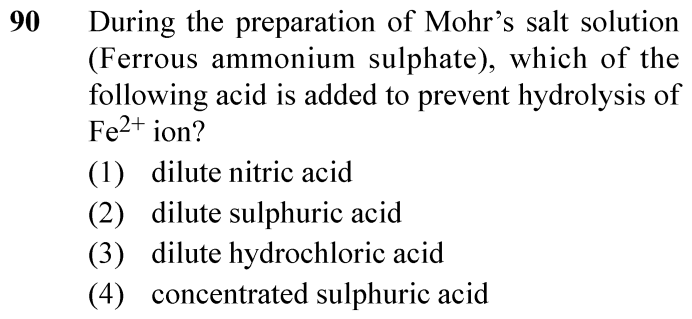
NEET 2024 Chemistry Question 90: Preparation of Mohr’s Salt Solution and Prevention of Fe2+ Hydrolysis

Question

During the preparation of Mohr's salt solution (Ferrous ammonium sulphate), which of the following acid is added to prevent hydrolysis of Fe²⁺ ion?

✓
Verified Against NTA Final Answer Key
Option (2) : dilute sulphuric acid
📚 Practical Chemistry Easy
📋 Given Parameters & Problem Setup
Target solution Mohr’s salt solution (Ferrous ammonium sulphate: FeSO4·(NH4)2SO4·6H2O)
Objective Acid added to prevent hydrolysis of Fe2+ ion
⚡

The 30-Second Exam Hall Shortcut: ⚡ Common Ion & Non-Interfering Acid Hack

⏱️ Save ~30 seconds

Mohr’s salt is a SULPHATE double salt! Dilute H2SO4 prevents hydrolysis of Fe²⁺ to Fe(OH)2 without introducing foreign anions or oxidizing Fe²⁺!

1 Mohr’s salt is ferrous ammonium sulphate, [FeSO4 · (NH4)2SO4 · 6H2O].
2 In neutral water, Fe²⁺ undergoes cationic hydrolysis with water to form pale yellow/brown turbid insoluble ferrous hydroxide Fe(OH)2.
3 Adding acid supplies H⁺ ions, shifting the hydrolysis equilibrium backward to preserve clear green Fe²⁺ ions.
4 Dilute HNO3 CANNOT be used because it is an oxidizing agent that oxidizes Fe²⁺ to Fe³⁺.
5 Dilute HCl CANNOT be used because Cl⁻ interferes with KMnO4 in redox titrations (KMnO4 oxidizes Cl⁻ to Cl2).
6 Dilute H2SO4 shares the common sulphate (SO4²⁻) ion, does not oxidize Fe²⁺, and does not interfere with permanganate.
7 Option (2) in 5 seconds!
🛡️
Why You Can 100% Trust This Shortcut: NCERT Chemistry · Practical Chemistry (Preparation of standard solution of Mohr’s salt and prevention of hydrolysis of Fe2+ using dilute H2SO4).
📐

Step-by-Step Rigorous Workflow & Mathematical Proof

Step 1

Hydrolysis Equilibrium of Ferrous Ion

When Mohr’s salt dissolves in neutral water, the Fe²⁺ cation acts as a weak conjugate acid and undergoes hydrolysis, producing basic salts / insoluble Fe(OH)2 which causes the solution to turn brownish and turbid:

Fe2++2H2O⇌Fe(OH)2↓+2H⊕\text{Fe}^{2+} + 2\text{H}_2\text{O} \rightleftharpoons \text{Fe(OH)}_2\downarrow + 2\text{H}^\oplus
Step 2

Le Chatelier Suppression by Added Acid

By adding dilute sulphuric acid, the high concentration of hydronium ions (H⁺) shifts the hydrolysis equilibrium to the left according to Le Chatelier’s principle, completely preventing the precipitation of Fe(OH)2 and maintaining a clear, transparent solution of Fe²⁺:

[H⊕]↑  ⟹  Equilibrium shifts left, suppressing Fe(OH)2 formation[\text{H}^\oplus] \uparrow \implies \text{Equilibrium shifts left, suppressing } \text{Fe(OH)}_2 \text{ formation}
Step 3

Why Other Acids are Unsuitable

Evaluating the alternative acids: - Dilute HNO3: Nitric acid is a strong oxidizing agent that oxidizes ferrous (Fe²⁺) to ferric (Fe³⁺), destroying the standard reducing solution: 3 Fe²⁺ + NO3⁻ + 4 H⁺ ⟶ 3 Fe³⁺ + NO + 2 H2O. - Dilute HCl: In redox titrations with KMnO4, hydrochloric acid is oxidized by permanganate to chlorine gas (2 Cl⁻ ⟶ Cl2 + 2e⁻), consuming titrant and producing false titer values. - Concentrated H2SO4: Charring agent; unnecessary and dangerous for aqueous volumetric solutions. Hence, dilute H2SO4 is the unique, ideal choice.

Only dilute H2SO4 prevents hydrolysis without redox interference\text{Only dilute H}_2\text{SO}_4 \text{ prevents hydrolysis without redox interference}
⭐

360° Option Elimination Engine Key Feature

Diagnose every choice: Know exactly why the right option works and why distractors fail.

4-Option Deep Scan
1 (1)
✗ Incorrect
Verdict & Scientific Reason:

Oxidizes Fe²⁺ to Fe³⁺, destroying the reducing capacity of Mohr’s salt.

⚠️
Student Fallacy (Why candidates pick this trap): Forgetting that HNO3 is an active oxidizing agent.
2 (2)
✓ 100% Correct
Verdict & Scientific Reason:

Supplies H⁺ to suppress hydrolysis, shares common sulphate ion, and does not interfere with KMnO4 titrations.

💡
Why this is airtight: None.
3 (3)
✗ Incorrect
Verdict & Scientific Reason:

Cl⁻ is oxidized to Cl2 by KMnO4 during redox titration.

⚠️
Student Fallacy (Why candidates pick this trap): Overlooking the permanganate-chloride side reaction.
4 (4)
✗ Incorrect
Verdict & Scientific Reason:

Excessively hazardous and unnecessary; only dilute acid is specified.

⚠️
Student Fallacy (Why candidates pick this trap): Choosing concentrated over dilute.
⚠️

NTA Trap Alert: Choosing Dilute HCl Instead of Dilute H2SO4

Students often think any strong mineral acid will work. In redox titrations, KMnO4 oxidizes HCl to Cl2! Only dilute H2SO4 provides the non-interfering acidic environment.

🛡️ How to avoid the -1 mark: Always remember: Mohr’s salt titration with KMnO4 MUST use dilute H2SO4.
📖

Core NEET Syllabus Standard

Chemistry Core Practical Chemistry · Practical Chemistry Standard Benchmark
Core Scientific Principle Tested:

"Dilute H2SO4 is added during the preparation of Mohr’s salt solution to prevent cationic hydrolysis of Fe2+ ions into Fe(OH)2."

Syllabus Focus: Volumetric Analysis: Redox Titration of Mohr’s Salt with KMnO4
✓ Core NEET UG Syllabus Anchor Syllabus & Academic Standards ↗
Mohr’s salt is a sulphate friend: Dilute H2SO4 keeps Fe2+ to the end!

Ready to attempt under real exam pressure?

Test your speed and accuracy in the authentic 200-minute timed NTA simulator.

Launch NEET 2024 CBT Test →

Spotted a mistake in this solution? Report an error (support@mycompetitiveexams.com)

⚖️ Legal & Fair Dealing Notice: Sourced from publicly released NEET 2024 question papers and NEET answer keys for private study, research, and non-commercial educational practice under Fair Dealing (Section 52(1)(a) of the Indian Copyright Act, 1957). Not affiliated with or endorsed by NTA or NMC.

Solve 4 NEET Questions a Day — One per Subject

Cover all 1,140 official NEET questions in 285 days at your own pace. Progress is saved on your device. No login needed.