MyCompetitiveExams Logo MyCompetitiveExams
Search 1,140+ Questions
Chapters, formulas, speed tricks
→
⚡ Brahmastra NEET 2027
720 MARKS

Dynamic 180-question full-length simulator mixed dynamically from all 6 years for 2027 & 2026 aspirants.

Launch Brahmastra 2027 Test →
Start Practice →
100% Free · No Login Required
Q.89 Chemistry · Section B ⭐ 360° Option Elimination Active
Vault ↗

NEET 2024 Chemistry Question 89 Solution

Topic: Practical Chemistry · Official NTA Booklet Code T1
NEET 2024 Chemistry Question 89: Systematic Group Classification of Basic Radicals (Cations)

Question

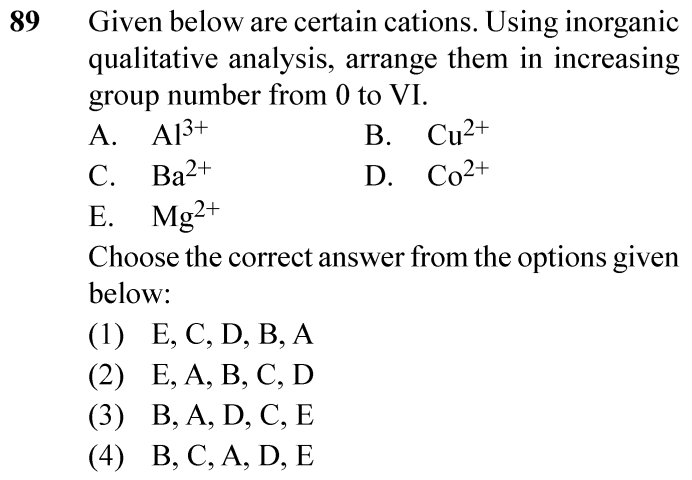
Given below are certain cations. Using inorganic qualitative analysis, arrange them in increasing group number from 0 to VI. A. Al³⁺ B. Cu²⁺ C. Ba²⁺ D. Co²⁺ E. Mg²⁺ Choose the correct answer from the options given below:

✓
Verified Against NTA Final Answer Key
Option (3) : B, A, D, C, E (Cu2+, Al3+, Co2+, Ba2+, Mg2+)
📚 Practical Chemistry Easy
📋 Given Parameters & Problem Setup
Cation A Al3+
Cation B Cu2+
Cation C Ba2+
Cation D Co2+
Cation E Mg2+
Objective Arrange cations in increasing group number from 0 to VI
⚡

The 30-Second Exam Hall Shortcut: ⚡ Qualitative Analysis Group Order Rule

⏱️ Save ~40 seconds

Cu²⁺ is Group II (B); Al³⁺ is Group III (A); Co²⁺ is Group IV (D); Ba²⁺ is Group V (C); Mg²⁺ is Group VI (E) -> Sequence: B, A, D, C, E!

1 Recall the canonical qualitative analysis cation groups and group reagents:
2 - Group 0: NH4⁺.
3 - Group I: Pb²⁺ (dil. HCl).
4 - Group II: Cu²⁺, Pb²⁺, As³⁺ (H2S in dil. HCl) -> Cu²⁺ = Group II (B).
5 - Group III: Fe³⁺, Al³⁺, Cr³⁺ (NH4OH in presence of NH4Cl) -> Al³⁺ = Group III (A).
6 - Group IV: Co²⁺, Ni²⁺, Mn²⁺, Zn²⁺ (H2S in presence of NH4OH) -> Co²⁺ = Group IV (D).
7 - Group V: Ba²⁺, Sr²⁺, Ca²⁺ ((NH4)2CO3 in presence of NH4OH) -> Ba²⁺ = Group V (C).
8 - Group VI: Mg²⁺ (disodium hydrogen phosphate) -> Mg²⁺ = Group VI (E).
9 Increasing group number: B (II) < A (III) < D (IV) < C (V) < E (VI).
10 Sequence: B, A, D, C, E -> Option (3) in 5 seconds!
🛡️
Why You Can 100% Trust This Shortcut: NCERT Chemistry · Practical Chemistry (Systematic analysis of basic radicals: cation group separation scheme).
📐

Step-by-Step Rigorous Workflow & Mathematical Proof

Step 1

Principles of Systematic Cation Separation

Qualitative inorganic analysis separates basic radicals (cations) into analytical groups based on the solubility products (Ksp) of their insoluble chlorides, sulphides, hydroxides, and carbonates:

Precipitation occurs when Ionic Product (IP) >Ksp\text{Precipitation occurs when Ionic Product (IP) } > K_{sp}
Step 2

Group Assignment for Each Given Cation

Mapping each given cation to its analytical group and identifying its group reagent: - B (Cu²⁺): Group II (precipitated as black CuS with H2S gas in acidic medium). Group Number = 2. - A (Al³⁺): Group III (precipitated as gelatinous white Al(OH)3 with NH4OH in the presence of NH4Cl). Group Number = 3. - D (Co²⁺): Group IV (precipitated as black CoS with H2S in ammoniacal medium). Group Number = 4. - C (Ba²⁺): Group V (precipitated as white BaCO3 with (NH4)2CO3 in ammoniacal medium). Group Number = 5. - E (Mg²⁺): Group VI (precipitated as white crystalline Mg(NH4)PO4). Group Number = 6.

Cu2+(II)<Al3+(III)<Co2+(IV)<Ba2+(V)<Mg2+(VI)\text{Cu}^{2+} (\text{II}) < \text{Al}^{3+} (\text{III}) < \text{Co}^{2+} (\text{IV}) < \text{Ba}^{2+} (\text{V}) < \text{Mg}^{2+} (\text{VI})
Step 3

Ordering by Analytical Group

Arranging in order of increasing group number from Group 0 to VI yields: B (Group II) ⟶ A (Group III) ⟶ D (Group IV) ⟶ C (Group V) ⟶ E (Group VI). Matching sequence: B, A, D, C, E.

Sequence: B,A,D,C,E  (Option 3)\text{Sequence: } \mathbf{B, A, D, C, E} \; (\text{Option 3})
⭐

360° Option Elimination Engine Key Feature

Diagnose every choice: Know exactly why the right option works and why distractors fail.

4-Option Deep Scan
1 (1)
✗ Incorrect
Verdict & Scientific Reason:

Reverses the order (decreasing group number).

⚠️
Student Fallacy (Why candidates pick this trap): Arranging in decreasing order instead of increasing.
2 (2)
✗ Incorrect
Verdict & Scientific Reason:

Places magnesium in the first position.

⚠️
Student Fallacy (Why candidates pick this trap): Confusing Group VI with Group 0.
3 (3)
✓ 100% Correct
Verdict & Scientific Reason:

Strictly matches analytical groups II, III, IV, V, and VI.

💡
Why this is airtight: None.
4 (4)
✗ Incorrect
Verdict & Scientific Reason:

Places barium (Group V) before aluminum (Group III).

⚠️
Student Fallacy (Why candidates pick this trap): Misremembering barium’s group number.
⚠️

NTA Trap Alert: Confusing Periodic Table Groups with Analytical Groups

Periodic table group for Mg is Group 2, but in qualitative salt analysis, Magnesium is in Group VI! Always use analytical salt analysis groups!

🛡️ How to avoid the -1 mark: Remember the mnemonic for analytical groups: Lead (I), Copper (II), Aluminium (III), Cobalt (IV), Barium (V), Magnesium (VI).
📖

Core NEET Syllabus Standard

Chemistry Core Practical Chemistry · Practical Chemistry Standard Benchmark
Core Scientific Principle Tested:

"Basic radicals are classified into six analytical groups based on selective precipitation with group reagents."

Syllabus Focus: Qualitative Analysis: Group Reagents and Systematic Classification of Cations
✓ Core NEET UG Syllabus Anchor Syllabus & Academic Standards ↗
Copper two, Al three, Cobalt four, Barium five, Magnesium six: B-A-D-C-E does the trick!

Ready to attempt under real exam pressure?

Test your speed and accuracy in the authentic 200-minute timed NTA simulator.

Launch NEET 2024 CBT Test →

Spotted a mistake in this solution? Report an error (support@mycompetitiveexams.com)

⚖️ Legal & Fair Dealing Notice: Sourced from publicly released NEET 2024 question papers and NEET answer keys for private study, research, and non-commercial educational practice under Fair Dealing (Section 52(1)(a) of the Indian Copyright Act, 1957). Not affiliated with or endorsed by NTA or NMC.

Solve 4 NEET Questions a Day — One per Subject

Cover all 1,140 official NEET questions in 285 days at your own pace. Progress is saved on your device. No login needed.