Q.79 Chemistry · Section A ⭐ 360° Option Elimination Active
NEET 2024 Chemistry Question 79 Solution
Topic: Equilibrium · Official NTA Booklet Code T1
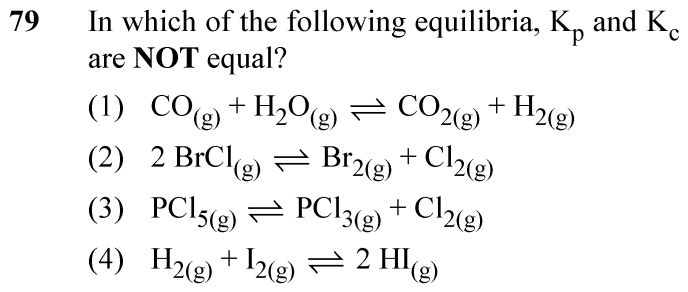
Question
In which of the following equilibria, Kp and Kc are NOT equal?
 MyCompetitiveExams
Dynamic 180-question full-length simulator mixed dynamically from all 6 years for 2027 & 2026 aspirants.
In which of the following equilibria, Kp and Kc are NOT equal?
K_p = K_c when Δn_g = 0. In PCl5(g) ⇌ PCl3(g) + Cl2(g), Δn_g = (1 + 1) - 1 = +1 ≠ 0 -> K_p ≠ K_c!
For a general gas-phase equilibrium aA + bB ⇌ cC + dD, partial pressures relate to molar concentrations by the ideal gas law: p_i = [i]RT. Substituting this into the Kp expression yields:
For Kp to equal Kc identically (independent of temperature): (RT)^Δng = 1 ⟹ Δng = 0. Thus, Kp = Kc if and only if the total stoichiometric sum of gaseous product coefficients equals that of the gaseous reactants.
Calculating Δng for all four reactions: 1. CO(g) + H2O(g) ⇌ CO2(g) + H2(g): Δng = (1 + 1) - (1 + 1) = 0 ⟹ Kp = Kc. 2. 2 BrCl(g) ⇌ Br2(g) + Cl2(g): Δng = (1 + 1) - 2 = 0 ⟹ Kp = Kc. 3. PCl5(g) ⇌ PCl3(g) + Cl2(g): Δng = (1 + 1) - 1 = +1 ⟹ Kp = Kc(RT) ≠ Kc! 4. H2(g) + I2(g) ⇌ 2 HI(g): Δng = 2 - (1 + 1) = 0 ⟹ Kp = Kc.
Diagnose every choice: Know exactly why the right option works and why distractors fail.
Δng = 0, so Kp = Kc.
Δng = 0, so Kp = Kc.
Δng = +1 ≠ 0, making Kp and Kc strictly unequal.
Δng = 0, so Kp = Kc.
The question asks where Kp and Kc are NOT equal. Three options have Kp = Kc, and only Option (3) has Kp ≠ Kc.
"Kp equals Kc only when Δng = 0; when Δng ≠ 0 (as in PCl5 decomposition where Δng = +1), Kp ≠ Kc."
Test your speed and accuracy in the authentic 200-minute timed NTA simulator.
Spotted a mistake in this solution? Report an error (support@mycompetitiveexams.com)
Cover all 1,140 official NEET questions in 285 days at your own pace. Progress is saved on your device. No login needed.