MyCompetitiveExams Logo MyCompetitiveExams
Search 1,140+ Questions
Chapters, formulas, speed tricks
→
⚡ Brahmastra NEET 2027
720 MARKS

Dynamic 180-question full-length simulator mixed dynamically from all 6 years for 2027 & 2026 aspirants.

Launch Brahmastra 2027 Test →
Start Practice →
100% Free · No Login Required
Q.136 Botany ⭐ 360° Option Elimination Active
Vault ↗

NEET 2024 Botany Question 136 Solution

Topic: Morphology of Flowering Plants · Official NTA Booklet Code T1
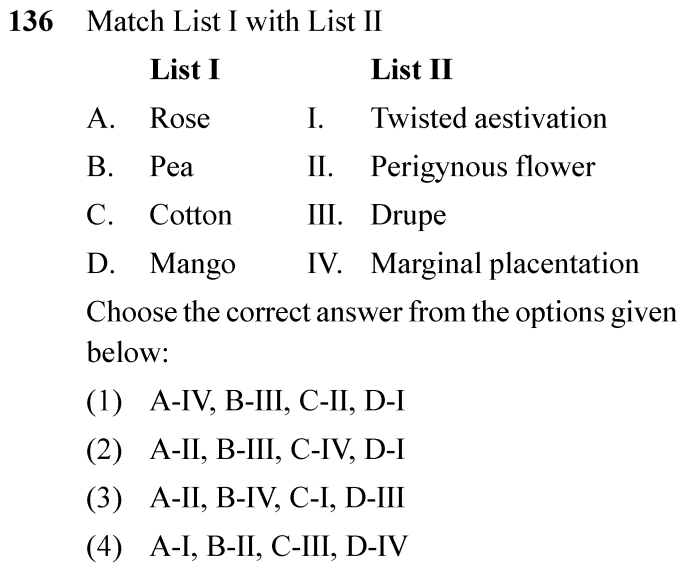
NEET 2024 Botany Question 136: Floral Characteristics: Ovary Position, Placentation, Aestivation, and Fruit

Question

Match List I with List II. List I: A. Rose; B. Pea; C. Cotton; D. Mango. List II: I. Twisted aestivation; II. Perigynous flower; III. Drupe; IV. Marginal placentation. Choose the correct answer from the options given below:

✓
Verified Against NTA Final Answer Key
Option (3) : A-II, B-IV, C-I, D-III
📚 Morphology of Flowering Plants Easy
📋 Given Parameters & Problem Setup
List I (Plants) A: Rose; B: Pea; C: Cotton; D: Mango
List II (Morphological Traits) I: Twisted aestivation; II: Perigynous flower; III: Drupe; IV: Marginal placentation
⚡

The 30-Second Exam Hall Shortcut: ⚡ Plant Morphology Classic Matching

⏱️ Save ~25 seconds

Rose = Perigynous (II); Pea = Marginal placentation (IV); Cotton = Twisted aestivation (I); Mango = Drupe fruit (III). Matches: A-II, B-IV, C-I, D-III!

1 A. Rose: flower is perigynous with half-inferior ovary (II).
2 B. Pea: gynoecium has marginal placentation (IV).
3 C. Cotton: petals exhibit twisted aestivation (I) (China rose, lady’s finger, cotton).
4 D. Mango: fruit is a classic single-seeded Drupe (III).
5 Matches: A-II, B-IV, C-I, D-III -> Option (3) / C.
🛡️
Why You Can 100% Trust This Shortcut: NCERT Biology · Morphology of Flowering Plants (Aestivation, Placentation, and Fruits)
📐

Step-by-Step Rigorous Workflow & Mathematical Proof

Step 1

Match Rose and Pea Features

Rose possesses perigynous flowers where the rim of the thalamus bears floral organs at the level of the half-inferior ovary (A -> II). Pea exhibits marginal placentation along the ventral suture of the monocarpellary ovary (B -> IV).

Step 2

Match Cotton and Mango Features

Cotton belongs to Malvaceae, showing twisted aestivation where one margin of an appendage overlaps that of the next (C -> I). Mango fruit develops from a monocarpellary superior ovary as a drupe with stony endocarp (D -> III).

Step 3

Verify Matching Combination

The corresponding combination is A-II, B-IV, C-I, D-III, matching Option (3).

⭐

360° Option Elimination Engine Key Feature

Diagnose every choice: Know exactly why the right option works and why distractors fail.

4-Option Deep Scan
1 (1)
✗ Incorrect
Verdict & Scientific Reason:

Mismatches Rose with Marginal placentation and Mango with Twisted aestivation.

⚠️
Student Fallacy (Why candidates pick this trap): Mismatches Rose with Marginal placentation and Mango with Twisted aestivation.
2 (2)
✗ Incorrect
Verdict & Scientific Reason:

Mismatches Pea with Drupe and Mango with Twisted aestivation.

⚠️
Student Fallacy (Why candidates pick this trap): Mismatches Pea with Drupe and Mango with Twisted aestivation.
3 (3)
✓ 100% Correct
Verdict & Scientific Reason:

Accurately pairs all four species with their distinctive morphological features.

💡
Why this is airtight: None.
4 (4)
✗ Incorrect
Verdict & Scientific Reason:

Mismatches Rose with Drupe and Mango with Perigynous flower.

⚠️
Student Fallacy (Why candidates pick this trap): Mismatches Rose with Drupe and Mango with Perigynous flower.
⚠️

NTA Trap Alert: Drupe vs Berry Classification

Confusing drupe fruits (mango, coconut) with hesperidium or berries.

🛡️ How to avoid the -1 mark: Remember: Mango and coconut are textbook drupes with a hard, stony endocarp.
📖

Core NEET Syllabus Standard

Biology Core Botany · Morphology of Flowering Plants Standard Benchmark
Core Scientific Principle Tested:

"In rose, the flower is perigynous. In marginal placentation, the placenta forms a ridge along the ventral suture of the ovary (e.g. pea). In twisted aestivation, one margin overlaps the next (cotton). In mango and coconut, the fruit is known as a drupe."

Syllabus Focus: Floral Characteristics: Ovary Position, Placentation, Aestivation, and Fruit
✓ Core NEET UG Syllabus Anchor Syllabus & Academic Standards ↗

Ready to attempt under real exam pressure?

Test your speed and accuracy in the authentic 200-minute timed NTA simulator.

Launch NEET 2024 CBT Test →

Spotted a mistake in this solution? Report an error (support@mycompetitiveexams.com)

⚖️ Legal & Fair Dealing Notice: Sourced from publicly released NEET 2024 question papers and NEET answer keys for private study, research, and non-commercial educational practice under Fair Dealing (Section 52(1)(a) of the Indian Copyright Act, 1957). Not affiliated with or endorsed by NTA or NMC.

Solve 4 NEET Questions a Day — One per Subject

Cover all 1,140 official NEET questions in 285 days at your own pace. Progress is saved on your device. No login needed.