NEET 2020 Physics Question 175 Solution
Question
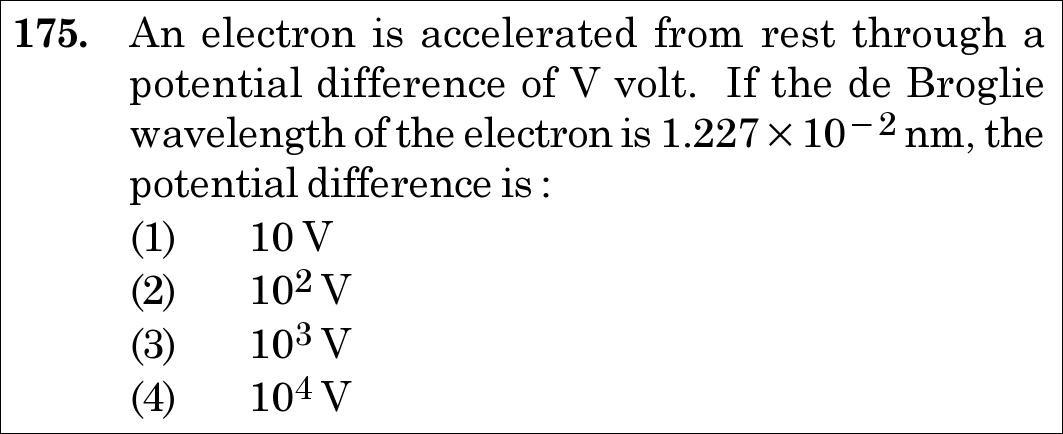
An electron is accelerated from rest through a potential difference of V volt. If the de Broglie wavelength of the electron is 1.227×10⁻² nm, the potential difference is:
Dynamic 180-question full-length simulator mixed dynamically from all 6 years for 2027 & 2026 aspirants.
An electron is accelerated from rest through a potential difference of V volt. If the de Broglie wavelength of the electron is 1.227×10⁻² nm, the potential difference is:
For an electron accelerated through potential difference V, de Broglie wavelength is lambda = 1.227 / sqrt(V) nm. Equating to 1.227 × 10^-2 nm gives sqrt(V) = 1 / 10^-2 = 100 => V = 100^2 = 10000 V = 10^4 V. Don't forget to square 100! Mark Option (4) in 5 seconds.
An electron of mass and charge accelerated from rest through potential difference acquires kinetic energy . Its de Broglie wavelength is: .
Substituting , , and gives the standard compact formula: .
Given : Divide both sides by : . Squaring both sides: .
Matches Option 4.
Diagnose every choice: Know exactly why the right option works and why distractors fail.
Incorrect; for V = 10 V, lambda ≈ 0.388 nm.
Incorrect; forgets to square sqrt(V) = 100, answering 100 V instead of 10000 V.
Incorrect; corresponds to sqrt(V) ≈ 31.6 V.
Accurate value; sqrt(V) = 100 => V = 100^2 = 10^4 V.
Students frequently solve for sqrt(V) = 100 and immediately mark 100 V (10^2 V, Option B). The potential is V, so you MUST square it: (100)^2 = 10^4 V.
""
Test your speed and accuracy in the authentic 180-minute timed NTA simulator.
Spotted a mistake in this solution? Report an error (support@mycompetitiveexams.com)
Cover all 1,140 official NEET questions in 285 days at your own pace. Progress is saved on your device. No login needed.