MyCompetitiveExams Logo MyCompetitiveExams
Search 1,140+ Questions
Chapters, formulas, speed tricks
→
⚡ Brahmastra NEET 2027
720 MARKS

Dynamic 180-question full-length simulator mixed dynamically from all 6 years for 2027 & 2026 aspirants.

Launch Brahmastra 2027 Test →
Start Practice →
100% Free · No Login Required
Q.149 Physics ⭐ 360° Option Elimination Active
Vault ↗

NEET 2020 Physics Question 149 Solution

Topic: System of Particles and Rotational Motion · Official NTA Booklet Code E1
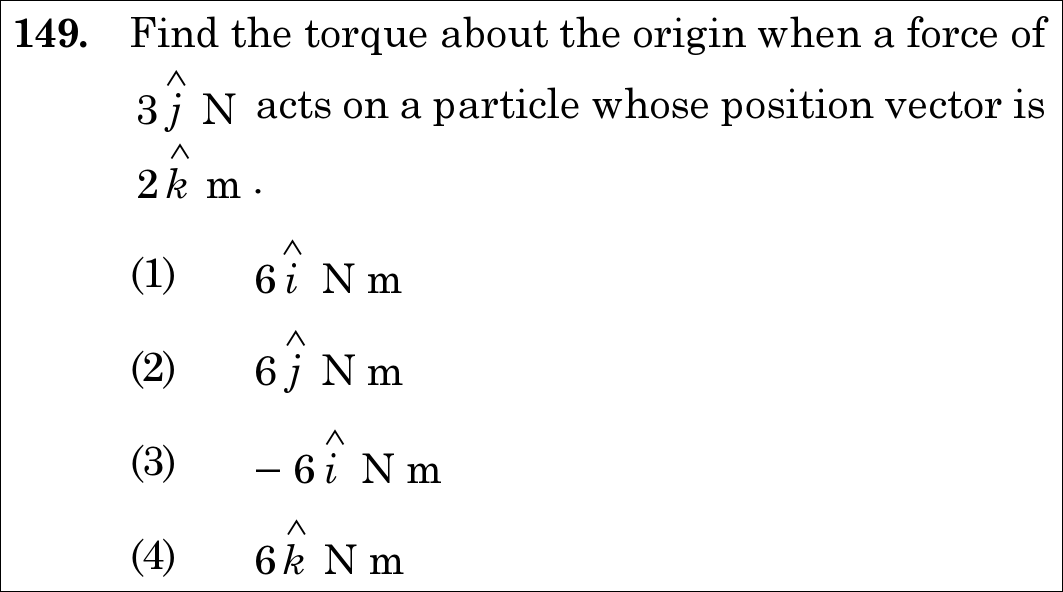
NEET 2020 Physics Question 149: Torque Vector Calculation: τ = r × F

Question

Find the torque about the origin when a force of 3ĵ N acts on a particle whose position vector is 2k̂ m.

✓
Verified Against NTA Final Answer Key
Option (3) : -6 i^ N m
📚 System of Particles and Rotational Motion Easy
📋 Given Parameters & Problem Setup
Position Vector (r) 2 k^ m
Force Vector (F) 3 j^ N
Reference Point Origin (0, 0, 0)
Vector Product Formula τ = r × F
⚡

The 30-Second Exam Hall Shortcut: ⚡ "τ = r × F = (2 k^) × (3 j^) = 6 (k^ × j^) = 6 (-i^) = -6 i^ N m!"

⏱️ 15 seconds

Torque is the cross product of position vector and force vector: τ⃗=r⃗×F⃗\vec{\tau} = \vec{r} \times \vec{F}. Substituting: τ⃗=(2k^)×(3j^)=6(k^×j^)\vec{\tau} = (2\hat{k}) \times (3\hat{j}) = 6 (\hat{k} \times \hat{j}). Using the right-hand cyclic rule: k^×j^=−i^\hat{k} \times \hat{j} = -\hat{i}. Therefore, τ⃗=−6i^ N m\vec{\tau} = -6\hat{i}\text{ N m}! Mark Option (3) in 5 seconds.

1 Formula: τ = r × F (order matters: r first, F second!).
2 Substitute given vectors: r = 2 k^, F = 3 j^.
3 Cross product: τ = (2 k^) × (3 j^) = 6 (k^ × j^).
4 Right-hand unit vector cycle: i^ × j^ = k^, j^ × k^ = i^, k^ × j^ = -i^.
5 Result: τ = -6 i^ N m.
6 Select Option (3).
🛡️
Why You Can 100% Trust This Shortcut: NCERT Physics · System of Particles and Rotational Motion (Angular Momentum and Torque: Vector Product)
📐

Step-by-Step Rigorous Workflow & Mathematical Proof

Step 1

Define Torque Vector with Respect to Origin

The torque (moment of force) τ⃗\vec{\tau} acting on a particle having position vector r⃗\vec{r} with respect to the origin is defined as the cross product: τ⃗=r⃗×F⃗\vec{\tau} = \vec{r} \times \vec{F} Note that the cross product is anti-commutative (r⃗×F⃗=−(F⃗×r⃗)\vec{r} \times \vec{F} = -(\vec{F} \times \vec{r})), so the order of vectors is critical.

Step 2

Insert Given Vectors

Given: r⃗=2k^ m\vec{r} = 2\hat{k} \text{ m} F⃗=3j^ N\vec{F} = 3\hat{j} \text{ N}

Step 3

Evaluate Cross Product Using Unit Vector Rules

Recall the right-handed Cartesian cyclic cross product relations: - i^×j^=k^\hat{i} \times \hat{j} = \hat{k} - j^×k^=i^\hat{j} \times \hat{k} = \hat{i} - k^×i^=j^\hat{k} \times \hat{i} = \hat{j} In reverse (counter-cyclic) order: - k^×j^=−i^\hat{k} \times \hat{j} = -\hat{i} Therefore: τ⃗=(2k^)×(3j^)=(2×3)(k^×j^)=6(−i^)=−6i^ N m\vec{\tau} = (2\hat{k}) \times (3\hat{j}) = (2 \times 3)(\hat{k} \times \hat{j}) = 6(-\hat{i}) = -6\hat{i} \text{ N m}

Step 4

Verify Determinant Method

τ⃗=∣i^j^k^002030∣=i^(0−6)−j^(0−0)+k^(0−0)=−6i^ N m\vec{\tau} = \begin{vmatrix} \hat{i} & \hat{j} & \hat{k} \\ 0 & 0 & 2 \\ 0 & 3 & 0 \end{vmatrix} = \hat{i}(0 - 6) - \hat{j}(0 - 0) + \hat{k}(0 - 0) = -6\hat{i}\text{ N m} This confirms Option (3).

⭐

360° Option Elimination Engine Key Feature

Diagnose every choice: Know exactly why the right option works and why distractors fail.

4-Option Deep Scan
1 A
✗ Incorrect
Verdict & Scientific Reason:

Incorrect; classic sign error caused by calculating F⃗×r⃗=(3j^)×(2k^)=+6i^\vec{F} \times \vec{r} = (3\hat{j}) \times (2\hat{k}) = +6\hat{i} instead of r⃗×F⃗\vec{r} \times \vec{F}.

⚠️
Student Fallacy (Why candidates pick this trap): Reversing the order of cross product (F⃗×r⃗\vec{F} \times \vec{r} instead of r⃗×F⃗\vec{r} \times \vec{F}).
2 B
✗ Incorrect
Verdict & Scientific Reason:

Incorrect; vector cross product of k^\hat{k} and j^\hat{j} lies along the i^\hat{i} axis, perpendicular to both.

⚠️
Student Fallacy (Why candidates pick this trap): Assuming torque points along the force direction.
3 C
✓ 100% Correct
Verdict & Scientific Reason:

Factually and mathematically exact; τ⃗=2k^×3j^=−6i^ N m\vec{\tau} = 2\hat{k} \times 3\hat{j} = -6\hat{i}\text{ N m}.

💡
Why this is airtight: None; rigorous vector algebra.
4 D
✗ Incorrect
Verdict & Scientific Reason:

Incorrect; torque cannot be parallel to position vector.

⚠️
Student Fallacy (Why candidates pick this trap): Confusing vector directions.
⚠️

NTA Trap Alert: r × F vs F × r Order Trap

Torque is r⃗×F⃗\vec{r} \times \vec{F}, NOT F⃗×r⃗\vec{F} \times \vec{r}! k^×j^=−i^\hat{k} \times \hat{j} = -\hat{i}. If you do F×rF \times r, you get +6i^+6\hat{i} (Option 1, the trap!).

🛡️ How to avoid the -1 mark: Write the formula explicitly: τ⃗=r⃗×F⃗\vec{\tau} = \vec{r} \times \vec{F}! Remember: k^×j^=−i^\hat{k} \times \hat{j} = -\hat{i}!
📖

Core NEET Syllabus Standard

Physics · System of Particles and Rotational Motion Standard Benchmark
Core Scientific Principle Tested:

""

Syllabus Focus: Torque Vector Calculation: τ = r × F
✓ Core NEET UG Syllabus Anchor Syllabus & Academic Standards ↗

Ready to attempt under real exam pressure?

Test your speed and accuracy in the authentic 180-minute timed NTA simulator.

Launch NEET 2020 CBT Test →

Spotted a mistake in this solution? Report an error (support@mycompetitiveexams.com)

⚖️ Legal & Fair Dealing Notice: Sourced from publicly released NEET 2020 question papers and NEET answer keys for private study, research, and non-commercial educational practice under Fair Dealing (Section 52(1)(a) of the Indian Copyright Act, 1957). Not affiliated with or endorsed by NTA or NMC.

Solve 4 NEET Questions a Day — One per Subject

Cover all 1,140 official NEET questions in 285 days at your own pace. Progress is saved on your device. No login needed.