MyCompetitiveExams Logo MyCompetitiveExams
Search 1,140+ Questions
Chapters, formulas, speed tricks
→
⚡ Brahmastra NEET 2027
720 MARKS

Dynamic 180-question full-length simulator mixed dynamically from all 6 years for 2027 & 2026 aspirants.

Launch Brahmastra 2027 Test →
Start Practice →
100% Free · No Login Required
Q.11 Botany ⭐ 360° Option Elimination Active
Vault ↗

NEET 2020 Botany Question 11 Solution

Topic: Biomolecules · Official NTA Booklet Code E1
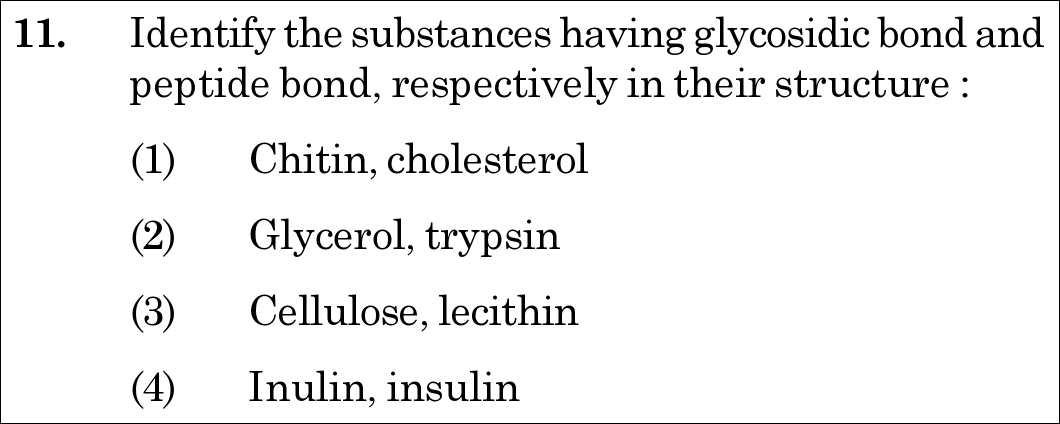
NEET 2020 Botany Question 11: Glycosidic Bonds in Polysaccharides (Inulin) and Peptide Bonds in Polypeptides (Insulin)

Question

Identify the substances having glycosidic bond and peptide bond, respectively in their structure:

  1. (1)Chitin, cholesterol
  2. (2)Glycerol, trypsin
  3. (3)Cellulose, lecithin
  4. (4)Inulin, insulin
✓
Verified Against NTA Final Answer Key
Option (4) : Inulin, insulin
📚 Biomolecules Easy
📋 Given Parameters & Problem Setup
Bond 1 Glycosidic bond (Ether linkage between monosaccharide units)
Bond 2 Peptide bond (-CONH- amide linkage between amino acids)
Question Objective Identify substances possessing glycosidic bond and peptide bond, respectively
⚡

The 30-Second Exam Hall Shortcut: ⚡ "Inulin is a Polysaccharide (Glycosidic); Insulin is a Protein (Peptide)!"

⏱️ Save ~20 seconds

Inulin is a homopolysaccharide polymer of fructose joined by beta-(2,1)-glycosidic bonds. Insulin is a 51-amino acid polypeptide hormone joined by peptide bonds. Inulin and Insulin represent glycosidic and peptide bonds respectively! Mark Option (4) in 5 seconds.

1 Identify chemical class of Substance 1: Must be a carbohydrate/polysaccharide to contain glycosidic bonds.
2 Identify chemical class of Substance 2: Must be a protein/polypeptide to contain peptide bonds.
3 Inspect pairs: - Pair (1): Chitin (glycosidic) and Cholesterol (lipid/sterol, no peptide bond) -> False. - Pair (2): Glycerol (simple polyol, no glycosidic bond) and Trypsin (protein) -> False. - Pair (3): Cellulose (glycosidic) and Lecithin (phospholipid, ester bonds) -> False. - Pair (4): Inulin (fructan carbohydrate) and Insulin (peptide hormone) -> 100% CORRECT!
4 Select Option (4).
🛡️
Why You Can 100% Trust This Shortcut: NCERT Biology · Biomolecules (Nature of Bonds Linking Monomers in a Polymer: In a polysaccharide the individual monosaccharides are linked by a glycosidic bond, e.g. inulin is a polymer of fructose. In a polypeptide or protein, amino acids are linked by a peptide bond formed when carboxyl group reacts with amino group).
📐

Step-by-Step Rigorous Workflow & Mathematical Proof

Step 1

Biochemical Nature of Glycosidic and Peptide Linkages

- Glycosidic Bond: Formed by dehydration synthesis between two carbon atoms of adjacent monosaccharide rings (eliminating a water molecule) to yield an ether linkage (−C−O−C−-C-O-C-). Canonical examples include starch, glycogen, cellulose, and inulin (a linear storage fructan polymer of D-fructose found in dahlia tubers). - Peptide Bond: Formed by condensation between the α\alpha-carboxyl group (−COOH-COOH) of one amino acid and the α\alpha-amino group (−NH2-NH_2) of the next amino acid with elimination of water, forming a planar −CO−NH−-CO-NH- amide linkage. Canonical examples include enzymes, antibodies, and peptide hormones like insulin (51 amino acids across chain A and chain B).

Monosaccharide+Monosaccharide→−H2OGlycosidic Bond(e.g. Inulin)Amino Acid+Amino Acid→−H2OPeptide Bond (−CO−NH−)(e.g. Insulin)\begin{aligned} \text{Monosaccharide} + \text{Monosaccharide} &\xrightarrow{-H_2O} \mathbf{Glycosidic\,Bond} \quad (\text{e.g. \textbf{Inulin}}) \\[4pt] \text{Amino Acid} + \text{Amino Acid} &\xrightarrow{-H_2O} \mathbf{Peptide\,Bond\,(-CO-NH-)} \quad (\text{e.g. \textbf{Insulin}}) \end{aligned}
Step 2

Elimination of Competing Biomolecules

- Cholesterol: A sterol lipid composed of four fused hydrocarbon rings (cyclopentanoperhydrophenanthrene), containing neither glycosidic nor peptide bonds. - Glycerol: Trihydroxy propane (alcohol), forming ester linkages with fatty acids in neutral fats. - Lecithin: A phospholipid containing ester and phosphoester bonds, not peptide bonds.

⭐

360° Option Elimination Engine Key Feature

Diagnose every choice: Know exactly why the right option works and why distractors fail.

4-Option Deep Scan
1 A
✗ Incorrect
Verdict & Scientific Reason:

Incorrect. While chitin has glycosidic bonds (N-acetylglucosamine), cholesterol is a steroid lipid lacking peptide bonds.

⚠️
Student Fallacy (Why candidates pick this trap): Assuming cholesterol contains peptide bonds.
2 B
✗ Incorrect
Verdict & Scientific Reason:

Incorrect. Glycerol is a simple trihydric alcohol lacking glycosidic bonds.

⚠️
Student Fallacy (Why candidates pick this trap): Mistaking glycerol for a polysaccharide.
3 C
✗ Incorrect
Verdict & Scientific Reason:

Incorrect. Cellulose has glycosidic bonds, but lecithin is a phospholipid, not a peptide.

⚠️
Student Fallacy (Why candidates pick this trap): Confusing phospholipids with proteins.
4 D
✓ 100% Correct
Verdict & Scientific Reason:

Correct. Inulin is a fructan polysaccharide (glycosidic bonds) and insulin is a polypeptide hormone (peptide bonds).

💡
Why this is airtight: None. Candidate recognizes the chemical identities of inulin and insulin.
⚠️

NTA Trap Alert: Inulin vs Insulin Phonetic Confusion Trap

Students frequently confuse "Inulin" (plant storage fructan carbohydrate) with "Insulin" (pancreatic polypeptide hormone). Inulin = Glycosidic; Insulin = Peptide.

🛡️ How to avoid the -1 mark: Remember: InulIN is sugar/fructose; InsulIN is a protein hormone.
📖

Core NEET Syllabus Standard

NEET / NCERT Biology · Biomolecules Standard Benchmark
Core Scientific Principle Tested:

"Inulin is a polysaccharide containing glycosidic bonds; insulin is a protein containing peptide bonds."

Syllabus Focus: Bonds in Biomolecules
✓ Core NEET UG Syllabus Anchor Syllabus & Academic Standards ↗

Ready to attempt under real exam pressure?

Test your speed and accuracy in the authentic 180-minute timed NTA simulator.

Launch NEET 2020 CBT Test →

Spotted a mistake in this solution? Report an error (support@mycompetitiveexams.com)

⚖️ Legal & Fair Dealing Notice: Sourced from publicly released NEET 2020 question papers and NEET answer keys for private study, research, and non-commercial educational practice under Fair Dealing (Section 52(1)(a) of the Indian Copyright Act, 1957). Not affiliated with or endorsed by NTA or NMC.

Solve 4 NEET Questions a Day — One per Subject

Cover all 1,140 official NEET questions in 285 days at your own pace. Progress is saved on your device. No login needed.