NEET 2020 Chemistry Question 122 Solution
Question
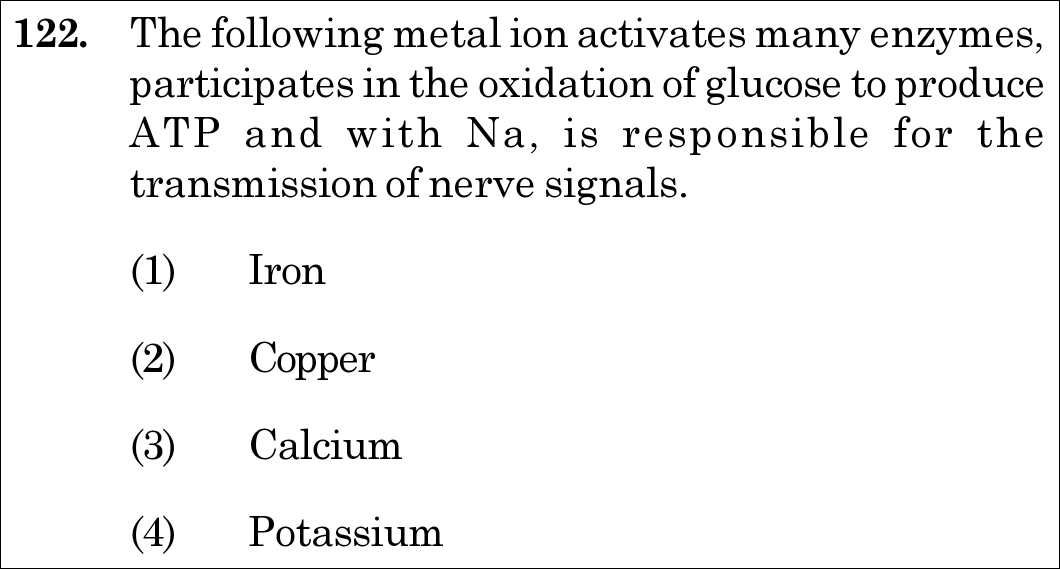
The following metal ion activates many enzymes, participates in the oxidation of glucose to produce ATP and with Na⁺, is responsible for the transmission of nerve signals.
Dynamic 180-question full-length simulator mixed dynamically from all 6 years for 2027 & 2026 aspirants.
The following metal ion activates many enzymes, participates in the oxidation of glucose to produce ATP and with Na⁺, is responsible for the transmission of nerve signals.
Potassium ions () are the most abundant intracellular cations. They activate many enzymes (especially those involved in glycolysis / glucose oxidation to produce ATP) and, along with , maintain the resting membrane potential and nerve impulse transmission via the Sodium-Potassium pump ( ATPase). Mark Potassium (Option 4) in 5 seconds!
In the s-block elements chapter, NCERT presents an explicit section detailing the biological roles of sodium and potassium ions in human physiology.
NCERT states verbatim: "Potassium ions are the most abundant cations within cell fluids, where they activate many enzymes, participate in the oxidation of glucose to produce ATP and, with sodium, are responsible for the transmission of nerve signals."
The operating concentration gradient across the neuronal membrane (high inside, high outside) is maintained by the active pump, which consumes more than one-third of total resting ATP in a resting animal to propagate nerve impulses.
- Calcium (): Essential for neuromuscular excitability, blood clotting, and bone mineralization. - Iron (): Part of haemoglobin and cytochromes for electron transport. - Copper (): Component of cytochrome c oxidase and tyrosinase. Thus, Potassium is uniquely described by all three statements.
Diagnose every choice: Know exactly why the right option works and why distractors fail.
Incorrect; iron is primarily involved in oxygen transport in haemoglobin and electron transport in cytochromes, not coordinating with Na+ in nerve transmission.
Incorrect; copper is a trace cofactor for redox enzymes like cytochrome c oxidase.
Incorrect; calcium is involved in muscle contraction, blood clotting, and secondary messenger signaling, not partnering with Na+ in glycolysis ATP production.
Factually exact; verbatim match to the NCERT description of potassium's biological functions.
- Sodium (): Main EXTRACELLULAR cation (blood plasma & interstitial fluid), regulates osmotic balance and water retention. - Potassium (): Main INTRACELLULAR cation, activates GLYCOLYTIC ENZYMES and generates ATP, works with in NERVE TRANSMISSION.
""
Test your speed and accuracy in the authentic 180-minute timed NTA simulator.
Spotted a mistake in this solution? Report an error (support@mycompetitiveexams.com)
Cover all 1,140 official NEET questions in 285 days at your own pace. Progress is saved on your device. No login needed.