MyCompetitiveExams Logo MyCompetitiveExams
Search 1,140+ Questions
Chapters, formulas, speed tricks
→
⚡ Brahmastra NEET 2027
720 MARKS

Dynamic 180-question full-length simulator mixed dynamically from all 6 years for 2027 & 2026 aspirants.

Launch Brahmastra 2027 Test →
Start Practice →
100% Free · No Login Required
Q.178 Physics ⭐ 360° Option Elimination Active
Vault ↗

NEET 2020 Physics Question 178 Solution

Topic: Mechanical Properties of Fluids · Official NTA Booklet Code E1
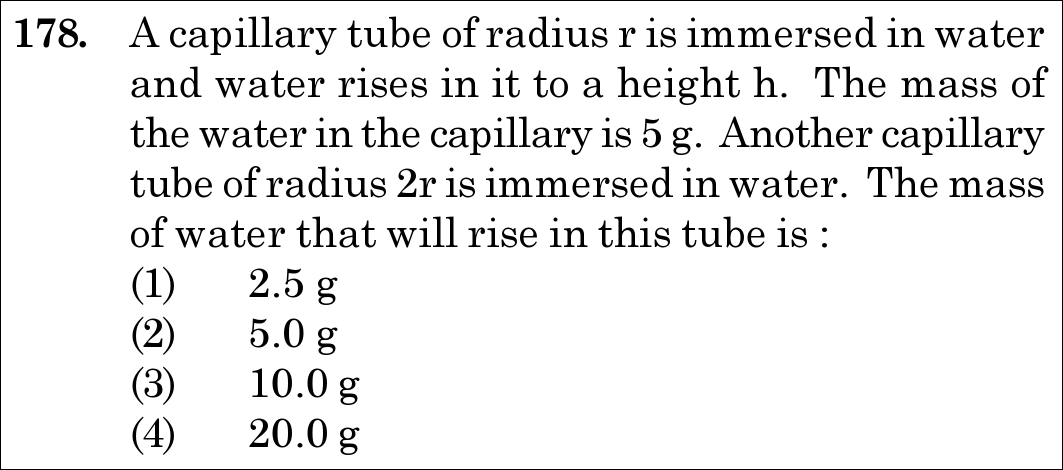
NEET 2020 Physics Question 178: Mass of Liquid Supported in a Capillary Tube vs Tube Radius

Question

A capillary tube of radius r is immersed in water and water rises in it to a height h. The mass of the water in the capillary is 5 g. Another capillary tube of radius 2r is immersed in water. The mass of water that will rise in this tube is:

✓
Verified Against NTA Final Answer Key
Option (3) : 10.0 g
📚 Mechanical Properties of Fluids Medium
📋 Given Parameters & Problem Setup
Capillary 1 Radius r, holds mass m = 5 g
Capillary 2 Radius 2r
⚡

The 30-Second Exam Hall Shortcut: ⚡ "Upward force of surface tension 2pi r T cos theta balances weight m g => m proportional to r. When radius doubles from r to 2r, mass doubles: 2 × 5 g = 10.0 g!"

⏱️ 20 seconds

The upward surface tension force acting along the perimeter of the meniscus is F = 2πr · T · cos θ. In equilibrium, this balances the weight of the liquid column: W = mg = 2πr T cos θ. Therefore, mass m is directly proportional to radius r (m ∝ r). When radius doubles from r to 2r, mass of water lifted also doubles: 2 × 5 g = 10.0 g. Direct 5-second answer!

1 Force balance: mg=2πrTcos⁡θm g = 2\pi r T \cos\theta.
2 Notice: m∝rm \propto r.
3 For radius 2r2r: m′=2mm' = 2m.
4 Substitute m=5 gm = 5\text{ g}: m′=2×5 g=10.0 gm' = 2 \times 5\text{ g} = 10.0\text{ g}.
5 Select Option (3).
🛡️
Why You Can 100% Trust This Shortcut: NCERT Physics · Mechanical Properties of Fluids (Surface Tension, Capillary Rise and Jurin’s Law)
📐

Step-by-Step Rigorous Workflow & Mathematical Proof

Step 1

Equilibrium of Liquid in a Capillary Tube

When a capillary tube of internal radius rr is immersed in water, the meniscus forms a contact angle θ\theta. Surface tension TT acts along the contact perimeter 2πr2\pi r. The upward vertical force supporting the liquid column is: Fup=2πrTcos⁡θF_{\text{up}} = 2\pi r T \cos\theta.

Step 2

Balance with Weight of Liquid Column

At equilibrium, this upward force balances the weight of the liquid inside the capillary: W=mgW = m g mg=2πrTcos⁡θ  ⟹  m=2πrTcos⁡θgm g = 2\pi r T \cos\theta \implies m = \frac{2\pi r T \cos\theta}{g}.

Step 3

Analyze Proportionality with Radius

Since surface tension TT, contact angle θ\theta, and gg are constant for the water-glass system: m∝rm \propto r (Note: Even though height h=2Tcos⁡θρgr∝1rh = \frac{2T\cos\theta}{\rho g r} \propto \frac{1}{r} halves, the cross-sectional area A=πr2A = \pi r^2 quadruples, so volume V=Ah∝r2×(1/r)=rV = A h \propto r^2 \times (1/r) = r, confirming m∝rm \propto r).

Step 4

Compute New Mass for Radius 2r

For the second tube with radius r2=2rr_2 = 2r: m2=2×m1=2×5 g=10.0 gm_2 = 2 \times m_1 = 2 \times 5\text{ g} = 10.0\text{ g}. Matches Option 3.

⭐

360° Option Elimination Engine Key Feature

Diagnose every choice: Know exactly why the right option works and why distractors fail.

4-Option Deep Scan
1 A
✗ Incorrect
Verdict & Scientific Reason:

Incorrect; assumes mass is proportional to height (which halves, 5 / 2 = 2.5 g), forgetting that tube cross-section quadruples.

⚠️
Student Fallacy (Why candidates pick this trap): Confusing mass with height of capillary rise.
2 B
✗ Incorrect
Verdict & Scientific Reason:

Incorrect; assumes mass remains unchanged regardless of radius.

⚠️
Student Fallacy (Why candidates pick this trap): Assuming invariant mass in capillary tubes.
3 C
✓ 100% Correct
Verdict & Scientific Reason:

Accurate value; upward force F = 2pi r T cos theta doubles with radius, supporting double the mass (10.0 g).

💡
Why this is airtight: None; rigorous force-balance understanding.
4 D
✗ Incorrect
Verdict & Scientific Reason:

Incorrect; assumes mass scales as r^2, ignoring that height simultaneously halves.

⚠️
Student Fallacy (Why candidates pick this trap): Ignoring the halving of capillary height.
⚠️

NTA Trap Alert: Height vs Mass in Capillary Rise

Height of liquid column h ∝ 1/r (halves when r doubles). But Mass m = rho · pi · r^2 · h ∝ r^2 · (1/r) = r (doubles when r doubles).

🛡️ How to avoid the -1 mark: Remember: Upward force = 2πr T cos θ = mg. Force is proportional to perimeter (r), so mass is proportional to r!
📖

Core NEET Syllabus Standard

Physics · Mechanical Properties of Fluids Standard Benchmark
Core Scientific Principle Tested:

""

Syllabus Focus: Mass of Liquid Supported in a Capillary Tube vs Tube Radius
✓ Core NEET UG Syllabus Anchor Syllabus & Academic Standards ↗

Ready to attempt under real exam pressure?

Test your speed and accuracy in the authentic 180-minute timed NTA simulator.

Launch NEET 2020 CBT Test →

Spotted a mistake in this solution? Report an error (support@mycompetitiveexams.com)

⚖️ Legal & Fair Dealing Notice: Sourced from publicly released NEET 2020 question papers and NEET answer keys for private study, research, and non-commercial educational practice under Fair Dealing (Section 52(1)(a) of the Indian Copyright Act, 1957). Not affiliated with or endorsed by NTA or NMC.

Solve 4 NEET Questions a Day — One per Subject

Cover all 1,140 official NEET questions in 285 days at your own pace. Progress is saved on your device. No login needed.