MyCompetitiveExams Logo MyCompetitiveExams
Search 1,140+ Questions
Chapters, formulas, speed tricks
→
⚡ Brahmastra NEET 2027
720 MARKS

Dynamic 180-question full-length simulator mixed dynamically from all 6 years for 2027 & 2026 aspirants.

Launch Brahmastra 2027 Test →
Start Practice →
100% Free · No Login Required
Q.140 Physics ⭐ 360° Option Elimination Active
Vault ↗

NEET 2020 Physics Question 140 Solution

Topic: Ray Optics and Optical Instruments · Official NTA Booklet Code E1
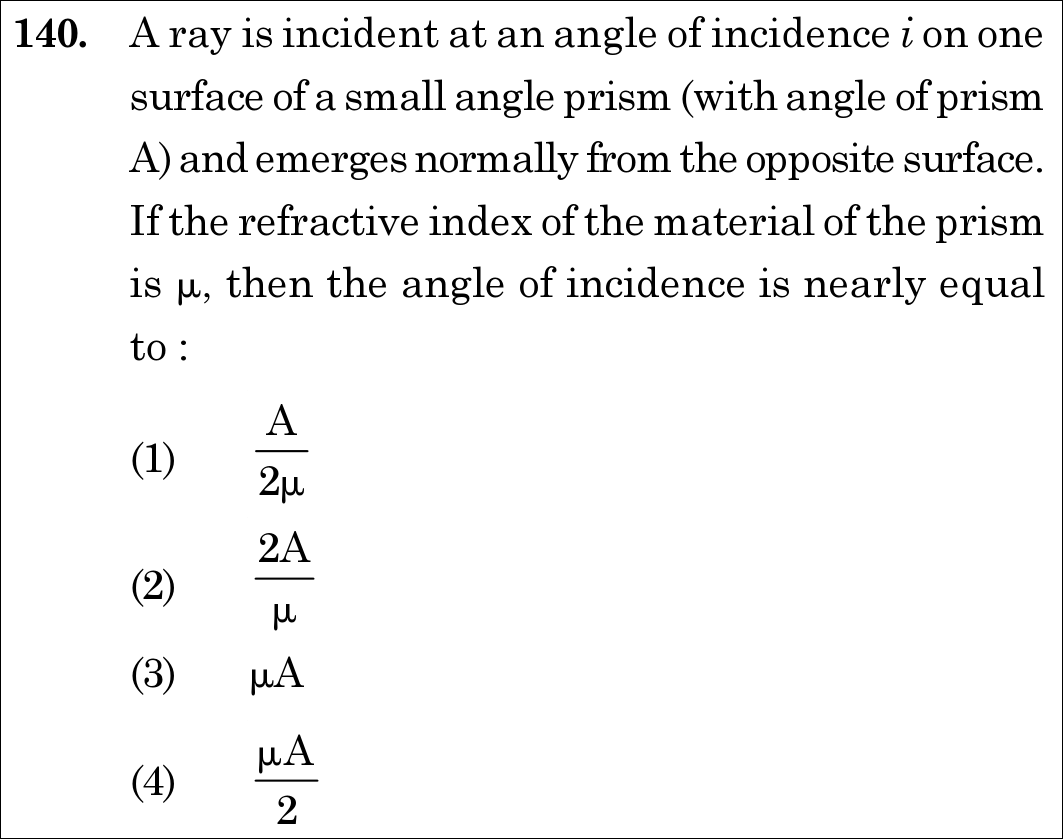
NEET 2020 Physics Question 140: Small-Angle Prism with Normal Emergence: Incident Angle i ≈ μA

Question

A ray is incident at an angle of incidence i on one surface of a small angle prism (with angle of prism A) and emerges normally from the opposite surface. If the refractive index of the material of the prism is μ, then the angle of incidence is nearly equal to:

✓
Verified Against NTA Final Answer Key
Option (3) : µA
📚 Ray Optics and Optical Instruments Easy
📋 Given Parameters & Problem Setup
Prism Geometry Small angle prism (prism angle A is small, in radians)
Refractive Index μ
Emergence Condition Emerges normally from the opposite surface (e = 0, r2 = 0)
Question Objective Find the angle of incidence i
⚡

The 30-Second Exam Hall Shortcut: ⚡ "Normal Emergence: r2 = 0 -> r1 = A; Small Angle: i = μ r1 = μA!"

⏱️ 20 seconds

Normal emergence from the second face means angle of emergence e=0e = 0 and second angle of refraction r2=0r_2 = 0. From prism relation r1+r2=Ar_1 + r_2 = A, we get r1=Ar_1 = A. Applying Snell's law at the first face: sin⁡i=μsin⁡r1=μsin⁡A\sin i = \mu \sin r_1 = \mu \sin A. For a small angle prism (A≪1A \ll 1), sin⁡θ≈θ\sin \theta \approx \theta, so i≈μAi \approx \mu A! Mark Option (3) in 5 seconds.

1 Ray emerges normally from second surface: angle of refraction r2 = 0.
2 Prism angle equation: r1 + r2 = A => r1 = A.
3 Snell's law at first surface: sin(i) = μ sin(r1) = μ sin(A).
4 For small angles (sin θ ≈ θ): i ≈ μA.
5 Select Option (3) µA.
🛡️
Why You Can 100% Trust This Shortcut: NCERT Physics · Ray Optics and Optical Instruments (Refraction through a Prism)
📐

Step-by-Step Rigorous Workflow & Mathematical Proof

Step 1

Apply Normal Emergence Condition

The ray emerges normally from the second surface of the prism. This means the ray is perpendicular to the second interface (θ=90∘\theta = 90^\circ to the surface, hence along the normal): r2=0∘ande=0∘r_2 = 0^\circ \quad \text{and} \quad e = 0^\circ

Step 2

Relate Internal Angles to Prism Angle

For any triangular prism, geometry dictates that the prism angle AA equals the sum of the two internal refraction angles: r1+r2=Ar_1 + r_2 = A Since r2=0r_2 = 0: r1+0=A  ⟹  r1=Ar_1 + 0 = A \implies r_1 = A

Step 3

Apply Snell's Law at First Surface

At the first refracting surface, light passes from air (μ1=1\mu_1 = 1) into the prism medium (μ2=μ\mu_2 = \mu) at incident angle ii: sin⁡i=μsin⁡r1\sin i = \mu \sin r_1 Substituting r1=Ar_1 = A: sin⁡i=μsin⁡A\sin i = \mu \sin A

Step 4

Use Small Angle Approximation

Because the question explicitly specifies a "small angle prism" (typically A≤10∘A \le 10^\circ), we utilize the standard paraxial small-angle trigonometric approximations: sin⁡i≈iandsin⁡A≈A\sin i \approx i \quad \text{and} \quad \sin A \approx A Substituting these approximations yields: i≈μAi \approx \mu A This directly gives Option (3).

⭐

360° Option Elimination Engine Key Feature

Diagnose every choice: Know exactly why the right option works and why distractors fail.

4-Option Deep Scan
1 A
✗ Incorrect
Verdict & Scientific Reason:

Incorrect; inverts the refractive index and introduces an erroneous factor of 2.

⚠️
Student Fallacy (Why candidates pick this trap): Confusing with minimum deviation symmetric conditions (r=A/2r = A/2).
2 B
✗ Incorrect
Verdict & Scientific Reason:

Incorrect; dimensional error.

⚠️
Student Fallacy (Why candidates pick this trap): Multiplying by 2 and dividing by μ\mu.
3 C
✓ 100% Correct
Verdict & Scientific Reason:

Factually and optically exact; normal emergence yields r1=Ar_1 = A, giving i≈μAi \approx \mu A.

💡
Why this is airtight: None; standard optical prism derivation.
4 D
✗ Incorrect
Verdict & Scientific Reason:

Incorrect; duplicate distorted formula.

⚠️
Student Fallacy (Why candidates pick this trap): Assuming division by refractive index.
⚠️

NTA Trap Alert: Minimum Deviation vs Normal Emergence

- MINIMUM DEVIATION: r1=r2=A/2r_1 = r_2 = A/2, symmetric refraction. - NORMAL EMERGENCE: r2=0r_2 = 0, so r1=Ar_1 = A, leading to i≈μAi \approx \mu A.

🛡️ How to avoid the -1 mark: Look for "emerges normally" -> r2=0r_2 = 0 -> r1=Ar_1 = A -> i=μAi = \mu A!
📖

Core NEET Syllabus Standard

Physics · Ray Optics and Optical Instruments Standard Benchmark
Core Scientific Principle Tested:

""

Syllabus Focus: Small-Angle Prism with Normal Emergence: Incident Angle i ≈ μA
✓ Core NEET UG Syllabus Anchor Syllabus & Academic Standards ↗

Ready to attempt under real exam pressure?

Test your speed and accuracy in the authentic 180-minute timed NTA simulator.

Launch NEET 2020 CBT Test →

Spotted a mistake in this solution? Report an error (support@mycompetitiveexams.com)

⚖️ Legal & Fair Dealing Notice: Sourced from publicly released NEET 2020 question papers and NEET answer keys for private study, research, and non-commercial educational practice under Fair Dealing (Section 52(1)(a) of the Indian Copyright Act, 1957). Not affiliated with or endorsed by NTA or NMC.

Solve 4 NEET Questions a Day — One per Subject

Cover all 1,140 official NEET questions in 285 days at your own pace. Progress is saved on your device. No login needed.