MyCompetitiveExams Logo MyCompetitiveExams
Search 1,140+ Questions
Chapters, formulas, speed tricks
→
⚡ Brahmastra NEET 2027
720 MARKS

Dynamic 180-question full-length simulator mixed dynamically from all 6 years for 2027 & 2026 aspirants.

Launch Brahmastra 2027 Test →
Start Practice →
100% Free · No Login Required
Q.38 Botany ⭐ 360° Option Elimination Active
Vault ↗

NEET 2020 Botany Question 38 Solution

Topic: Evolution · Official NTA Booklet Code E1
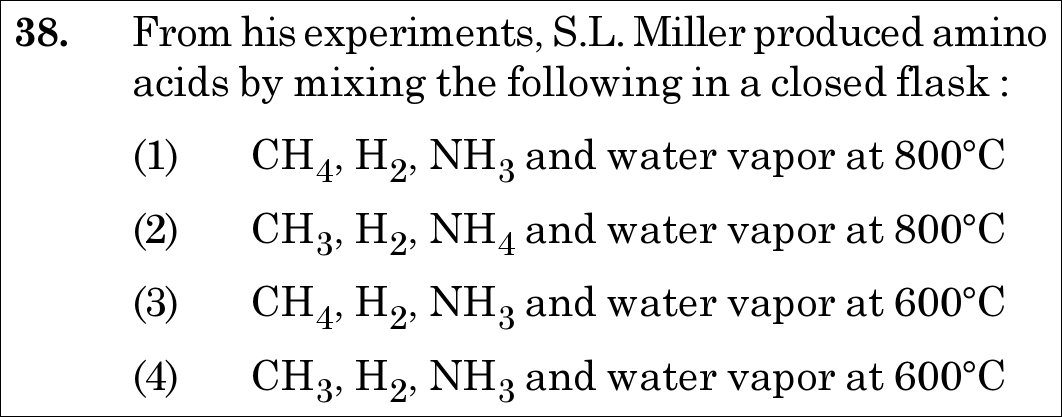
NEET 2020 Botany Question 38: Stanley Miller Spark-Discharge Experiment Parameters

Question

From his experiments, S.L. Miller produced amino acids by mixing the following in a closed flask:

  1. (1)CH4, H2, NH3 and water vapor at 8008C
  2. (2)CH3, H2, NH4 and water vapor at 8008C
  3. (3)CH4, H2, NH3 and water vapor at 6008C
  4. (4)CH3, H2, NH3 and water vapor at 6008C
✓
Verified Against NTA Final Answer Key
Option (1) : CH4, H2, NH3 and water vapor at 800°C
📚 Evolution Easy
📋 Given Parameters & Problem Setup
Experimenter S.L. Miller (1953)
Experimental Conditions Electric discharge spark in closed flask simulating primitive Earth
Question Objective Identify the exact gas mixture and temperature used
⚡

The 30-Second Exam Hall Shortcut: ⚡ "Miller = CH4 + H2 + NH3 + H2O at 800°C"

⏱️ 30 seconds

Miller used Methane (CH4), Hydrogen (H2), Ammonia (NH3), and water vapor (ratio 2:2:1 or 2:1:2) with electric spark discharge at exactly 800°C. Beware of fake formulas like CH3 or NH4, and lower temperatures like 600°C. Mark Option (1) in 5 seconds!

1 Check formulas: Methane is CH4 (not radical CH3); Ammonia is NH3 (not ammonium NH4).
2 Check temperature: Electric discharge occurred at 800°C (not 600°C).
3 Select Option (1).
🛡️
Why You Can 100% Trust This Shortcut: NCERT Biology · Evolution (Origin of Life: S.L. Miller's Simulation Experiment)
📐

Step-by-Step Rigorous Workflow & Mathematical Proof

Step 1

Recall S.L. Miller's 1953 Landmark Experiment

In 1953, Stanley L. Miller, an American scientist, created electric discharge in a closed flask containing CH4, H2, NH3, and water vapor at 800°C, simulating the prebiotic reducing atmospheric conditions of early Earth.

Step 2

Scrutinize Chemical Formulas

The gas molecules were methane (CH4, not methyl radical CH3), molecular hydrogen (H2), and ammonia (NH3, not ammonium cation NH4). Options (2) and (4) incorrectly use CH3 and NH4.

Step 3

Verify the Chamber Temperature

The electric spark discharge inside the closed simulation chamber operated at 800°C. Options (3) and (4) propose 600°C, which is historically and factually incorrect.

Step 4

Identify the Formed Products

After running the simulation for one week, Miller observed the synthesis of simple amino acids (glycine, alanine, and aspartic acid) from these inorganic precursors.

⭐

360° Option Elimination Engine Key Feature

Diagnose every choice: Know exactly why the right option works and why distractors fail.

4-Option Deep Scan
1 A
✓ 100% Correct
Verdict & Scientific Reason:

Factually and chemically exact; correctly identifies all four gaseous components and the precise temperature (800°C).

💡
Why this is airtight: None; exact textbook quotation.
2 B
✗ Incorrect
Verdict & Scientific Reason:

Incorrect chemical formulas; uses methyl (CH3) and ammonium (NH4) instead of methane (CH4) and ammonia (NH3).

⚠️
Student Fallacy (Why candidates pick this trap): Students failing to notice the subscripts "CH3" and "NH4".
3 C
✗ Incorrect
Verdict & Scientific Reason:

Incorrect temperature; Miller operated his electric spark discharge at 800°C, not 600°C.

⚠️
Student Fallacy (Why candidates pick this trap): Misremembering the numerical temperature value.
4 D
✗ Incorrect
Verdict & Scientific Reason:

Incorrect formula (CH3) and incorrect temperature (600°C).

⚠️
Student Fallacy (Why candidates pick this trap): Overlooking both subscript errors and temperature mismatch.
⚠️

NTA Trap Alert: Subscripts and Temperature Distractors

NTA purposefully plants typos in subscripts: CH3 vs CH4, and NH4 vs NH3, combined with temperature distractors (600°C vs 800°C).

🛡️ How to avoid the -1 mark: Double check every subscript: Methane has 4 hydrogens (CH4), Ammonia has 3 hydrogens (NH3), and the temperature is 800°C!
📖

Core NEET Syllabus Standard

Botany · Evolution Standard Benchmark
Core Scientific Principle Tested:

""

Syllabus Focus: Stanley Miller Spark-Discharge Experiment Parameters
✓ Core NEET UG Syllabus Anchor Syllabus & Academic Standards ↗

Ready to attempt under real exam pressure?

Test your speed and accuracy in the authentic 180-minute timed NTA simulator.

Launch NEET 2020 CBT Test →

Spotted a mistake in this solution? Report an error (support@mycompetitiveexams.com)

⚖️ Legal & Fair Dealing Notice: Sourced from publicly released NEET 2020 question papers and NEET answer keys for private study, research, and non-commercial educational practice under Fair Dealing (Section 52(1)(a) of the Indian Copyright Act, 1957). Not affiliated with or endorsed by NTA or NMC.

Solve 4 NEET Questions a Day — One per Subject

Cover all 1,140 official NEET questions in 285 days at your own pace. Progress is saved on your device. No login needed.