MyCompetitiveExams Logo MyCompetitiveExams
Search 1,140+ Questions
Chapters, formulas, speed tricks
→
⚡ Brahmastra NEET 2027
720 MARKS

Dynamic 180-question full-length simulator mixed dynamically from all 6 years for 2027 & 2026 aspirants.

Launch Brahmastra 2027 Test →
Start Practice →
100% Free · No Login Required
Q.35 Botany ⭐ 360° Option Elimination Active
Vault ↗

NEET 2020 Botany Question 35 Solution

Topic: Biotechnology and its Applications · Official NTA Booklet Code E1
NEET 2020 Botany Question 35: Proinsulin Structure, Maturation & Disulphide Bonding

Question

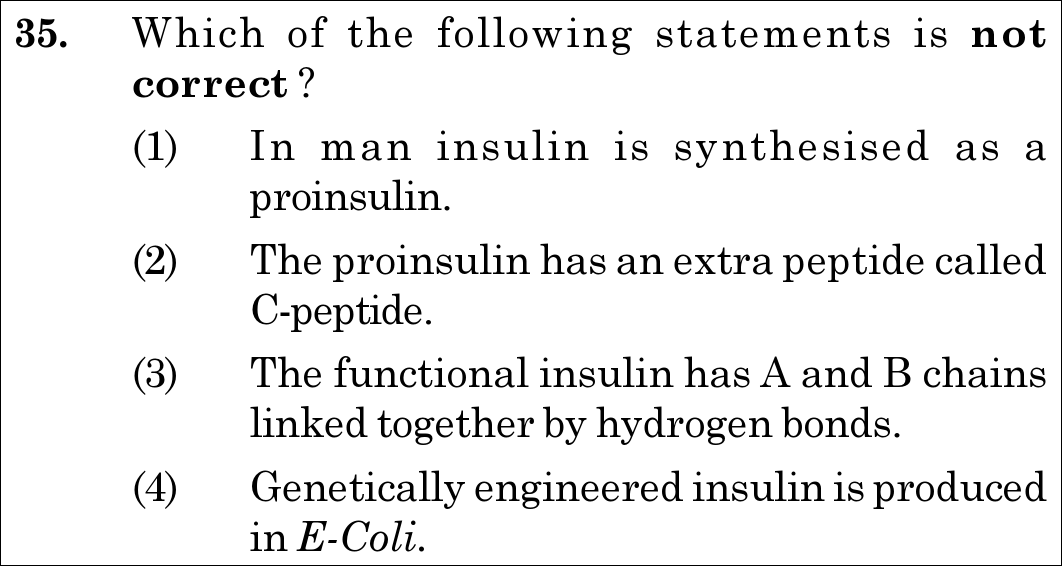
Which of the following statements is not correct?

  1. (1)In man insulin is synthesised as a proinsulin.
  2. (2)The proinsulin has an extra peptide called C-peptide.
  3. (3)The functional insulin has A and B chains linked together by hydrogen bonds.
  4. (4)Genetically engineered insulin is produced in E-Coli.
✓
Verified Against NTA Final Answer Key
Option (3) : The functional insulin has A and B chains linked together by hydrogen bonds.
📚 Biotechnology and its Applications Easy
📋 Given Parameters & Problem Setup
Biomolecule Human Insulin / Proinsulin
Question Objective Identify which statement regarding insulin structure/synthesis is NOT correct
⚡

The 30-Second Exam Hall Shortcut: ⚡ "Insulin Chains Are Linked by DISULPHIDE Bridges, NOT Hydrogen Bonds!"

⏱️ 40 seconds

Proinsulin has an extra C-peptide which is removed during maturation. The functional mature A (21 aa) and B (30 aa) polypeptide chains are held together by covalent DISULPHIDE bonds (-S-S- bridges), not weak hydrogen bonds. Statement (3) is false!

1 Recall insulin architecture: Synthesized as proinsulin containing an extra peptide called C-peptide.
2 In mature functional insulin, C-peptide is removed, and chains A and B are linked by disulphide (-S-S-) bonds.
3 Statement (3) claims chains are held by "hydrogen bonds" — blatantly false! Mark Option (3) in 10 seconds.
🛡️
Why You Can 100% Trust This Shortcut: NCERT Biology · Biotechnology and its Applications (Genetically Engineered Insulin)
📐

Step-by-Step Rigorous Workflow & Mathematical Proof

Step 1

Synthesis of Proinsulin in Humans

In humans and mammals, insulin is synthesized as a pro-hormone (proinsulin) that requires proteolytic processing before it becomes fully active and functional.

Step 2

C-Peptide Removal During Maturation

Proinsulin contains an extra polypeptide segment called the C-peptide (connecting peptide). During maturation into functional insulin, this C-peptide is cleaved and removed; it is completely absent in mature active insulin.

Step 3

Disulphide Bonds in Functional Mature Insulin

Mature functional insulin consists of two polypeptide chains: Chain A (21 amino acids) and Chain B (30 amino acids). These two chains are covalently linked together by two interchain disulphide bonds (and one intrachain bond in Chain A), NOT by weak hydrogen bonds.

Step 4

Production of Humulin by Recombinant DNA Technology

In 1983, American company Eli Lilly prepared two DNA sequences corresponding to chains A and B of human insulin, introduced them into plasmids of E. coli to produce chains A and B separately, extracted them, and combined them by creating disulphide bonds in vitro.

⭐

360° Option Elimination Engine Key Feature

Diagnose every choice: Know exactly why the right option works and why distractors fail.

4-Option Deep Scan
1 A
✗ Incorrect
Verdict & Scientific Reason:

This statement is factually true, hence not the required incorrect answer.

⚠️
Student Fallacy (Why candidates pick this trap): Students who confuse proinsulin with mature hormone might mistakenly select this statement.
2 B
✗ Incorrect
Verdict & Scientific Reason:

Factually true; proinsulin possesses the connecting C-peptide which is excised during maturation.

⚠️
Student Fallacy (Why candidates pick this trap): None; standard well-known molecular biology fact.
3 C
✓ 100% Correct
Verdict & Scientific Reason:

This statement is FALSE and therefore the correct answer. Chains A and B are linked by covalent disulphide (-S-S-) bonds, not hydrogen bonds.

💡
Why this is airtight: Students who skim quickly may see "linked together" and fail to verify whether the bond type stated is disulphide or hydrogen.
4 D
✗ Incorrect
Verdict & Scientific Reason:

Factually true; Eli Lilly successfully used recombinant Escherichia coli to produce chains A and B in 1983.

⚠️
Student Fallacy (Why candidates pick this trap): Students sometimes wonder if yeast is used; while yeast can produce insulin, E. coli was the landmark host used by Eli Lilly described in NCERT.
⚠️

NTA Trap Alert: Disulphide Bond vs Hydrogen Bond Confusion

Proteins have secondary structures stabilized by hydrogen bonds, but the covalent linkage holding the separate A and B polypeptide chains of insulin together is strictly DISULPHIDE (-S-S-) bridges.

🛡️ How to avoid the -1 mark: Always check the exact chemical bond specified in structural biochemistry questions: Insulin A and B chains = Covalent Disulphide Bridges!
📖

Core NEET Syllabus Standard

Botany · Biotechnology and its Applications Standard Benchmark
Core Scientific Principle Tested:

""

Syllabus Focus: Proinsulin Structure, Maturation & Disulphide Bonding
✓ Core NEET UG Syllabus Anchor Syllabus & Academic Standards ↗

Ready to attempt under real exam pressure?

Test your speed and accuracy in the authentic 180-minute timed NTA simulator.

Launch NEET 2020 CBT Test →

Spotted a mistake in this solution? Report an error (support@mycompetitiveexams.com)

⚖️ Legal & Fair Dealing Notice: Sourced from publicly released NEET 2020 question papers and NEET answer keys for private study, research, and non-commercial educational practice under Fair Dealing (Section 52(1)(a) of the Indian Copyright Act, 1957). Not affiliated with or endorsed by NTA or NMC.

Solve 4 NEET Questions a Day — One per Subject

Cover all 1,140 official NEET questions in 285 days at your own pace. Progress is saved on your device. No login needed.