MyCompetitiveExams Logo MyCompetitiveExams
Search 1,140+ Questions
Chapters, formulas, speed tricks
→
⚡ Brahmastra NEET 2027
720 MARKS

Dynamic 180-question full-length simulator mixed dynamically from all 6 years for 2027 & 2026 aspirants.

Launch Brahmastra 2027 Test →
Start Practice →
100% Free · No Login Required
Q.104 Chemistry ⭐ 360° Option Elimination Active
Vault ↗

NEET 2020 Chemistry Question 104 Solution

Topic: Thermodynamics · Official NTA Booklet Code E1
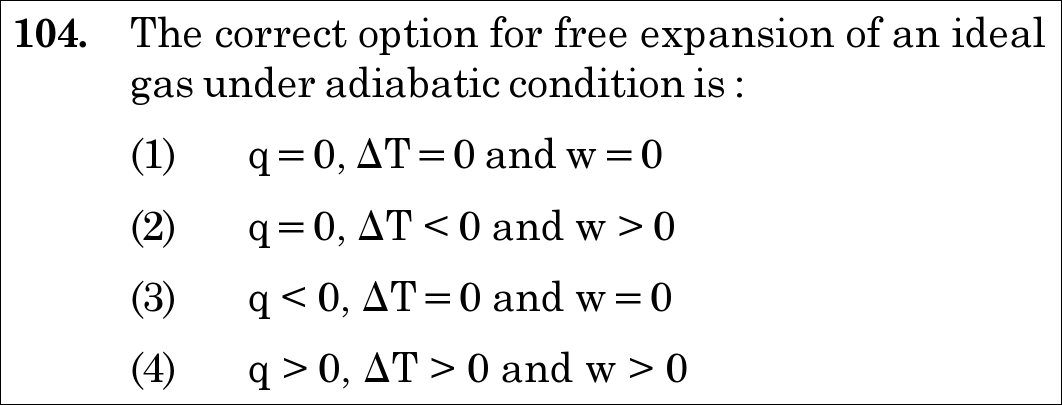
NEET 2020 Chemistry Question 104: Free Expansion of an Ideal Gas under Adiabatic Conditions: q = 0, w = 0, ΔT = 0

Question

The correct option for free expansion of an ideal gas under adiabatic condition is:

✓
Verified Against NTA Final Answer Key
Option (1) : q=0, ∆T=0 and w=0
📚 Thermodynamics Easy
📋 Given Parameters & Problem Setup
System Ideal gas
Process 1 Free expansion (expansion against vacuum, P_ext = 0)
Process 2 Adiabatic condition (no heat exchange with surroundings)
⚡

The 30-Second Exam Hall Shortcut: ⚡ "Free Expansion -> w = 0; Adiabatic -> q = 0; Ideal Gas -> ΔT = 0!"

⏱️ 20 seconds

In free expansion, the gas expands against vacuum (Pext=0P_{\text{ext}} = 0), so work done w=−PextΔV=0w = -P_{\text{ext}} \Delta V = 0. In an adiabatic process, there is no heat exchange, so q=0q = 0. By First Law, ΔU=q+w=0\Delta U = q + w = 0. For an ideal gas, internal energy depends only on temperature (ΔU=CvΔT\Delta U = C_v \Delta T), so ΔU=0  ⟹  ΔT=0\Delta U = 0 \implies \Delta T = 0! Mark Option (1) in 5 seconds.

1 Adiabatic condition means q = 0.
2 Free expansion into vacuum means P_ext = 0, hence w = -P_ext × ΔV = 0.
3 First law of thermodynamics: ΔU = q + w = 0 + 0 = 0.
4 For an ideal gas, ΔU = n Cv ΔT = 0, which requires ΔT = 0.
5 Result: q = 0, ΔT = 0, w = 0.
6 Select Option (1).
🛡️
Why You Can 100% Trust This Shortcut: NCERT Chemistry · Thermodynamics (First Law of Thermodynamics: Free Expansion)
📐

Step-by-Step Rigorous Workflow & Mathematical Proof

Step 1

Define Free Expansion

Free expansion refers to the irreversible expansion of a gas against zero external opposing pressure (Pext=0P_{\text{ext}} = 0, i.e. into a vacuum). The mechanical work done is: w=−∫Pext dV=−0×ΔV=0w = -\int P_{\text{ext}} \, dV = -0 \times \Delta V = 0

Step 2

Apply Adiabatic Condition

An adiabatic process is thermally insulated from its environment, meaning no heat enters or leaves the system: q=0q = 0

Step 3

Apply First Law of Thermodynamics

According to the first law of thermodynamics: ΔU=q+w\Delta U = q + w Substituting q=0q = 0 and w=0w = 0: ΔU=0+0=0\Delta U = 0 + 0 = 0

Step 4

Deduce Temperature Change for Ideal Gas

For an ideal gas, internal energy is purely a function of temperature (U=f(T)U = f(T), Joule's law of internal energy). Because there are no intermolecular attractive forces to overcome during expansion: ΔU=nCvΔT=0  ⟹  ΔT=0\Delta U = n C_v \Delta T = 0 \implies \Delta T = 0 Therefore, the temperature of the ideal gas remains constant during adiabatic free expansion (q=0,w=0,ΔT=0q = 0, w = 0, \Delta T = 0).

⭐

360° Option Elimination Engine Key Feature

Diagnose every choice: Know exactly why the right option works and why distractors fail.

4-Option Deep Scan
1 A
✓ 100% Correct
Verdict & Scientific Reason:

Factually and thermodynamically exact; vacuum expansion gives w=0w = 0, adiabatic gives q=0q = 0, and ideal gas yields ΔT=0\Delta T = 0.

💡
Why this is airtight: None; core physical chemistry concept.
2 B
✗ Incorrect
Verdict & Scientific Reason:

Incorrect; holds for reversible adiabatic expansion against non-zero external pressure where gas does work at the expense of internal energy (w<0,ΔT<0w < 0, \Delta T < 0), not free expansion.

⚠️
Student Fallacy (Why candidates pick this trap): Confusing free expansion into vacuum with expansion against a piston.
3 C
✗ Incorrect
Verdict & Scientific Reason:

Incorrect; adiabatic condition strictly demands q=0q = 0, never q<0q < 0.

⚠️
Student Fallacy (Why candidates pick this trap): Violating the definition of an adiabatic system.
4 D
✗ Incorrect
Verdict & Scientific Reason:

Incorrect; violates both adiabatic (q=0q = 0) and free expansion (w=0w = 0) definitions.

⚠️
Student Fallacy (Why candidates pick this trap): Random thermodynamic signs.
⚠️

NTA Trap Alert: Adiabatic Free Expansion vs Reversible Adiabatic Expansion

- In REVERSIBLE adiabatic expansion: Work is done against pressure (w≠0w \neq 0), so ΔU<0\Delta U < 0 and the gas COOLS (ΔT<0\Delta T < 0). - In FREE adiabatic expansion: Pext=0  ⟹  w=0P_{\text{ext}} = 0 \implies w = 0, so ΔU=0\Delta U = 0 and ΔT=0\Delta T = 0 for an ideal gas!

🛡️ How to avoid the -1 mark: Look for "FREE EXPANSION": Work done is ALWAYS ZERO (w=0w = 0)!
📖

Core NEET Syllabus Standard

Chemistry · Thermodynamics Standard Benchmark
Core Scientific Principle Tested:

""

Syllabus Focus: Free Expansion of an Ideal Gas under Adiabatic Conditions: q = 0, w = 0, ΔT = 0
✓ Core NEET UG Syllabus Anchor Syllabus & Academic Standards ↗

Ready to attempt under real exam pressure?

Test your speed and accuracy in the authentic 180-minute timed NTA simulator.

Launch NEET 2020 CBT Test →

Spotted a mistake in this solution? Report an error (support@mycompetitiveexams.com)

⚖️ Legal & Fair Dealing Notice: Sourced from publicly released NEET 2020 question papers and NEET answer keys for private study, research, and non-commercial educational practice under Fair Dealing (Section 52(1)(a) of the Indian Copyright Act, 1957). Not affiliated with or endorsed by NTA or NMC.

Solve 4 NEET Questions a Day — One per Subject

Cover all 1,140 official NEET questions in 285 days at your own pace. Progress is saved on your device. No login needed.