MyCompetitiveExams Logo MyCompetitiveExams
Search 1,140+ Questions
Chapters, formulas, speed tricks
→
⚡ Brahmastra NEET 2027
720 MARKS

Dynamic 180-question full-length simulator mixed dynamically from all 6 years for 2027 & 2026 aspirants.

Launch Brahmastra 2027 Test →
Start Practice →
100% Free · No Login Required
Q.10 Botany ⭐ 360° Option Elimination Active
Vault ↗

NEET 2020 Botany Question 10 Solution

Topic: Human Health and Disease · Official NTA Booklet Code E1
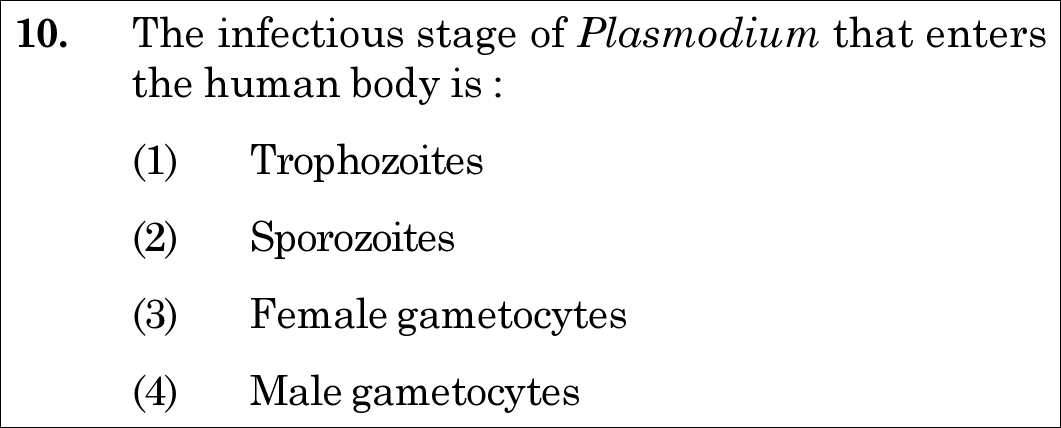
NEET 2020 Botany Question 10: Life Cycle of Plasmodium: Infectious Sporozoite Stage in Humans

Question

The infectious stage of Plasmodium that enters the human body is:

  1. (1)Trophozoites
  2. (2)Sporozoites
  3. (3)Female gametocytes
  4. (4)Male gametocytes
✓
Verified Against NTA Final Answer Key
Option (2) : Sporozoites
📚 Human Health and Disease Easy
📋 Given Parameters & Problem Setup
Parasite Plasmodium (Malaria Parasite)
Host Human Body (Intermediate Host)
Question Objective Identify the specific infectious stage that enters the human body
⚡

The 30-Second Exam Hall Shortcut: ⚡ "Mosquito Saliva Injects SPOROZOITES into Human Blood!"

⏱️ Save ~20 seconds

The infective stage of Plasmodium that enters the human body via the bite of an infected female Anopheles mosquito is the SPOROZOITE. Once in blood, sporozoites invade hepatocytes (liver cells). Mark Sporozoites (Option 2) in 5 seconds!

1 Recall Plasmodium life cycle stages: - Mosquito salivary glands contain infective Sporozoites. - Liver schizogony yields Merozoites. - Erythrocytic stage forms Trophozoites, Signet ring stage, and Schizonts. - Blood contains Gametocytes (taken up by mosquito).
2 Question asks: "Infectious stage that enters the human body".
3 Select Option (2): Sporozoites.
🛡️
Why You Can 100% Trust This Shortcut: NCERT Biology · Human Health and Disease (Infectious Diseases: Plasmodium enters the human body as sporozoites (infectious form) through the bite of infected female Anopheles mosquito).
📐

Step-by-Step Rigorous Workflow & Mathematical Proof

Step 1

Transmission and Entry of Plasmodium into Humans

_Plasmodium_ is a digenetic protozoan parasite requiring two hosts to complete its life cycle: 1. Inoculation: When an infected female _Anopheles_ mosquito pierces human skin for a blood meal, it injects saliva containing anticoagulants and thousands of sickle-shaped, motile sporozoites directly into the capillary bloodstream. 2. Hepatic Schizogony: Circulating sporozoites travel to the liver within 30 minutes, penetrating hepatocytes to undergo asexual multiple fission (pre-erythrocytic schizogony) to produce merozoites. 3. Erythrocytic Cycle: Merozoites rupture hepatocytes and invade red blood cells, developing into amoeboid feeding trophozoites, which digest hemoglobin into toxic hemozoin crystals. 4. Gametocytes: A subpopulation of merozoites differentiates into male and female gametocytes, which are taken up by a biting mosquito to complete sexual reproduction (syngamy and sporogony) in the mosquito gut wall.

Female Anopheles Bite→InoculatesSporozoites→InvadeLiver Cells (Hepatocytes)\text{Female } \textit{Anopheles} \text{ Bite} \xrightarrow{\text{Inoculates}} \mathbf{Sporozoites} \xrightarrow{\text{Invade}} \text{Liver Cells (Hepatocytes)}
Step 2

Evaluation of Other Life Cycle Stages

- Trophozoites: The intraerythrocytic actively feeding vegetative stage inside human RBCs. - Female & Male Gametocytes: The sexual stages formed in human peripheral blood that serve as the infectious stage for the mosquito, not the human.

⭐

360° Option Elimination Engine Key Feature

Diagnose every choice: Know exactly why the right option works and why distractors fail.

4-Option Deep Scan
1 A
✗ Incorrect
Verdict & Scientific Reason:

Incorrect. Trophozoites are formed inside human erythrocytes during the clinical erythrocytic cycle.

⚠️
Student Fallacy (Why candidates pick this trap): Confusing the feeding RBC stage with the mosquito inoculate.
2 B
✓ 100% Correct
Verdict & Scientific Reason:

Correct. Sporozoites are the motile, infective parasitic form stored in mosquito salivary glands that enter human blood.

💡
Why this is airtight: None. Direct recall of canonical malaria life cycle stages.
3 C
✗ Incorrect
Verdict & Scientific Reason:

Incorrect. Gametocytes are ingested by mosquitoes from human blood, not injected into humans.

⚠️
Student Fallacy (Why candidates pick this trap): Inverting human-to-mosquito vs mosquito-to-human transmission.
4 D
✗ Incorrect
Verdict & Scientific Reason:

Incorrect for the same reason; gametocytes develop within the human host for transmission to mosquitoes.

⚠️
Student Fallacy (Why candidates pick this trap): Same inversion error as Option 3.
⚠️

NTA Trap Alert: Human vs Mosquito Infective Stage Inversion Trap

The infective stage *for humans* is the Sporozoite (injected by mosquito). The infective stage *for mosquitoes* is the Gametocyte (ingested from human blood). Do not confuse the two hosts.

🛡️ How to avoid the -1 mark: Remember: Mosquito injects Sporozoites into humans; Mosquito sucks Gametocytes from humans.
📖

Core NEET Syllabus Standard

NEET / NCERT Biology · Human Health and Disease Standard Benchmark
Core Scientific Principle Tested:

"Plasmodium enters the human body as sporozoites through the bite of an infected female Anopheles mosquito."

Syllabus Focus: Life Cycle of Plasmodium
✓ Core NEET UG Syllabus Anchor Syllabus & Academic Standards ↗

Ready to attempt under real exam pressure?

Test your speed and accuracy in the authentic 180-minute timed NTA simulator.

Launch NEET 2020 CBT Test →

Spotted a mistake in this solution? Report an error (support@mycompetitiveexams.com)

⚖️ Legal & Fair Dealing Notice: Sourced from publicly released NEET 2020 question papers and NEET answer keys for private study, research, and non-commercial educational practice under Fair Dealing (Section 52(1)(a) of the Indian Copyright Act, 1957). Not affiliated with or endorsed by NTA or NMC.

Solve 4 NEET Questions a Day — One per Subject

Cover all 1,140 official NEET questions in 285 days at your own pace. Progress is saved on your device. No login needed.