MyCompetitiveExams Logo MyCompetitiveExams
Search 1,140+ Questions
Chapters, formulas, speed tricks
→
⚡ Brahmastra NEET 2027
720 MARKS

Dynamic 180-question full-length simulator mixed dynamically from all 6 years for 2027 & 2026 aspirants.

Launch Brahmastra 2027 Test →
Start Practice →
100% Free · No Login Required
Q.3 Botany ⭐ 360° Option Elimination Active
Vault ↗

NEET 2020 Botany Question 3 Solution

Topic: Morphology of Flowering Plants · Official NTA Booklet Code E1
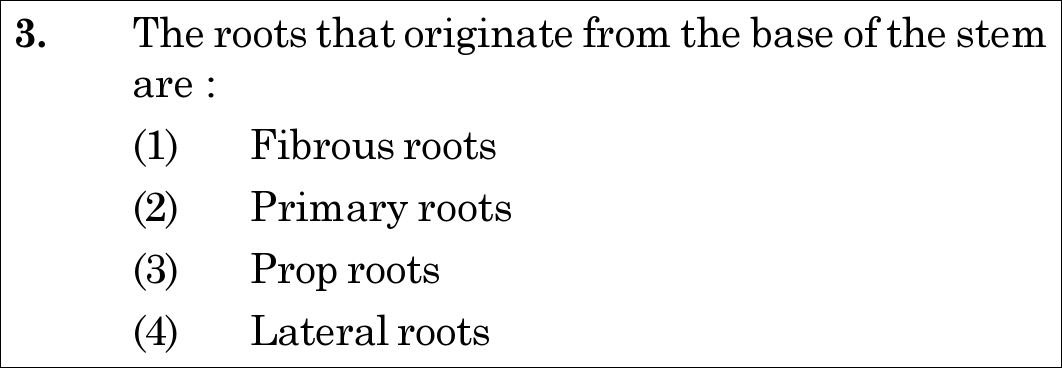
NEET 2020 Botany Question 3: Fibrous Root System in Monocotyledonous Plants

Question

The roots that originate from the base of the stem are:

  1. (1)Fibrous roots
  2. (2)Primary roots
  3. (3)Prop roots
  4. (4)Lateral roots
✓
Verified Against NTA Final Answer Key
Option (1) : Fibrous roots
📚 Morphology of Flowering Plants Easy
📋 Given Parameters & Problem Setup
Anatomical Origin Base of the stem
Plant Group Monocotyledonous plants (e.g. Wheat, Grasses)
Question Objective Identify the root system type
⚡

The 30-Second Exam Hall Shortcut: ⚡ "Roots from Base of Stem = Fibrous Roots (Monocots like Wheat)"

⏱️ Save ~20 seconds

In monocots, the short-lived primary taproot is replaced early by a cluster of roots originating from the BASE of the stem — these are Fibrous roots! Taproot arises from the radicle; Prop roots arise from aerial branches. Mark Fibrous roots (Option 1) in 5 seconds!

1 Recall NCERT root origins: - Radicle elongation →\to Primary root (Tap root system in dicots). - Base of stem →\to Fibrous root system (monocots like wheat). - Parts other than radicle/stem-base (e.g. branches, leaves) →\to Adventitious / Prop roots.
2 Origin specified in prompt: "Base of the stem".
3 Select Option (1): Fibrous roots.
🛡️
Why You Can 100% Trust This Shortcut: NCERT Biology · Morphology of Flowering Plants (The Root: In monocotyledonous plants, the primary root is short lived and is replaced by a large number of roots. These roots originate from the base of the stem and constitute the fibrous root system, as seen in the wheat plant).
📐

Step-by-Step Rigorous Workflow & Mathematical Proof

Step 1

Morphological Classification of Root Systems

Flowering plants exhibit three fundamental types of root systems based on their ontogeny and developmental origin: 1. Tap Root System: In dicots (e.g. mustard), direct elongation of the embryonic radicle forms the persistent primary root, which bears lateral roots of several orders (secondary, tertiary roots). 2. Fibrous Root System: In monocotyledonous plants (e.g. wheat, maize), the primary root is short-lived. It is quickly replaced by a large cluster of thin, thread-like roots that originate from the base of the stem. 3. Adventitious Roots: Roots that arise from any organ of the plant other than the embryonic radicle (e.g. *Monstera*, banyan tree prop roots, stilt roots of sugarcane).

Base of Stem Origin  ⟹  Fibrous Root System(e.g. Monocots / Wheat)\text{Base of Stem Origin} \implies \mathbf{Fibrous\,Root\,System} \quad (\text{e.g. Monocots / Wheat})
Step 2

Analysis of Distractors

- Primary roots: Direct downward continuation of the embryonic radicle. - Prop roots: Pillar-like massive adventitious roots hanging down from horizontal aerial tree branches (e.g. banyan tree) to provide columnar support. - Lateral roots: Endogenous branch roots originating from the pericycle of the primary root.

⭐

360° Option Elimination Engine Key Feature

Diagnose every choice: Know exactly why the right option works and why distractors fail.

4-Option Deep Scan
1 A
✓ 100% Correct
Verdict & Scientific Reason:

Correct. NCERT explicitly defines fibrous roots as roots originating from the base of the stem in monocots.

💡
Why this is airtight: None. Direct recall of textbook morphological definitions.
2 B
✗ Incorrect
Verdict & Scientific Reason:

Incorrect. Primary root arises from the embryonic radicle, not from the stem base.

⚠️
Student Fallacy (Why candidates pick this trap): Confusing primary root with early adventitious/fibrous roots.
3 C
✗ Incorrect
Verdict & Scientific Reason:

Incorrect. Prop roots arise from aerial branches of the banyan tree, not the stem base.

⚠️
Student Fallacy (Why candidates pick this trap): Confusing pillar prop roots with basal fibrous roots.
4 D
✗ Incorrect
Verdict & Scientific Reason:

Incorrect. Lateral roots develop endogenously from the pericycle of primary and secondary roots.

⚠️
Student Fallacy (Why candidates pick this trap): Mistaking horizontal branching roots for stem-borne roots.
⚠️

NTA Trap Alert: Fibrous vs Adventitious Root Overlap Trap

While fibrous roots are technically adventitious in a broad developmental sense (because they do not arise from the radicle), NCERT defines fibrous roots specifically by their unique locus: "originate from the base of the stem" in monocots.

🛡️ How to avoid the -1 mark: Remember verbatim cue: "Base of the stem" = Fibrous root system (Wheat).
📖

Core NEET Syllabus Standard

NEET / NCERT Biology · Morphology of Flowering Plants Standard Benchmark
Core Scientific Principle Tested:

"In monocots, roots originating from the base of the stem constitute the fibrous root system."

Syllabus Focus: Root Types
✓ Core NEET UG Syllabus Anchor Syllabus & Academic Standards ↗

Ready to attempt under real exam pressure?

Test your speed and accuracy in the authentic 180-minute timed NTA simulator.

Launch NEET 2020 CBT Test →

Spotted a mistake in this solution? Report an error (support@mycompetitiveexams.com)

⚖️ Legal & Fair Dealing Notice: Sourced from publicly released NEET 2020 question papers and NEET answer keys for private study, research, and non-commercial educational practice under Fair Dealing (Section 52(1)(a) of the Indian Copyright Act, 1957). Not affiliated with or endorsed by NTA or NMC.

Solve 4 NEET Questions a Day — One per Subject

Cover all 1,140 official NEET questions in 285 days at your own pace. Progress is saved on your device. No login needed.